No.4205
Talent Management System Market in Japan: Key Research Findings 2026
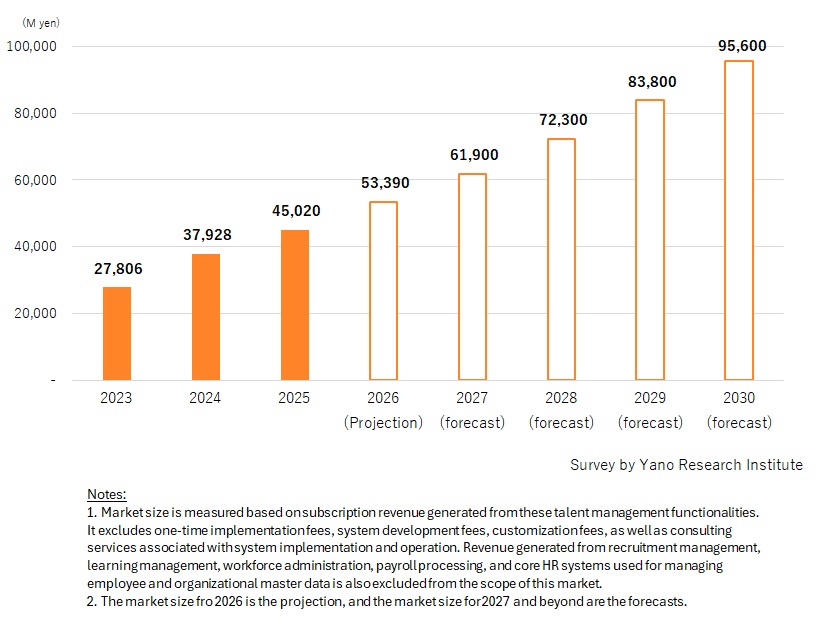
Japan’s Talent Management System Market Estimated at 45,020 Million Yen in 2025, Up 18.7% YoY
Yano Research Institute (the President, Takashi Mizukoshi) has conducted a survey on the talent management system market in Japan, discovering the current market situation, market trends, challenges and future outlook. This press release denotes the estimated market size of the talent management system market.
Market Overview
Japan’s talent management system market grew by 18.7% from the previous year to 45,020 million yen in 2025.
Market growth is being driven by an increasing number of organizations seeking to optimize workforce allocation and maximize the value of internal talent on an enterprise-wide basis. This trend is supported by growing emphasis on Human Capital Management (HCM), intensifying competition for talent, and the need to transform organizational structures and reskill employees in response to technological advancements such as artificial intelligence (AI).
In the early stages of market development, talent management systems were primarily adopted to centralize fragmented employee data. As the market has matured, the focus has shifted toward extracting actionable insights from accumulated talent data. To meet this demand, vendors are strengthening AI-powered analytics capabilities that support workforce planning, talent deployment, succession planning, and employee development.
Noteworthy Topics
TMS Taking on Greater Importance Amid Business Transition
When considering entry into a new business domain or a strategic shift in an existing business, a company must identify, on the basis of objective data, what types of talent are required and whether such talent is already available within the organization.
Such initiatives are directly linked to an organization's employee development and recruitment policies. As a foundation for aligning business strategy with talent strategy and for making timely decisions on placement, development, and hiring based on diverse workforce data, talent management systems are becoming increasingly important.
Meanwhile, collaboration between talent management system vendors and companies from other industries, such as banks, insurers, and system integrators, is increasing. By leveraging their partners' existing relationships with corporate clients, vendors are identifying latent HR issues such as employee turnover, leave of absence, health and productivity management, and talent retention and engagement. Some are also providing support that reduces the operational burden on client companies, such as data preparation and system operation. Efforts to translate these activities into continued system use are also important for market expansion.
Future Outlook
The talent management system market in Japan is projected to reach 53,390 million yen in 2026, up by 18.6% from the previous year. Steady expansion is expected through 2030, driven by the broadening of the customer base to small and medium-sized enterprises (SMEs) and changes in pricing structures accompanying the expansion of AI functionality.
Research Outline
2.Research Object: Domestic companies providing products and services related to talent management
3.Research Methogology: Face-to-face interviews by our expert researchers, survey via telephone, and literature research
Talent Management System Market
In this research, a talent management system (TMS) is defined as a collection of software functions that aggregate and retain employee-level talent data, such as performance assessment, skills, experience, and career preferences, and leverage this information to facilitate decision-making related to workforce deployment, promotion, succession planning, and talent development. Typical functionalities include performance management, employee engagement surveys, skills inventory management, workforce allocation simulation, development plan creation and progress management, and support for self-directed career development. Market size is measured based on subscription revenue generated from these talent management functionalities. It excludes one-time implementation fees, system development fees, customization fees, as well as consulting services associated with system implementation and operation. Revenue generated from recruitment management, learning management, workforce administration, payroll processing, and core HR systems used for managing employee and organizational master data is also excluded from the scope of this market.
<Products and Services in the Market>
Talent management system, talent management functionalities of enterprise solutions like ERP and HCM
Published Report
Contact Us
The copyright and all other rights pertaining to this report belong to Yano Research Institute.
Please contact our PR team when quoting the report contents for the purpose other than media coverage.
Depending on the purpose of using our report, we may ask you to present your sentences for confirmation beforehand.