No.4103
Perovskite Tandem Solar Cell Market in Japan: Key Research Findings 2026
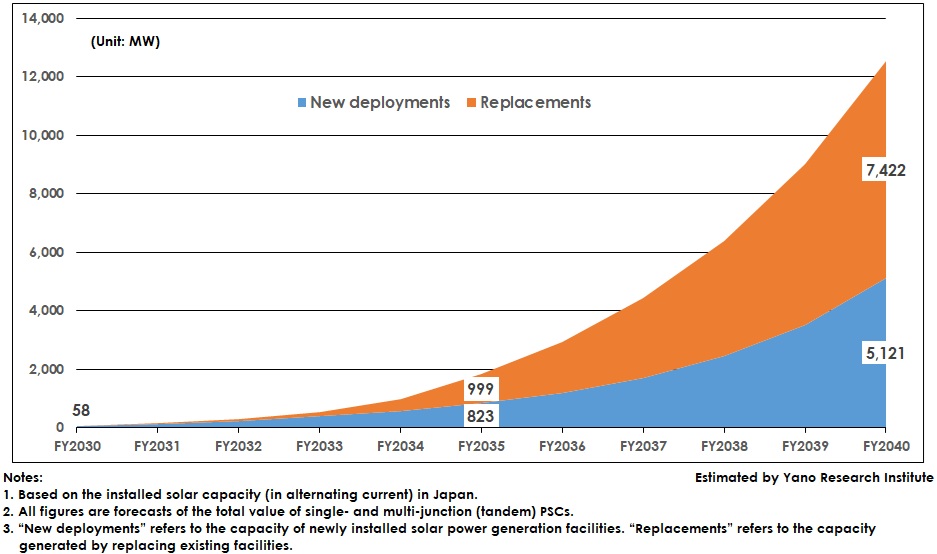
The Cumulative Installations of PSCs (Single-Junction and Tandem) Are Expected to Reach 12.5GW by 2040. Manufacturers Should Obtain a Larger Market Share Early On By Developing Applications of Cells with 10-Year Lifespan
Yano Research Institute (the President, Takashi Mizukoshi) conducted a survey of the domestic market for perovskite tandem solar cells. The survey revealed trends among market players and the market outlook. In here highlights the forecast for total perovskite solar cell installations, including both new installations and replacements of single-junction and tandem cells.
Market Overview
Compiled by the Ministry of Economy, Trade and Industry (METI) and approved by the Cabinet in February 2025, the Seventh Strategic Energy Plan aims for solar power to account for 23 to 29% of Japan’s total power sources by FY2040. The plan also sets a target of approximately 20 GW of perovskite solar cell (PSC) installations by FY2040. To accomplish these goals, it is essential to expand the areas dedicated to solar cell installations and the use of tandem solar cells to improve conversion efficiency and increase power generation. The development of tandem PSCs using crystalline silicon is underway by crystalline (Si) solar cell manufacturers.
Since Japan introduced its feed-in tariff (FIT) program in FY2012, demand for solar cells has surged. While solar cells were initially installed primarily on residential rooftops, the program has since expanded to include commercial and industrial applications, such as solar power plants. Assuming the lifespan of photovoltaic (PV) modules is twenty years, replacement demand will likely be generated by 2032 for the widely deployed solar cells introduced when the FIT began. To meet this demand, accelerating the development of tandem PSCs is imperative.
Noteworthy Topics
Due to Flexibility, Anticipated Popular Combinations for New Deployment Are Perovskite-Perovskite and Perovskite-CIG. Popular Combination for Replacement Is Expected to be Perovskite-Si Solar Cells
The demand for solar cell deployment and replacement is expected to boost PSC installations. This is partly because replacing existing crystalline silicon solar cells that have exceeded their useful life with PSCs increases power generation efficiency.
Currently, it is difficult to predict which type of PSC, single-junction or multijunction (tandem), will be popular for new installations. Many single-junction PSC manufacturers have begun developing tandem PSCs in anticipation of future demand from companies seeking greater efficiency. Thus, even if the market initially starts with single-junction PSCs, it is expected that these two types will eventually coexist, with each type catering to specific market needs.
When tandem PSCs are adopted as a new power source, the most likely combinations of materials used are perovskite-perovskite, or perovskite-CIGS (copper indium gallium selenide), as these materials are thin, lightweight, and flexible. These combinations allow for installations in buildings with weigh restrictions and in locations with curved or uneven surfaces. They also enable vertical installations on building openings.
Meanwhile, combinations of materials for replacement tandem PSCs must consider existing installations. Existing solar modules tend to be crystalline silicone solar cells installed on residential and building rooftops, and at solar power plants. In these cases, the choice of crystalline silicon-based installations are anticipated, such as perovskite-silicon solar cells, rather than new products, such as multijunction perovskite or perovskite-CIGS.
Future Outlook
Tandem PSCs are also being developed in China, Europe, and the United States. An influx of overseas products is anticipated in the future, which will lead to price competition. To avoid being involved in it, domestic manufacturers should establish themselves early on by performing well in applications with high barriers to entry for overseas manufacturers. These applications include areas where Japan enforces strict safety, fire resistance, and environmental regulations. Domestic manufacturers should also quickly launch products and secure their market shares. Since Japan enforces strict regulations on residential, automotive, and building-integrated photovoltaics (BIPV), as well as on installations on farmland and water surfaces, performing well in these areas is expected to open the door to the next market.
For tandem PSCs with the perovskite-crystalline silicon configuration, the useful life of the crystalline silicon bottom cell is approximately twenty years, while that of the perovskite top cell is currently half of that. Therefore, domestic manufacturers are developing perovskites with a twenty-year lifespan to equalize the two materials' life expectancies. Domestic manufacturers tend to prioritize perfect quality before releasing new products. However, the lengthy development process may result in an influx of overseas products and a loss of domestic market share. To avoid this, it may be better to develop and promote PSC applications with a ten-year lifespan. Addressing this issue requires shifting away from Japan’s perfectionism in product development.
Meanwhile, tandem PSCs that do not use crystalline silicon, such as the perovskite-perovskite or perovskite-CIGS configuration, offer features such as lightness, flexibility, and transparency. These new tandem PSCs are expected to be installed in locations with weight restrictions, such as on building walls, which would enable the buildings to generate power for self-consumption. Due to their flexibility and lightness, film-based tandem PSCs could serve as power sources for high-altitude platform stations (HAPS), drones, and flying cars.
However, manufacturers must improve the durability of perovskites for these applications to be appealing to customers. Specifically, achieving water resistance poses a significant challenge. Barrier functions that prevent water intrusion in cells are indispensable. To prevent perovskites from deteriorating due to water intrusion, a barrier layer of at least 10-4g/m2/day is necessary. To ensure long-term reliability, a barrier layer of 10-5g/m2/day is required. However, ultra-high barrier films that meet these conditions are not yet on the market. Therefore, collaboration among tandem PSC manufacturers, universities and other R&D institutions, and barrier film manufacturers is necessary to develop these films.
Research Outline
2.Research Object: Perovskite tandem solar cell manufacturers, universities
3.Research Methogology: Face-to-face interviews (including online interviews) by expert researchers and literature research
What are Perovskite Tandem Solar Cells?
A tandem solar cell is a type of multijunction solar cell that comprising a stack of layers with different bandgaps that absorb sunlight. Compared to single-junction solar cells, multijunction cells improve power generation efficiency. Tandem solar cells consist of a stack of materials including crystalline silicon (Si), perovskite, and copper indium gallium selenide (CIGS) in the bottom cell and perovskite in the top cell.
<Products and Services in the Market>
Perovskite tandem solar cells
Published Report
Contact Us
The copyright and all other rights pertaining to this report belong to Yano Research Institute.
Please contact our PR team when quoting the report contents for the purpose other than media coverage.
Depending on the purpose of using our report, we may ask you to present your sentences for confirmation beforehand.