No.4053
Eight Major Construction Segments in Japan: Key Research Findings 2026
Market Size for Eight Major Construction Segments in Japan Valued At 25,747,300 Million Yen For FY2024, Representing 106.0% of Previous Fiscal Year
Yano Research Institute (the President, Takashi Mizukoshi) carried out a survey on the eight key construction segments in Japan, and found out the market size, trends by segment, and future perspective.
Market Overview
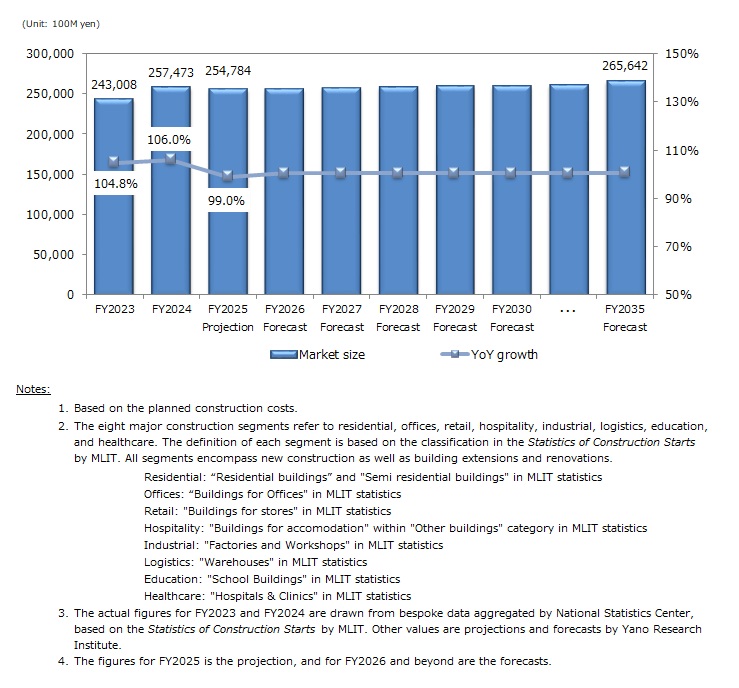
The market size for the eight major construction segments (residential, offices, retail, hospitality, industrial, logistics, education, and healthcare) is estimated at 25,747,300 million yen for FY2024, based on planned construction costs (representing 106.0% of the previous fiscal year).
Driven by robust inbound tourism demand and an expansion in capital expenditures for logistics facilities and semiconductor foundries, the market maintained an upward trajectory, significantly surpassing pre-pandemic levels (FY2019: 22,096,600 million yen).
Furthermore, market value was bolstered by a rise in per-unit construction costs, stemming from surging material prices and a strategic shift toward value-added building enhancements.
Noteworthy Topics
Keywords in Eight Major Construction Segments: “Focus on Existing Structures, Value Enhancement, and Selective Bidding”
When measured by total floor area, significant growth in demand is not anticipated across the eight major construction segments. Demand for new construction is softening particularly within the residential, education, and healthcare segments. Meanwhile, market momentum is sustained by the reuse of existing structures, including renovations and conversions (repurposing buildings for new functional uses).
On the supply side, elevated material costs and a chronic labor shortage have become permanent structural headwinds.
To ensure profitability, contractors are shifting their focus toward buildings that support decarbonization and energy efficiency—allowing for higher per-project values—while becoming more selective in bidding, prioritizing projects that align with their current operational capacity.
Future Outlook
The market size for the eight major construction segments (residential, offices, retail, hospitality, industrial, logistics, education, and healthcare) is valued at 25,478,400 million yen for FY2025 based on the planned construction costs (representing 99.0% of the previous fiscal year). While FY2024 experienced a significant surge in residential demand as developers rushed to beat the abolition of “No.4 Exception*”, a subsequent demand pullback is anticipated for FY2025. Looking toward the long-term horizon, the market size for the eight major construction segments is projected to reach 26,564,200 million yen by 2035 (based on the planned construction costs).
While traditional volume metrics such as building starts and total floor area are trending downward, the total market value is expected to climb through FY2035. This growth in value is primarily driven by escalating per-unit construction costs, fueled by persistent material price inflation and a strategic industry shift toward high-value building enhancements.
From a sectoral perspective, the hospitality segment is poised for expansion on the back of robust inbound tourism, while the industrial segment will see gains driven largely by the proliferation of semiconductor foundries. Conversely, the residential and education sectors are projected to contract in coming years, directly mirroring Japan’s demographic decline.
*Abolition of No.4 Building Exception: Historically, most detached houses in Japan—classified as “small wooden houses”—fell under the “No. 4 Buildings” category, a category that allowed them to skip submitting formal structural calculations when applying for building permits. However, with the upcoming repeal of the exemption, the industry anticipates a significant shift in FY2025. Contractors should prepare for increased compliance expenditures and extended project lead times as structural documentation becomes a mandatory requirement for approval.
Research Outline
2.Research Object: Eight key construction segments (Residential, Offices, Retail, Hospitality, Industrial, Logistics, Education, and Healthcare)
3.Research Methogology: Information gathered from documents and publicly available data, analysis based on custom data aggregation conducted by the National Statistics Center using data from the Statistics of Construction Starts compiled by the Ministry of Land, Infrastructure, Transport and Tourism (MLIT).
Eight Major Construction Segments
In this research, eight major construction segments refer to the following sectors: residential, offices, retail, hospitality, industrial, logistics, education, and healthcare. The definition of each segment is based on the “classification by the usage of buildings” in the Statistics of Construction Starts by the Ministry of Land, Infrastructure, Transport and Tourism (MLIT). All segments encompass new construction as well as building extensions and renovations.
The market size is calculated based on planned construction costs. Actual figures through FY2024 are drawn from bespoke data aggregated by National Statistics Center, based on the Statistics of Construction Starts published by MLIT. The figure for FY2025 is the projection by Yano Research Institute based on the same data. The figures for FY2026 and beyond are the forecasts by Yano Research Institute.
<Products and Services in the Market>
Housing (e.g. single-family homes, multifamily housing, apartments, condos), offices, retail stores, hotels, factories, warehouses, schools, hospitals
Published Report
Contact Us
The copyright and all other rights pertaining to this report belong to Yano Research Institute.
Please contact our PR team when quoting the report contents for the purpose other than media coverage.
Depending on the purpose of using our report, we may ask you to present your sentences for confirmation beforehand.