No.4039
Global All-Solid-State Batteries Market: Key Research Findings 2025
Redefining the Unique Advantages and Value of All-Solid-State Batteries in the Face of Advancements in LiB Technology
Yano Research Institute (the President, Takashi Mizukoshi) conducted a survey of the global market for all-solid-state batteries. The survey revealed the trends by material type (sulfide-, oxide-, polymer-, and semi-solid-state batteries), trends among market players, and the future market outlook.
Market Overview
Due to their many advantages and potential to outperform traditional lithium-ion batteries (LIBs), all-solid-state batteries are expected to expand in the battery electric vehicle (BEV) industry and other sectors. Some all-solid-state batteries (including semi-solid-state batteries) are already in production, and development of many others continues with the aim of achieving commercialization and commencing production in the latter half of the 2020s (2027 and beyond).
For sulfide-based all-solid-state batteries, several major automotive OEMs are aiming for commercialization around 2027 and 2028. Japanese auto OEMs are transitioning to the next phase of developing first-generation sulfide-based all-solid-state batteries, which surpass the specifications of current LIBs. The next phase focuses primarily on production technologies. However, reducing costs remains a significant challenge, making it difficult to demonstrate cost advantage over LIBs in the initial production phase.
Since oxide-based all-solid-state batteries face the challenge of increasing cell size, their adoption is limited to small power sources, such as industrial sensors. Meanwhile, polymer-based all-solid-state batteries have lower in ion conductivity than sulfide-based ones. A key challenge to their market growth is that they require heating to improve ion conductivity. In response to these challenges, the development aiming for early commercialization is underway primarily among Chinese developers for the hybrid of these batteries, which are semi-solid, with an electrolyte or gel polymer added to an oxide-based solid electrolyte.
Noteworthy Topics
Despite Technological Advances, Several Factors Continue to Drive Up Costs
Some developments have been made for the first generation of sulfide-based, all-solid-state batteries. These include the selection of materials (types of solid electrolytes, cathode materials, and anode materials) for battery cell specifications, and technological advances that surpass energy density of LIBs. However, cost remains a significant challenge, as each developer focuses on different initiatives, requiring time to establish the optimum production technology for full-scale production of battery cells and materials. In the meantime, small sulfide-based all-solid-state batteries are increasingly adopted for backup power sources for sensors.
Early commercialization of oxide- and polymer-based all-solid-state batteries is being promoted in the form of semi-solid batteries. Some major Chinese manufacturers have started producing small quantities in pilot plants in preparation for mass production. Some of these manufacturers have begun constructing or operating mass production facilities.
Future Outlook
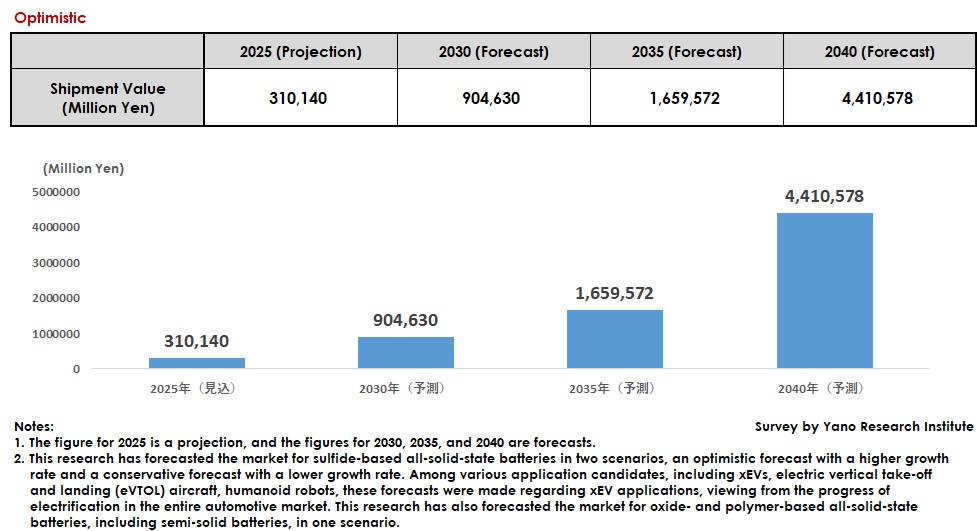
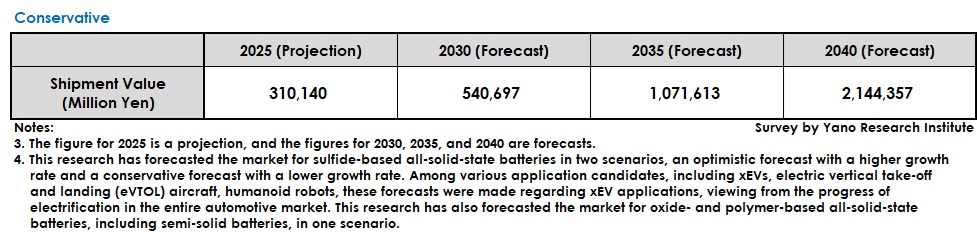
This research made market forecasts for sulfide-based all-solid-state batteries in two scenarios, an optimistic scenario with a higher growth rate and a conservative scenario with a lower growth rate. These forecasts were made for xEV applications, viewing from the progress of electrification in the entire automotive market, among various application candidates, including xEVs, electric vertical take-off and landing (eVTOL) aircraft, and humanoid robots. Additionally, this research forecasted the market for oxide- and polymer-based all-solid-state batteries, including semi-solid batteries, under one scenario.
The commercialization of sulfide-based all-solid-state batteries is expected to begin in the late 2020s. They are initially likely to be adopted by luxury, battery electric vehicle (BEV) brands due to their ability to absorb cost increases. There are various other potential applications. VTOL aircraft are expected to benefit from solid batteries (including semi-solid ones), because they have a higher energy density than current LIBs, which could extend flight hours. Test flights and certification acquisition have been conducted for VTOL aircraft with these batteries installed. Humanoid robots also require high-energy-density batteries, making sulfide-based all-solid-state batteries high potential for adoption in this application. That said, however, commercialization using current LIBs is also underway for these two applications. Some question the advantage of sulfide-based all-solid-state batteries in terms of price, which could lead to slow adoption. If optimum production technology is established for full-scale production and the price per kWh is similar to that of LIBs, demand for these applications will increase by 2035 or 2040.
With the goal of early commercialization of oxide- and polymer-based batteries, the production of semi-solid batteries, which are made by combining a solid electrolyte with an electrolyte liquid and a high-polymer solid electrolyte, takes place primarily in China. As of 2023, several Chinese OEMs have announced models with semi-solid batteries. The market for these batteries is forecast to exceed the market for sulfide-based all-solid-state batteries by 2035. However, concerns remain about their cost compared to current LIBs, and about the safety of these batteries due to their use of electrolyte liquid. Therefore, the advantages of Chinese manufacturers are viewed as questionable by many, including Chinese nationals. Depending on the technological advancement of sulfide-based all-solid-state batteries, the growth of oxide- and polymer-based batteries may not occur as forecasted in this research.
Research Outline
2.Research Object: All-solid-state and semi-solid-state battery manufacturers, material manufacturers, and device manufacturers (14 Japanese companies, 4 Chinese companies and 6 South Korean companies)
3.Research Methogology: Literature research based on face-to-face interviews by our expert researchers
What is the All-Solid-State Batteries Market?
The all-solid-state battery market includes sulfide-, polymer-, and oxide-based batteries, as well as semi-solid-state batteries (*). Market size is calculated based on shipment values using an exchange rate of 1 USD=155 JPY.
*Semi-solid-state batteries are defined as batteries in which an electrolyte or gel polymer is added to an oxide-based solid electrolyte.
<Products and Services in the Market>
Sulfide-based all-solid-state batteries, Oxide-based all-solid-state batteries, Polymer-based all-solid-state batteries, and Semi-solid-state batteries
Published Report
Contact Us
The copyright and all other rights pertaining to this report belong to Yano Research Institute.
Please contact our PR team when quoting the report contents for the purpose other than media coverage.
Depending on the purpose of using our report, we may ask you to present your sentences for confirmation beforehand.