No.4028
Consumer Survey on Health Foods in Japan: Key Research Findings 2026
Of Those Surveyed, 49.6% Responded That Commodity Price Increases Hardly Affected Their Health Food Consumption Habits
Yano Research Institute (the President, Takashi Mizukoshi) conducted a survey of male and female consumers in their 20s or older living in Japan on health concerns and health food consumption habits.
The focus here is on consumption of health and beauty foods (dietary supplements), including types, spending, places of purchase, purposes, important factors, and effects of recent commodity price increases on use of these foods and supplements..
Summary of Research Findings
In November 2025, a preliminary survey was conducted among 8,762 people (5,177 men and 3,585 women) aged 20 years or older living in Japan, on their consumption of health and beauty foods, including dietary supplements. The survey revealed that 26.4% of respondents consume these foods. This percentage was calculated by adding the responses “Currently taking these foods" (12.9%), “Sometimes taking these foods" (7.1%), and “Only when needed" (6.4%). These results indicate that approximately one in four people consume health and beauty foods, including dietary supplements.
The secondary survey focused on the purchase and consumption status among 1,430 people (691 men and 739 women) who indicated in a preliminary survey that they consume health and beauty foods. Participants were classified into three age groups: 20s to 30s, 40s to 50s, and 60s and older.
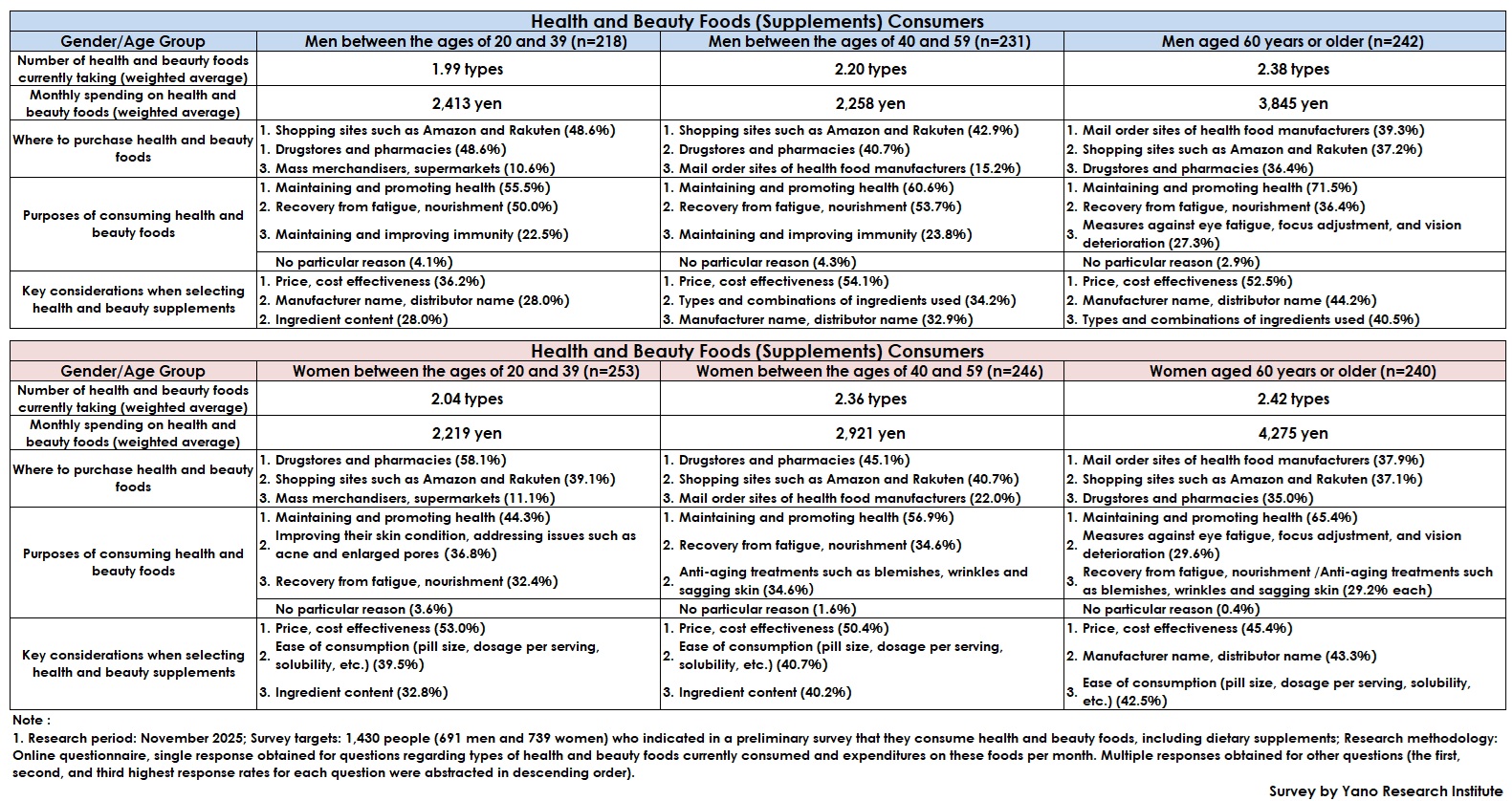
The survey revealed that the amount spent per month (a weighted average) on health foods increased with age, regardless of gender.
Women’s monthly spending on these foods increased prominently with age. On average, spending among those in their 20s and 30s was in the early 2,000 yen range, whereas spending increased to over 4,000 yen among those aged 60 and over. Meanwhile, men’s spending once decreased among the age group of those in their 40s and 50s but jumped among those aged 60 and over.
All age groups, except those aged 60 and over, purchased health foods from either “drugstores and pharmacies” or “shopping sites such as Amazon and Rakuten,” as both ranked within the top third. Most men and women aged 60 and over chose to purchase from "mail order sites of health food manufacturers.”
All male respondents indicated that they primarily consumed health and beauty foods for “health maintenance and promotion,” and “recovery from fatigue and nourishment.” The largest number of female respondents also cited “health maintenance and promotion” as their reason for consuming these foods. Beauty-related responses also occupied among women. Younger women responded that their purpose was to improve their skin condition, addressing issues such as acne and enlarged pores. Middle-aged and older respondents consumed these foods for anti-aging purposes.
Noteworthy Topics
Influence of Recent Commodity Price Increases on the Use of Health and Beauty Foods
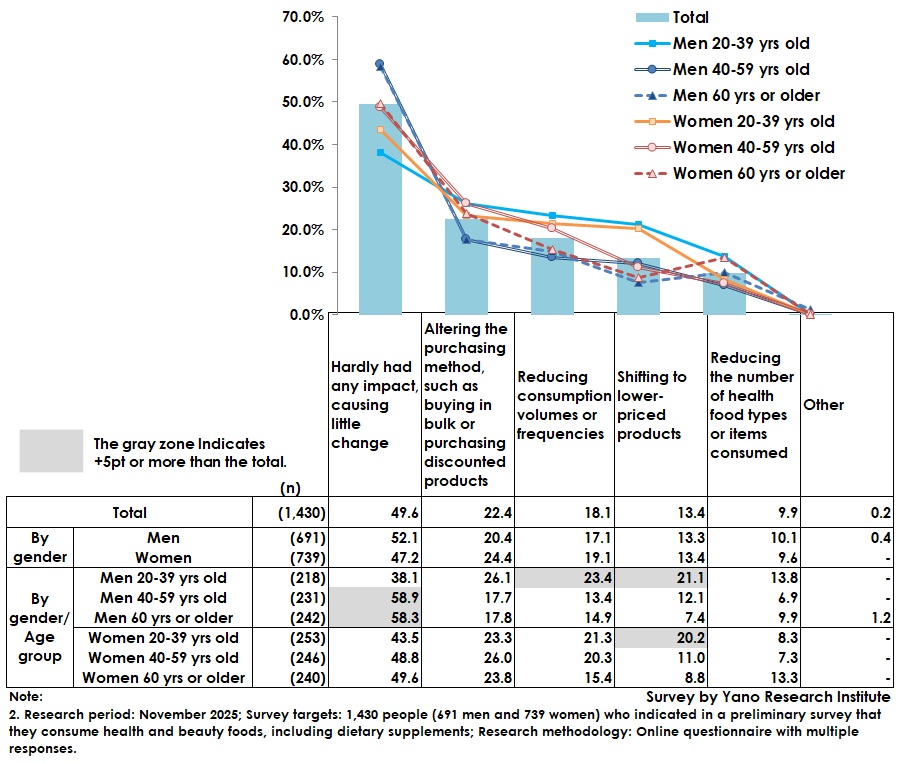
When asked about the influence of recent commodity price hikes on the use of health and beauty foods, including dietary supplements among 1,430 consumers of these foods, the most popular answer, “hardly had any impact, causing little change,” accounted for 49.6%.
The other half of the consumers took some measures in response to price increases, indicating that commodity price increases affected their purchasing activities to some extent. These activities included “altering the purchasing method, such as buying in bulk or purchasing discounted products" (22.4%), followed by “reducing consumption volumes or frequencies" (18.1%), “shifting to lower-priced products" (13.4%), and “reducing the number of health food types or items consumed" (9.9%).
Regardless of gender, people in their 20s and 30s were more affected by commodity price increases than people in other age groups, as 23.4% of male and 21.3% of female participants in this age group responded that they reduced consumption volumes or frequencies and 21.1% of male and 20.2% of female participants responded that they shifted to lower-priced products.
Conversely, the largest number of respondents in their 40s and older, especially men, said that price increases hardly impacted them, causing little change in their habits. This response accounted for 58.9% of male respondents in their 40s and 50s, and 58.3% of male respondents in their 60s and older. These results suggest that they continued consuming these foods without altering their habits.
The survey results revealed that even among those who took measures against rising commodity prices, consumers chose to maintain their health food consumption by using alternative purchasing methods, such as buying in bulk or using discount offers, rather than significantly reducing the consumption volume or frequency. They demonstrated their determination to continue investing in health.
Research Outline
2.Research Object: A total of 8,762 people (5,177 men and 3,585 women) aged 20 or older living in Japan
3.Research Methogology: Online consumer survey (questionnaire)
Consumer Survey on Health Foods
A preliminary survey was conducted in November 2025 among a total of 8,762 people (5,177 men and 3,585 women) aged 20 years or older living in Japan on their health/beauty measures and their consumption status of health and beauty foods (dietary supplements) or foods with health claims (foods with functional claims and foods for specified health uses (FOSHU)).
A more detailed secondary survey was conducted among a total of 1,430 people (691 men and 739 women) who had responded to the preliminary survey that they used health and beauty foods (dietary supplements).
The focus here is on the analysis of the consumption habits of health and beauty foods, including types, spending, places of purchase, purposes, and important factors, among three age groups: 20s to 30s, 40s to 50s, and 60 and over. The survey also examined the effects of recent commodity price increases on the use of these foods.
This research defines health and beauty foods (dietary supplements) as foods in the form of tablets, capsules, powders, or bottled liquids that are intended for health maintenance and promotion, beauty, etc., and do not include pharmaceuticals and quasi-drugs.
<Products and Services in the Market>
Health and beauty foods (dietary supplements), Foods with functional claims, foods for specified health uses (FOSHU)
Published Report
Contact Us
The copyright and all other rights pertaining to this report belong to Yano Research Institute.
Please contact our PR team when quoting the report contents for the purpose other than media coverage.
Depending on the purpose of using our report, we may ask you to present your sentences for confirmation beforehand.