Home Cooking and Heating Equipment Market: Key Research Findings 2009
Competition between electricity and gas as the source of household heating energy in the new housing sector is expanding into the existing housing market.
Research Outline
Yano Research Institute has conducted a study on the household cooking and heating equipment market as described below.
1. Research period: March to July 2009
2. Research targets: Manufacturers of home cooking, water heater and room heating equipment, electric power companies and gas companies
3. Research methodologies:
Face-to-face interviews with relevant personnel, supplemented by interviews via telephone and e-mail, and literature researches.
Summary of Research Findings
 Key Findings
¨ All-electric household energy system installations exceeded 3 million homes in total.
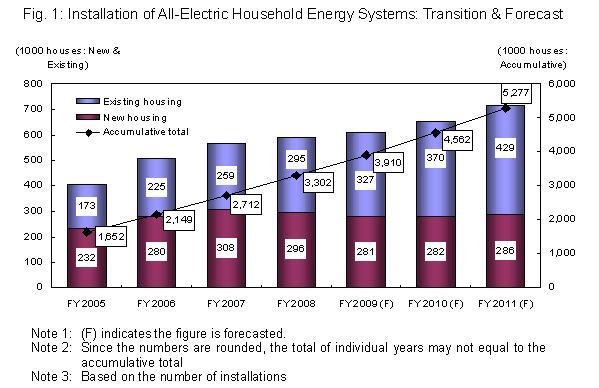
The all-electric household energy system installations in fiscal 2008 were 590,400 homes, increased by 4.3 percent compared to the previous year. The accumulative installations have exceeded 3 million homes, and the penetration rate per household exceeded 6 percent.
¨ The number of all-electric household energy system installations in the new housing sector has turned to decrease for the first time.
The all-electric household energy system installations in new housing sector have decreased by 3.9 percent compared to the previous year, first time since the start of its popularization, which may be attributable to the fact that the number of new housing starts has been suppressed by the economic recession although the ratio of installation has been improving.
¨ The market size of an electric heat pump water heater, “Eco Cute” will reach to 770,000 units in fiscal 2011.
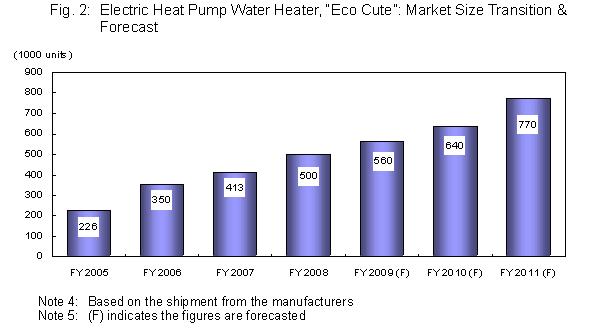
The market size (shipment from the manufacturers) of electric heat pump water heaters in fiscal 2008 was 500,000 units, increased by 21.1% compared to the preceding year. As new space-saving models have been introduced into the market for developing the market in the existing housing sector, the market is estimated to grow to 770,000 units in fiscal 2010.
¨ The market size of a residential-use fuel cell system, “ENE-FARM” will reach to 78,000 units in fiscal 2015.
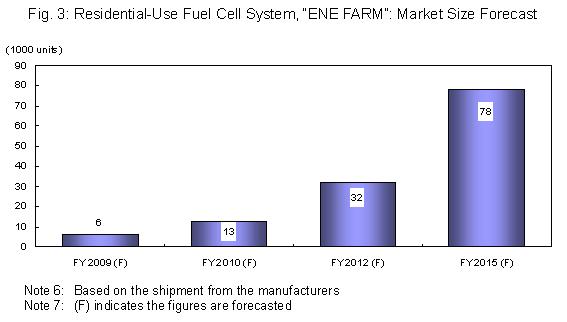
The market size (based on the shipment from manufacturers) for a residential-use fuel cell system, “ENE-FARM” is expected to be 6,000 units in fiscal 2009. With the expectation of positive market development by new enterprises entering into the market, including “Dual Generation” combined with solar power generation, the market size in fiscal 2015 is estimated to be 78,000 units.
Research Summary1. Trends in the popularization of all-electric homes
The installation of “all-electric” household energy system for cooking, hot-water supply and room heating in fiscal 2008 was 590,400 homes, increased by 4.3% compared to the previous year, increasing consistently since the start of its popularization around 2000. The accumulative installations have exceeded 3 million homes, and the penetration rate per household exceeded 6 percent.
Observing the installation by new and existing housing, however, while the installation has increased by 14.0% in the existing housing sector, the installation has decreased by 3.9% in the new housing sector, first time since the start of its popularization, which may be attributable to the fact that the number of new housing starts has been suppressed by the economic recession and by some additional impacts of the revision of the Building Standards Act, although the ratio of installation has been improving. (Refer to Fig. 1) Note: The total number of households is 49 million according to the national census of October 1, 2005.
2. Trends of the electric power and gas companies
Due to the expected decrease of population and government policies placing priority on existing housing stock (renovation of old houses, etc.), there is very few factors which may increase the number of new housing starts, on which the spread of all-electric homes has been focused on. In order to further enhance the popularization of all-electric homes, therefore, electric power companies are working on the development of demands in the existing housing sector. One of their activities is to strengthen the alliance with housing equipment manufacturers, sales and installation contractors and volume-sales electrical appliance stores who hold strong sales channels in the existing housing sector. An alliance with volume-sales electrical appliance stores, especially, may contribute considerably to enhancing the popularization of all-electric homes by creating a scale-merit to the manufacturers and permitting mass production and standardization for further cost reduction.
In the existing housing sector where gas has been used as taken granted for cooking and water heating, popularization of all-electric homes means the decrease of gas dependent households, which may lead to a significant corporate management issue. The gas companies, therefore, are trying to stop the spread of all-electric homes by further reinforcing their community-based sales organization, including restructuring of their established service networks including meter reading, checkups and maintenances.
3. Trends in the water heater
Both electricity and gas companies are appealing the “high environment performance” of their products, focusing on high efficiency water heaters. Electric power companies are focusing on an electric heat pump water heater, “Eco Cute”, while gas companies on a residential-use fuel cell system, “ENE FARM”. In addition to the decrease of population and number of new housing starts, negative factors such as the economic recession are causing the total water heater market to decrease gradually. As to the high efficiency water heaters, however, the market is expanding due to the raising of environmental awareness and a provision of government subsidies.
In case of “Eco Cute” from the electric power company group, as discount fare plans offered by individual power companies and reduction of running cost achieved by high energy saving features have been valued, in addition to the government and public subsidies, the market is expanding steadily, reaching to 500,000 units in fiscal 2008, increased by 21.1% compared to the previous year. In order to cultivate the demands in the existing housing sector where the penetration has been limited, space-saving models have been introduced into the market. Based on these backgrounds, the market is expected to keep growing, to the sales of 770,000 units in fiscal 2011. (Refer to Fig. 2)
In order to regain the image of “superior environmental performance” and “advanced”, which have been beginning to be associated with “all-electric home”, gas company group has released their flagship product, “ENE FARM” to the public in 2009. Although it is expensive as a basic unit is priced over 3 million yen, they are making a good start, backed with over 1 million yen subsidy per installation and features such as “Dual Generation” by combining with solar power generation system. The sales of “ENE FARM” are estimated to be 6,000 units in fiscal 2009, and the sales in 2015 are forecasted to be 78,000 units. (Refer to Fig. 3)
Published Report
Report Title: Home Cooking Range, Hot Water Supply and Heater Market 2009
*The information provided in the "Research Summary" is what is as of the date of announcement and could be altered or renewed without any prior notice.