No.4178
Plastic Recycling Market in Japan: Key Research Findings 2026
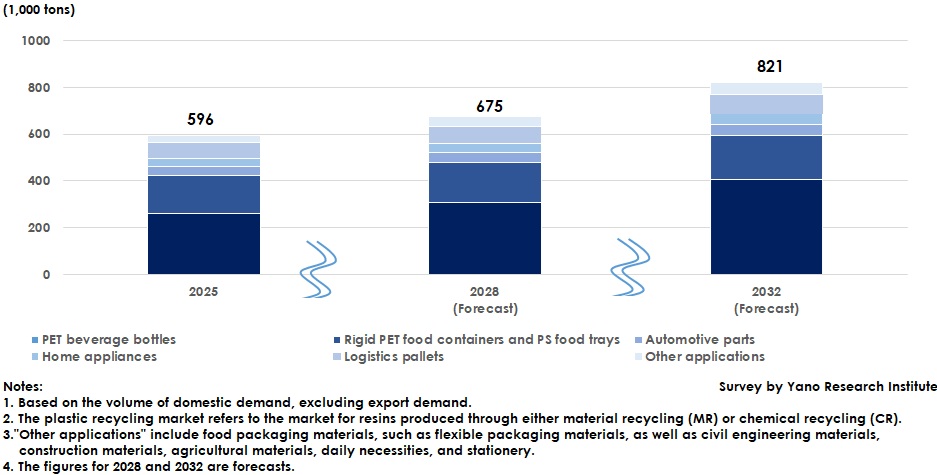
Volume-Based Demand for Recycled Plastics (the Volume Used in Products) in Japan Estimated at 596,000 Tons in 2026
Yano Research Institute (the President, Takashi Mizukoshi) conducted a survey on trends in Japan's plastic recycling market. The survey revealed trends in the user industry and the outlook of plastic recycling. This article discusses the estimated volume-based demand for recycled plastics in Japan (the volume used in products) in 2025, as well as the forecasted demand for 2028 and 2032.
Market Overview
In this research, the plastic recycling market refers to the market for resins produced through either material recycling (MR) or chemical recycling (CR). Market size is calculated based on the volume of domestic demand for recycled plastics used for producing PET beverage bottles, food containers, automotive parts, home appliances, and logistics products such as pallets. Market size only includes domestic demand and excludes export demand. The plastic recycling market (i.e., recycled resins) is estimated to have reached 596,000 tons in 2025. Approximately 260,000 tons were used for beverages (PET bottles), 160,000 tons for food containers (rigid PET and polystyrene (PS) food trays), 40,000 tons for automotive applications, 30,000 tons for home appliances, 60,000 tons for logistics pallets, and 30,000 tons for other applications.
The adoption of recycled plastics is progressing or under consideration in various industries through the establishment of targets and regulations. For example, the Japan Soft Drink Association has announced its intention to increase its bottle-to-bottle recycling rate (the percentage of PET bottles made from recycled PET bottles) to 50% by 2030 (*1), while in the automotive industry, the End-of-Life Vehicle (ELV) Regulation was published in Europe in July 2026 and took effect in the following month (*2).
In April 2026, the Act on the Promotion of Effective Utilization of Resources was revised (*3). Starting from FY2027, businesses that manufacture, import, or sell a certain amount of products designated as "products that promote decarbonization and the use of recycled resources" must submit a plan that sets a target for using recycled plastics and report their progress on this plan to the government. These businesses include manufacturers that produce over 10,000 tons of plastic container packages annually, manufacturers that produce over 50,000 units of each of the four types of home appliances (home-use air conditioners, televisions, refrigerators, and washing machines) annually, and automakers or car importers that manufacture or sell over 10,000 automobiles annually.
*1) Source: The report on Japan Soft Drink Association’s declaration to increase their bottle-to-bottle recycling rate (the percentage of PET bottles produced from recycled PET bottles) to 50% by 2030 (in Japanese):
https://www.j-sda.or.jp/news/2021/04/19/post-568/
*2) Reference: Official Journal of the European Union:
https://eur-lex.europa.eu/legal-content/EN/TXT/HTML/?uri=OJ:L_202601738&qid=1788318719902
*3) Source: The Act on the Promotion of Effective Utilization of Resources has been revised (in Japanese):
https://www.meti.go.jp/policy/recycle/main/admin_info/law/02/
Noteworthy Topics
Building a Scheme to Encourage Behavioral Changes in Consumers and Collect Used Plastics to Produce Recycled Plastic Products
In order to recycle plastics, it is necessary to increase the collection of plastic waste. Since the 1990s, the automotive and home appliance industries have established recycling regulations, building a system that facilitates the process from collection to recycling. Meanwhile, some industries have not organized these regulations. Aiming to accelerate recycling habits even among these industries, some efforts beyond installing recycling bins are underway. These efforts encourage consumers to bring their waste containers to the bins by rewarding them with points for doing so. It is important to encourage consumers to change their behavior from discarding waste products to participating in collecting them as resources.
Currently, many industries are creating systems to facilitate recycling processes. If these systems include an initiative that grants incentives for consumers’ environmental contributions, more consumers may change their recognition and behavior toward plastic waste, which could lead to increased plastic recycling.
Future Outlook
In addition to encouraging consumers to change their behavior, two challenges must be addressed to increase plastic recycling: responding to passed-on prices for recycled materials and developing and expanding applications for them.
Some industries may require consumers to pay the increments for using recycled materials that are included in products’ selling prices. However, this is difficult to implement in industries that handle daily necessities, such as food and everyday items. This difficulty deters them from adopting recycled materials. Since companies or industries alone cannot solve this price-related challenge, these entities need to resort to government subsidies to bridge the price gap between petroleum-derived and recycled plastics.
It is also important to develop applications for recycled plastics instead of just producing more of them. When procuring recycled plastics, buyers should communicate their performance and physical property requirements to recyclers. In Japan, recyclers are businesses that recycle waste containers and wrapping materials collected from storage facilities. They are authorized to sell recycled materials. Offtakers can elevate recycled plastics from eco-friendly materials to functional ones by developing applications with recyclers.
Therefore, offtakers are required to take the initiative in generating and developing applications for recycled plastics rather than merely using them.
Research Outline
2.Research Object: Companies using recycled plastics in the automotive, beverage, daily necessity, cosmetics, stationery, office equipment, and construction industry
3.Research Methogology: Face-to-face interviews (including online interviews) by our expert researchers, and literature research
What is the Plastic Recycling Market?
In this research, the plastic recycling market refers to the market for resins produced either through material recycling (MR) or chemical recycling (CR). MR involves reusing collected waste plastics as raw materials to produce new products. This process includes sorting plastics out from rubbish, crushing and pulverizing them, cleaning them, and removing foreign materials. CR, on the other hand, involves chemically decomposing plastics into materials such as monomers, oil, and gas for reuse as raw materials in producing new products. Market size is calculated based on the domestic volume-based demand for recycled plastics. Market size excludes export demand.
Applications include polyethylene terephthalate (PET) beverage bottles, rigid PET food containers, polystyrene (PS) food trays, and materials used in automobiles, home appliances, and logistics pallets. Other applications include food packaging materials, such as flexible packaging materials, as well as civil engineering materials, construction materials, agricultural materials, daily necessities, and stationery.
<Products and Services in the Market>
Products made from plastic waste produced using material recycling (MR) or chemical recycling (CR) methods
Published Report
Contact Us
The copyright and all other rights pertaining to this report belong to Yano Research Institute.
Please contact our PR team when quoting the report contents for the purpose other than media coverage.
Depending on the purpose of using our report, we may ask you to present your sentences for confirmation beforehand.