No.4148
Ecommerce Platform Market in Japan: Key Research Findings 2026
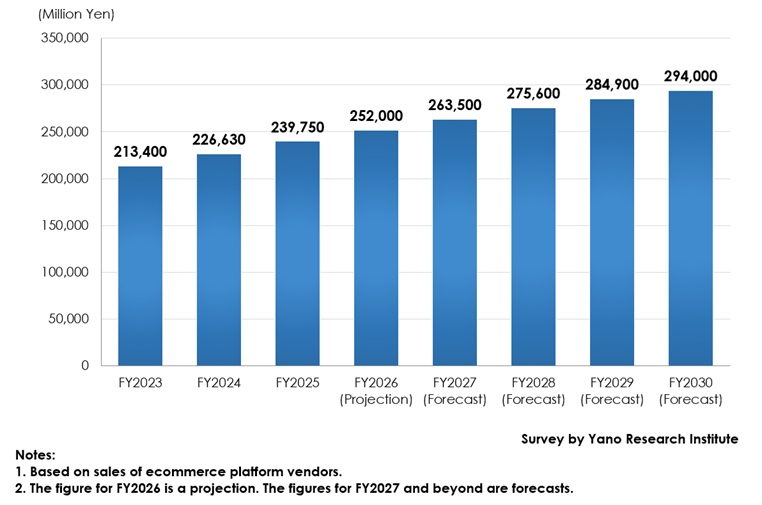
The Ecommerce Platform Market Reached 239.8 Billion Yen in FY2025, Marking a 5.8% Year-Over-Year Increase
Yano Research Institute (the President, Takashi Mizukoshi) conducted a survey of the ecommerce platform market in Japan. The survey revealed the market's estimated size and forecast, market trends by construction model, the strategies and AI-utilization status of major businesses, the status of the agentic commerce market, and the overall outlook.
Market Overview
The ecommerce platform market in Japan is growing, due to the widespread adoption of ecommerce and digital transformation projects within enterprises. Along with the prevalence of Software as a Service (SaaS) ecommerce models, ecommerce platforms have expanded their offerings to support omnichannel commerce* and cross-border ecommerce, as well as data utilization. Ecommerce platform businesses are investing in improving work efficiency and customer experience. Examples include using generative AI to generate product information and respond to customers and implementing marketing support features that leverage customer information and sales data.
*) Supporting omnichannel commerce involves integrating data across all sales and distribution channels, including physical and online stores.
Meanwhile, the demand for developing new ecommerce sites, which increased during the pandemic, has overall subsided. The ecommerce market is now mature. Consequently, market growth has shifted from new deployments to revamping existing websites, adding advanced features, and providing marketing support using data. Market growth is driven by an increase in average revenue per user (ARPU) for each ecommerce vendor, stemming from an increase in system replacements and B2B transactions among medium and large companies.
Additionally, advancements in generative AI and AI agents have emerged as new competitive factors, such as an AI-enabled platform that provides a common framework for AI to perform site-wide searches and retrieve relevant information. Other factors include data utilization capabilities, alignment with an application programming interface (API), and the support for the model context protocol (MCP)*, all of which have become increasingly important. As interest in AI agents and agentic commerce grows, the market environment is entering a new phase of change.
Consequently, Japan’s ecommerce platform market is expected to reach 239.75 billion yen in FY2025, based on the sales from businesses, which is a 5.8% increase from the previous fiscal year.
*) The Model Context Protocol (MCP) is an open standard that connects AI applications and ecommerce systems. As an important alignment technology in the era of agentic commerce, the MCP is gaining attention because it optimally provides AI applications with commerce information, including products, inventory, and orders.
Noteworthy Topics
Agentic Commerce Serves as a New Purchase Channel
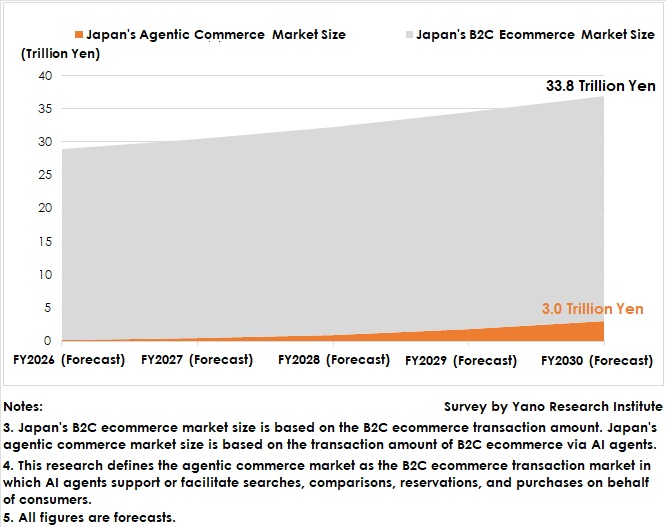
This research defines the agentic commerce market as a B2C transaction model in which AI agents conduct or support searching for, comparing, reserving, and purchasing products and/or services on behalf of consumers.
While AI agents can easily be adopted for regular purchases, such as daily necessities and consumables, traditional ecommerce is expected to persist in areas where brand values and purchase experiences are highly valued. Thus, the market structure is expected to shift toward the coexistence of agentic commerce, which prioritizes efficiency, and conventional ecommerce, which prioritizes experience-based values.
From this perspective, agentic commerce is anticipated to gradually grow as a new purchase channel rather than replace the existing ecommerce model.
Based on the B2C transaction amount via AI agents, the domestic agentic commerce market is projected to increase from 150 billion yen in FY2026 to a 3 trillion-yen size by FY2030. Despite an anticipated compound annual growth rate (CAGR) of 111.5% from FY2026 to FY2030, agentic commerce is expected to account for only 8.9% of Japan's B2C ecommerce market. In the meantime, the market is expected to grow in the area of daily necessities and consumables, serving as a new purchase channel that complements the existing ecommerce model.
Future Outlook
The domestic ecommerce platform market is expected to grow more slowly than before, due to the mature B2C ecommerce market and fulfilled demand for new ecommerce sites.
Going forward, market growth will likely be driven by renewing existing sites, adding advanced features, and increased investments in B2B transactions for digital transformation, omnichannel capabilities, and cross-border e-commerce rather than new deployments.
The growing use of generative AI and AI agents is expected to encourage market growth in the medium to long term. Specifically, the expanded role of AI agents, shifting from operational support to operational autonomy, will increase the value of ecommerce platforms. This will improve the average revenue per user (ARPU) for each ecommerce vendor and increase the market size.
Additionally, robust market growth is anticipated through API alignment, alignment-rich features, highly customizable SaaS models, and continued shifts from the full-scratch model to the SaaS and packaged models.
In this context, the domestic ecommerce platform market is expected to reach 239.75 billion yen in FY2025 and 294.0 billion yen in FY2030, with a CAGR of 3.9% from FY2026 to FY2030.
Research Outline
2.Research Object: Ecommerce platform vendors and AI specialty vendors.
3.Research Methogology: Face-to-face interviews by our expert researchers (including online interviews) and literature research
What is the Ecommerce Platform Market?
For the purposes of this research, the ecommerce platform market refers to the market for platforms and services that support the development and operation of ecommerce websites. This research targets the following three development models: software as a service (SaaS)/application service providers (ASPs), packaged or customized, and full-scratch. Each model is described below. Market size is based on the sales from ecommerce platform businesses.
This research defines the agentic commerce market as the B2C ecommerce transaction market in which AI agents support or facilitate searches, comparisons, reservations, and purchases on behalf of consumers. Market size is calculated based on the transaction amount of B2C ecommerce via AI agents.
Descriptions of Ecommerce Platform Development Models
SaaS and ASP models: These models provide ecommerce platforms in the form of cloud services. They typically use subscription-based pricing models, such as monthly payments. These platforms are characterized by quick setup and regular feature updates.
Packaged or customized models: These models provide a license to use a ready-made ecommerce platform that can be optimized to meet a company’s requirements. Traditionally, these models are sold as packages that include license sales and maintenance support. However, more vendors are offering cloud-based operations and subscription-based pricing models.
Full-scratch models: This model involves developing a company’s original ecommerce platform from scratch. Vendors primarily earn revenue from development. Companies operating this type of ecommerce platform enjoy high levels of customizability and scalability.
<Products and Services in the Market>
Ecommerce platform services, including SaaS model, packaged model, and full-scratch model
Published Report
Contact Us
The copyright and all other rights pertaining to this report belong to Yano Research Institute.
Please contact our PR team when quoting the report contents for the purpose other than media coverage.
Depending on the purpose of using our report, we may ask you to present your sentences for confirmation beforehand.