No.4106
Non-Residential Building Refurbishment Market in Japan: Key Research Findings 2026
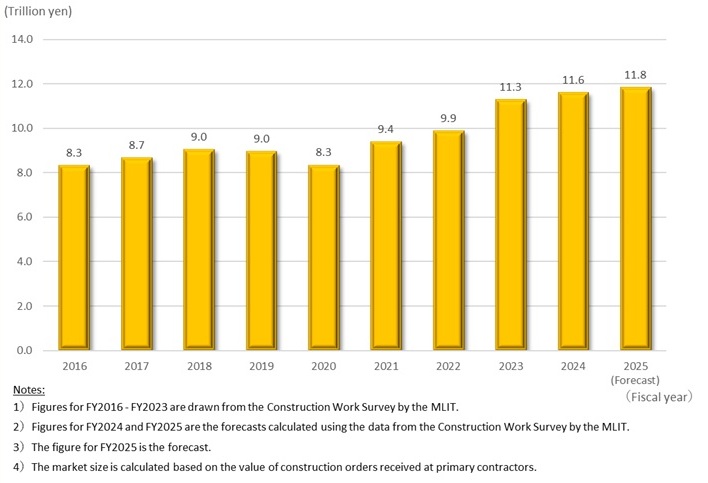
Non-Residential Building Refurbishment Market Valued At 11.59 Trillion Yen in FY2024
Yano Research Institute (the President, Takashi Mizukoshi) has recently released a market report "Non-Residential Building Refurbishment 2026", which explored the market trends and future perspectives.
Market Overview
The non-residential building refurbishment market in Japan is sized at 11.59 trillion yen in FY2024, representing 2.8% increase from the previous fiscal year (on the value of construction orders received at primary contractors; estimated using the data from the Construction Work Survey by the Ministry of Land, Infrastructure, Transport and Tourism [MLIT].)
The demand for building refurbishment has surged, fueled by escalating construction costs resulting from spikes in material prices and labor wages. These financial pressures have prompted building owners to pivot their investment strategies, shifting focus from new construction toward the strategic utilization of existing assets.
Market growth is further bolstered by broader industry trends. Specifically, the value enhancement of existing buildings through renovation has become increasingly active. This trend is a response to the massive volume of building stock constructed during Japan’s Bubble Economy (late 1980s and early 1990s), which has now reached a critical stage in its lifecycle requiring comprehensive management and modernization.
Noteworthy Topics
Pivot to “Value Enhancement”
In the non-residential building refurbishment segment, value enhancement is gaining traction. To transform underperforming properties —such as obsolete office buildings and aging retail spaces—into high-demand assets, owners and tenants are increasingly adopting retrofitting measures. These include achieving net zero energy performance (Net Zero Energy Building [ZEB]) and introducing energy-efficient systems.
At the same time, improvements to the workspace environment can help strengthen business continuity planning (through enhanced disaster preparedness) and foster stronger engagement with both current and prospective employees. As a result, enhancing occupant comfort while maximizing asset value is becoming increasingly important in the non-residential refurbishment market.
Future Outlook
The size of non-residential refurbishment market is projected to attain 11.8 trillion yen in FY2025 (on the value of construction orders received at primary contractors; estimated using the data from the Construction Work Survey by the MLIT.)
While the market faces potential headwinds—such as a shortage of construction labor, high interest rates that may dampen investment, and the increased durability of modern materials which can extend repair cycles—the overall outlook for non-residential refurbishment remains positive.
High costs for new construction continue to drive building owners toward asset utilization rather than new development. This strategic shift, combined with a rising demand for value enhancement and the aging Bubble Economy building stock, suggests that the refurbishment market is poised for significant growth.
Research Outline
2.Research Object: Businesses related to refurbishment of non-residential buildings
3.Research Methogology: Face-to-face interviews by our expert researchers, complementary survey via telephone or letter, and secondary research
What is the Non-Residential Refurbishment Market?
In this research, “refurbishment” is categorized into three primary scopes:
1) Lifecycle maintenance: Repairs focused on asset preservation and managing physical degradation.
2) Renewal: The restoration or replacement of degraded elements and core systems.
3) Renovation: Interventions aimed at enhancing a building's usability, aesthetic appeal, or market value.
The term “non-residential building” encompasses all structures not specifically designed for housing. This typically includes commercial properties (offices, retail stores, and malls), industrial facilities (factories and warehouses), and institutional buildings (schools). Common work categories within this sector include structural retrofitting, extensions, envelope waterproofing, interior redesign, and the replacement of MEP systems (Mechanical, Electrical, and Plumbing).
The size of non-residential refurbishment market is estimated using the data from the Construction Work Survey by the Ministry of Land, Infrastructure, Transport and Tourism (MLIT).
<Products and Services in the Market>
Office, retail stores, shopping malls, factories, warehouses, schools, hotels, etc.
Published Report
Contact Us
The copyright and all other rights pertaining to this report belong to Yano Research Institute.
Please contact our PR team when quoting the report contents for the purpose other than media coverage.
Depending on the purpose of using our report, we may ask you to present your sentences for confirmation beforehand.