No.4033
Beverage Container Market in Japan: Key Research Findings 2025
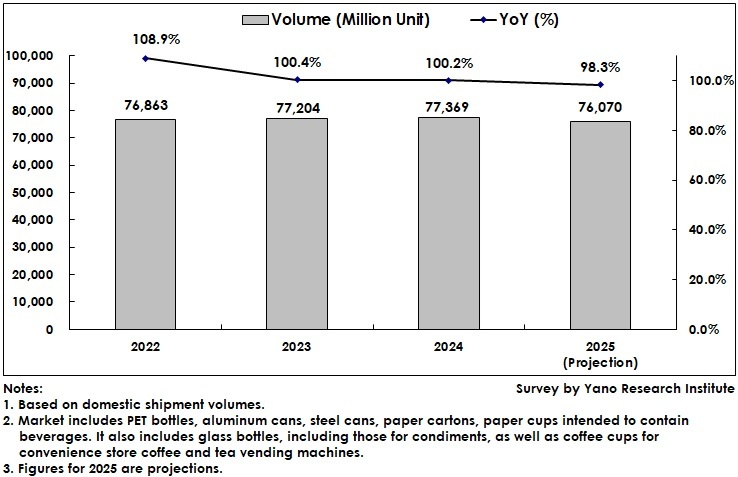
Domestic Beverage Container Market Size Expected to Decline by 1.7% YoY, Reaching 76.07 Billion Units in 2025
Yano Research Institute (the President, Takashi Mizukoshi) conducted a survey of the domestic market for beverage and food containers. The survey revealed the trends by product segment and the trends among market players. This press release highlights the domestic shipment volume of beverage containers.
Market Overview
Based on shipment volume, the beverage container market is estimated to reach 76.07 billion units, which is 98.3% of the size of the previous year. Fluctuations in container shipment volume have decreased due to the maturation of the beverage market. In other words, the contents of the containers have become more stable.
Aluminum cans for alcoholic beverages are expected to decline the most in 2025, with a 4.4% year-over-year decrease. Meanwhile, paper cups for food are expected to grow the most, with a 3.1% year-over-year increase. Overall, container fluctuations remain at 7.5%. Steel cans for beverages and aluminum cans for soft drinks are estimated to decline by 4.1% and 3.5%, respectively, but all other beverage containers are expected to differ by only around 1% to 2%.
In recent years, containers have generally met requirements, making it difficult to develop new ones. Additionally, mature markets for container content, including soft drinks and food, have stabilized the demand for containers. Consequently, the container market is expected to remain unchanged or experience only moderate fluctuation.
Noteworthy Topics
Many Government Policies and Container Users Have Set Targets for 2030, Encouraging Social Changes and Ultimately Fueling Container Reforms
Containers have been developed to meet various functional and environmental requirements, such as functional additions including recapping, barrier, and microwave-safe features, as well as the use of recycled or biomass materials. These efforts have made developing new containers more difficult. Additionally, demand for containers is unlikely to fluctuate in mature markets, such as beverages and food.
Nevertheless, looking ahead to 2030, the surrounding society of containers is undoubtedly changing. This change will impact containers.
For example, many environmental targets set by the government, overseas packaging regulatory bodies, and container users, such as beverage brand owners, convenience stores, and supermarkets, regard 2030 as a milestone for expanding container recycling and the biomass material use.
Additionally, containers’ end users, i.e., consumers, are experiencing aging and fewer populations, which is increasing the number of single-person or smaller households. This society requires containers to be more convenient for older people and single-person households. Examples include containers that are easy to open with minimal force, smaller lot sizes, and clearer instructions on content, expiration dates, and eating methods.
Meanwhile, inbound tourism is likely to continue surging and the government plans to welcome 30 million foreign visitors by 2030. Thus, the demand for gifts and souvenirs is expected to increase.
As Japanese rice wine, or “sake,” is gaining popularity among foreign tourists, personal-sized aluminum cans are attracting attention as an alternative to traditional glass bottles for bringing home these wines, because they are lightweight and less breakable, despite their current sluggish sales. Japanese snacks are also very popular, which may increase the demand for paper cups to prevent breakage when carrying them around.
Future Outlook
Container manufacturers face many challenges in meeting the 2030 targets. Environmental measures and social changes, including an aging society with fewer children and an influx of inbound tourists, may lead to a reevaluation of traditional container norms. For example, PET bottles may no longer be suitable for the largest market segment. This may also apply to other containers, including paper cartons for milk and fruit juice, cans for soda and beer, and glass bottles for wine, including Japanese rice wine.
2030 is a milestone for the environmental and social targets set by many stakeholders, including container users such as CVS, supermarkets and beverage brand owners. Currently, an aging population and lower birth rates are underway.
In this context, container manufacturers are required to develop and propose containers that address environmental concerns, meet demands of new consumers, such as foreign visitors, and update universal designs to cope with the increasing number of older people and single-person households.
The container market is unlikely to change immediately in the next four to five years until 2030. However, the products, technologies, and facilities that these manufacturers deploy toward 2030 will continue to drive these manufacturers beyond that date.
Container manufacturers have traditionally focused on maintaining and increasing current sales and market shares in mature markets. However, they should plan to meet user needs by 2030 and implement their business strategies that extend beyond that date, while continuing to increase current revenue and sales volumes.
Research Outline
2.Research Object: Manufacturers of beverage containers and food containers
3.Research Methogology: Face-to-face interviews by our expert researchers (including online interviews) and literature research
What are Beverage Containers?
This research defines beverage containers as PET bottles, aluminum cans, steel cans, paper cartons, and paper cups intended to contain beverages. The research also includes glass bottles, including those for condiments, as well as coffee cups for convenience store coffee and tea vending machines. Market size is calculated based on domestic shipment volume.
<Products and Services in the Market>
Light weight plastic containers (polystyrene paper [PSP] containers, amorphous polyethylene terephthalate (A-PET) containers, oriented polystyrene [OPS] containers, Polypropylene (PP) filler containers), polyethylene terephthalate (PET) bottles, metal cans (aluminum cans, steel cans), paper containers (paper cartons, paper cups, paper packages), glass bottles, coffee cups for CVS vending machines
Published Report
Contact Us
The copyright and all other rights pertaining to this report belong to Yano Research Institute.
Please contact our PR team when quoting the report contents for the purpose other than media coverage.
Depending on the purpose of using our report, we may ask you to present your sentences for confirmation beforehand.