No.3995
Flowers & Ornamental Plants Market in Japan: Key Research Findings 2025
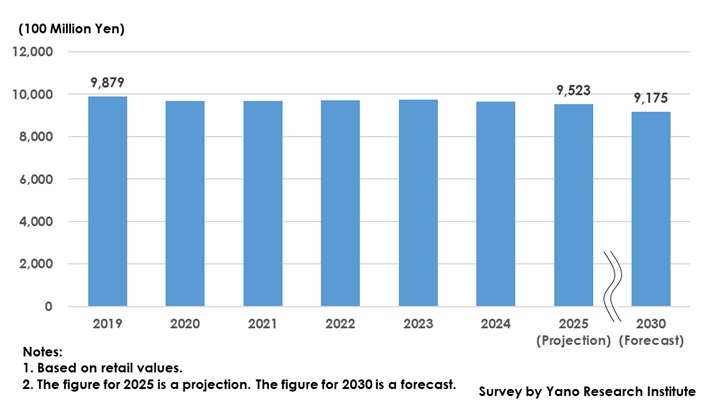
The Size of the Flowers & Ornamental Plants Retail Market Projected to Reach 952.3 Billion Yen, Down by 1.3% YoY
Yano Research Institute (the President, Takashi Mizukoshi) conducted a survey of the domestic flowers and ornamental plants market. The survey revealed the market size, the trends among market players, and future market outlook. In here discusses the transition and forecast of the retail market size of flowers and ornamental plants.
Market Overview
The retail market for flowers and ornamental plants is expected to reach 952.3 billion yen in 2025, which is 98.7% of the size of the preceding year. Small products have become common for business use, such as for weddings and funerals, as ceremonies on the scale of pre-pandemic levels have become rare. Consequently, the volume of flowers and plants used has decreased. Additionally, market players have raised prices due to rising flower prices and deteriorating supply caused by the weaker yen resulting from global events, as well as persistently high costs for almost everything including production.
Demand for flowers and ornamental plants for household use has increased due to pandemic-era demand and subscription services. This demand is shifting to be met by DIY stores and mass merchandisers, including supermarkets, which offer fresh plants at lower prices. This trend is likely to continue for the time being.
Noteworthy Topics
Logistics Issue Measures
Japan’s 2024 logistics problem which has become a recognized social challenge, is significantly impacting the flower and ornamental plant industry. It is estimated that 30% of current freight will be unable to be transported by 2030(*). According to industry officials, this sector may be affected more than others due to its characteristics, such as the significant difference between peak and off-peak seasons, particularly for ornamental plants and potted flowers.
* Source: The Ministry of Land, Infrastructure, Transport and Tourism
Some transportation companies are known to refuse to collect cargo from plant-growing districts when production volume is low. In some regions, plant producers have started bringing their produce to assembly centers of general home delivery businesses to take advantage of their logistics networks.
In 2025, the National Floral Logistics Future Conference was held to address inefficiencies in logistics across the entire industry. It is crucial for industry members to share their challenges and collaborate to solve them.
Some wholesale markets and transportation businesses have started streamlining logistics through relay transportation by establishing hub centers that serve as relay points. Cargo collected from multiple production districts is temporarily stored at the hub center before being wholly delivered to nearby markets. This reduces the number of locations that drivers must stop at, saving transportation time. Having a relay point at which collected cargo is stored before being delivered to each market and demand source reduces long-distance drivers’ burdens and working hours. Wholesalers in the same area have also begun sharing cargo collection.
Future Outlook
The industry faces the significant challenge of a low supply of cut flowers, because producers are aging and their number is decreasing. Aiming to strengthen domestic production and supply as well as develop products that meet consumer demand, some wholesale markets are exploring new production regions and species. They support production regions nationwide by providing original species of seeds and seedlings and selling them as high-value products. Some focus on developing products that utilize consumer data obtained through social media. These markets only sell products that have been improved based on feedback and evaluations collected from a certain number of consumers. This generates product-market fit (PMF), aligning offerings from uncompromising producers with consumer needs.
Along with the decline of retailers, such as flower shops, Yano Research Institute predicts an expansion into other channels, such as supermarkets and online flower stores. This shift also appears to stem from rising commodity prices, where consumers demand affordable products and higher cost efficiencies.
At the GREEN x EXPO 2027, scheduled to be held in Yokohama, attention is growing for greening in addition to ornamental plants. This will create momentum for greening roofs, walls, and interiors. The expo is expected to be a golden opportunity to increase the awareness of healing effects of ornamental plants and new ways of using them.
Research Outline
2.Research Object: Seedling manufacturers, wholesalers & retailers of flowers and ornamental plants, importers of cut flowers, online businesses, etc.
3.Research Methogology: Face-to-face interviews by our expert researchers (including online interviews), survey via telephone and email, and literature research
What is the Flowers & Ornamental Plants Market?
This research defines the flowers and ornamental plants market as plants used to decorate homes, offices, and commercial facilities, as well as plants utilized on social media, plant/flower subscription services, gift plants, and related products.
<Products and Services in the Market>
Cut flowers, seedlings for flower beds, flowering trees, bulbs, potted flowers, turf and other ground covering greens, preserved flowers, funeral flowers, etc.
Published Report
Contact Us
The copyright and all other rights pertaining to this report belong to Yano Research Institute.
Please contact our PR team when quoting the report contents for the purpose other than media coverage.
Depending on the purpose of using our report, we may ask you to present your sentences for confirmation beforehand.