No.3958
All-Photonics Network (APN) Development in Japan: Key Research Findings 2025
Development of Viable Use Cases Crucial for APN Penetration
Yano Research Institute (the President, Takashi Mizukoshi) has conducted a survey on the domestic All-Photonics Network (APN) market and explored the future outlook. This press release announces three deployment scenarios for APN in Japan.
Summary of Research Findings
The APN (All Photonics Network) is a technological concept designed to enable high-capacity, low-power, and low-latency data transmission by minimizing electro-optical conversions. The government positions APN as a core communication infrastructure capable of supporting the massive growth in data traffic expected in the future, while maintaining low energy consumption and low latency. APN is anticipated to serve as a foundational technology supporting Japan's transition toward Society 5.0.
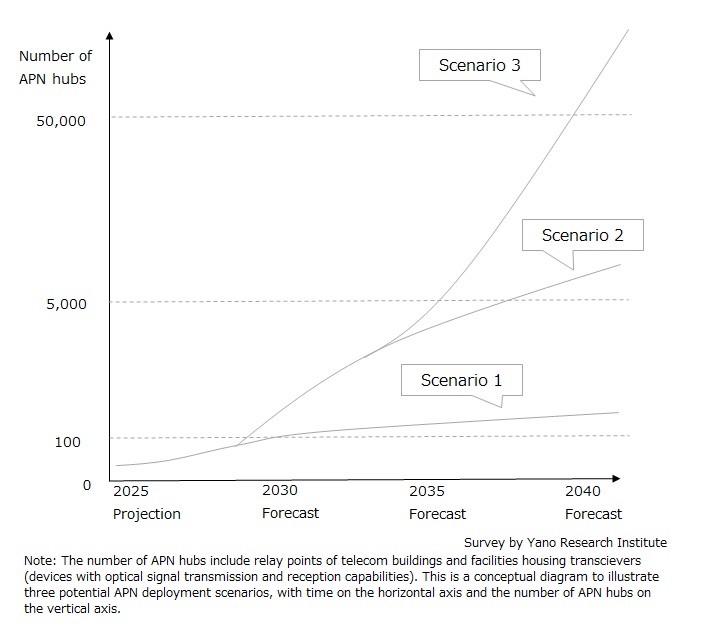
In the market report, we present a conceptual diagram illustrating three potential APN deployment scenarios based on differing assumptions about market conditions. The diagram plots time on the horizontal axis and the number of APN hubs on the vertical axis.
Scenario 1 (Downside Scenario) assumes that APN technology will be solely adopted by major data centers. Driven by the strong demand for generative AI, large-scale cloud service operators—often referred to as hyperscalers—are deploying APN. As seen in the initiative like Watt-Bit Integration, it is likely that APN will be adopted as communication link between data centers. This will lead to a slight increase in the number of APN hubs.
Scenario 2 (Base Case Scenario) entails the implementation of APN within mobile fronthaul and telecom buildings. Development of a common APN infrastructure enables seamless optical fiber network-based connection among multiple carriers. Moreover, once APN is deployed for mobile fronthaul (the optical fiber connecting antenna to controller unit) of 5G base stations, there is a high chance that hubs will be implemented to telecom buildings nationwide. This scenario envisages that APN will be utilized primarily by the telecom carriers as infrastructure, i.e., not used directly by general businesses and consumers.
Scenario 3 (Upside Scenario) presumes that rising corporate demand stimulates extensive utilization of APN, with APN devices standardized, downsized, and economized. APN transceivers will be housed in micro data centers across the country, and hubs will be established in facilities of general businesses as well. This would enable various use cases, for instance, of sending large data from nearby IoT device (like automobile) to cloud and receive AI-analyzed result back via IoT device. With Scenario 3, intelligent society envisioned by Society 5.0 is achievable.
Noteworthy Topics
Development of Viable Use Cases Needed for Wide Adoption of APN
To achieve the broad adoption of APN that many stakeholders anticipate, there is broad agreement across the industry that the development of viable use cases will be critical to its future.
At present, efforts to develop APN use cases are largely driven by telecoms. Many user companies (general businesses that consume telecom services) have yet to seriously explore business applications that fully leverage APN’s capabilities, such as high-capacity, low-power, and low-latency communications.
Although APN remains at an early stage as a technological concept, APN services have already been launched for corporate customers. In anticipation of potential societal changes, businesses in broad sense will need to start envisioning new business models that make effective use of the advantages APN brings to next-generation communications.
Research Outline
2.Research Object: Telecoms, businesses pertaining to optical wireless communication devices, etc.
3.Research Methogology: Face-to-face interviews by our expert researchers (including online interviews) and literature research
What is All-Photonics Network (APN)?
The All-Photonics Network (APN) is a technological concept that applies Photonics-Electronics Convergence (PEC) across the entire communication stack—from devices to networks—to minimize opto-electronic and electro-optical conversions. By doing so, APN aims to deliver massive transmission capacity, exceptional power efficiency, and ultra-low latency.
Although APN remains in a phased development stage, initial services for corporate users have already been launched. The government positions APN as a core communications infrastructure for the future, designed to support the growing need for large-scale data transmission with low energy consumption and minimal latency.
<Products and Services in the Market>
APN technology
Published Report
Contact Us
The copyright and all other rights pertaining to this report belong to Yano Research Institute.
Please contact our PR team when quoting the report contents for the purpose other than media coverage.
Depending on the purpose of using our report, we may ask you to present your sentences for confirmation beforehand.