No.3755
Payment Service Provider Market in Japan: Key Research Findings 2025
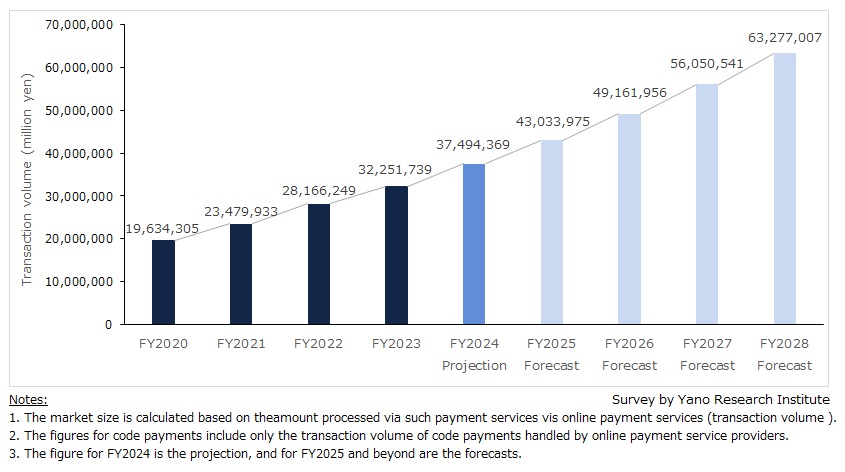
Payment Service Provider Market Estimated at 32,251,700 Million Yen for FY2023, Forecasted to Reach 63 Trillion Yen-Level by FY2028
Yano Research Institute (the President, Takashi Mizukoshi) has conducted a survey on the payment service provider market in Japan, and found out the current market status, the trends of market players, and future perspectives.
Market Overview
Payment service provider (PSP) is an intermediary that completes payment operation, primarily credit card payment and code payment, on behalf of EC site operator. With the diversification of payment methods and the expansion of service offerings, the business of PSP is sustaining momentum.
PSP supports merchants that wish to attract customers by providing broader range of payment options including code payments. PSP's service scope has expanded to include digital contents and services in addition to conventional physical goods sales. Additionally, some PSPs have extended their reach to physical stores (offline) and unmanned store with unattended checkout system, as well as the B2B transactions like BPSP* and invoice payment.
Against these backgrounds, the payment service provider market was valued at 32,251,700 million yen (114.5% of the previous fiscal year) for FY2023, and is projected to reach 37,494,400 million yen for FY2024 (116.3% of the previous fiscal year).
* BPSP is a short for Business Payment Solution Provider, a type of provider that offers B2B solution enabling payment between an enterprise (buyer) that wishes to pay by credit card and an enterprise(seller) that do not accept credit card payment. Note that in the Japanese context, BPSP refers not to a provider but for the service they provide.
Noteworthy Topics
Post-Payment Services (BNPL) on Expansion
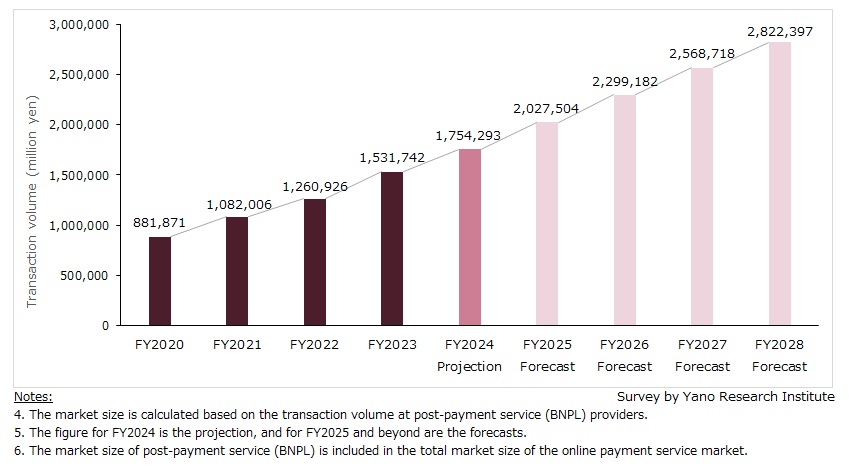
Expanding steadily, the market for Post-Payment Services (Buy Now Pay Later; BNPL) is projected to reach 1,531,700 million yen for FY2023, up by 21.5% from the previous fiscal year.
Although BNPL primarily targeted segments without credit cards—such as younger generations and homemakers—today, credit card holders also utilize the service when checking out at e-commerce sites they do not frequently visit.
BNPL providers have been working to enhance convenience and increase average transaction values by offering installment plans, as well as expanding usage scenarios beyond physical goods to include service-based e-commerce and in-person payments. As a result of these initiatives, the BNPL market is projected to reach 2.8 trillion yen by FY2028.
Future Outlook
Led by the growth of ecommerce dealing digital goods and services segment, with additional momentum coming from the expansion of B2B transactions, the payment service provider market is projected to reach approximately 63 trillion yen by FY2028.
Payment service providers are anticipated to diversify their offerings further, incorporating value-added services beyond traditional business scope.
Research Outline
2.Research Object: Payment service providers and related businesses
3.Research Methogology: Face-to-face interviews by our expert researchers (including online interviews) and literature research
<What is the Payment Service Provider? >
In this research, payment service providers (PSPs) mainly refer to third-party companies, the intermediaries between merchants and financial institutions (such as credit cards and code payment companies) to process transactions, offering services like payment gateways.
<What is the Payment Service Provider Market? >
In this research, size of the payment service provider market is calculated based on the amount processed via payment service providers (transaction volume).
Note: PSP market in Japan has evolved in tandem with the expansion of e-commerce. Against this background, the PSP market in this research encompasses the transaction volume of BNPL and COD processed via PSP.
<Products and Services in the Market>
Payment services, post-payment services [BNPL] and cash on delivery [COD] processed via PSP
Published Report
Contact Us
The copyright and all other rights pertaining to this report belong to Yano Research Institute.
Please contact our PR team when quoting the report contents for the purpose other than media coverage.
Depending on the purpose of using our report, we may ask you to present your sentences for confirmation beforehand.