No.4014
Public Sector Outsourcing Service Market in Japan: Key Research Findings 2025
The Public Sector Outsourcing Service Market Reached 5.1827 Trillion Yen in FY2024
Yano Research Institute (the President, Takashi Mizukoshi) conducted a survey of the domestic public sector outsourcing service market. The survey revealed market trends by category, the trends among market players, and the market outlook.
Market Overview
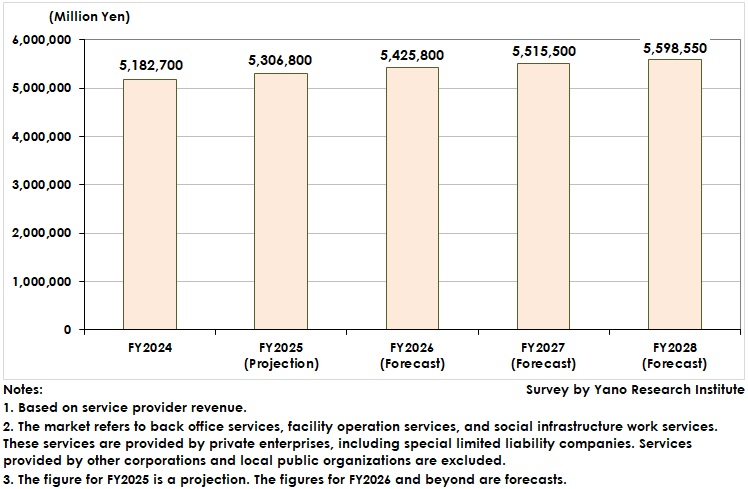
Based on service provider revenue, the public sector outsourcing service market, which consists of three market segments, reached 5.1827 trillion yen in FY2024. From FY2024 to FY2028, the market is expected to grow at a compound annual growth rate (CAGR) of 2.0%, reaching a size of 5.59855 trillion yen by FY2028.
Municipalities often find it difficult to respond to diversifying needs from citizens, due to labor shortages caused by a shrinking workforce and fewer adoptions. As a result, demand for public sector outsourcing services provided by private companies is increasing.
Meanwhile, labor shortages also affect the private sector, including outsourcing service providers. Therefore, many providers are transforming their system to efficiently process business operations with a small workforce by integrating tasks at outsourcing centers or promoting digital transformation.
Noteworthy Topics
Trends in Public Sector Outsourcing Services by Category
This research defines public sector outsourcing services as falling into one of three categories: back office services, facility operation services, and social infrastructure work services. From FY2024 to 2028, the CAGR was 2.2% for facility operation services, 1.8% for social infrastructure work services, and 1.5% for back office services.
Facility operation services had the highest CAGR because the aging of facilities nationwide has prompted many municipalities to adopt private capital to consolidate and converge these facilities into composite ones. Among various types of facilities, social welfare facilities are forecast to grow the most.
As childcare facilities are enhanced and expanded and as the number of long-term care facilities increases due to an aging population, the demand to outsource facility operations to private companies grows furthermore. Consequently, this market sector is expected to grow robustly.
“Waterworks and simplified water supply services” and “industrial water supply services” are growing markedly among social infrastructure operation services. According to the 2023 Cabinet Office Action Plan for the Public Private Partnership (PPP) / Private Finance Initiative (PFI) Promotion Office, the government plans to increase the “Water PPP” through FY2031. During this period, the government intends to expand the scope of water and sewage system integration, while strengthening organizational structures and reducing costs through economies of scale. These plans have been maintained and enhanced in the PPP/PFI Promotion Office’s revised action plans for 2024 and 2025, ensuring continued market expansion.
Of the various municipal back-office services that are outsourced to private companies, those for citizens are predicted to show a high growth rate. This is because, in the context of accelerated labor shortages due to a shrinking workforce and fewer adoptions, more municipalities will likely outsource public services for citizens, as municipal employees alone will have difficulty meeting citizens' diverse needs.
Even though electronic application procedures are becoming more common, citizen contact points will not be eliminated. This will require municipal employees to handle both citizen inquiries and online applications. This is expected to increase the number of cases where municipal employees depend more on outsourcing service providers.
Future Outlook
Japan’s declining population will reduce municipalities’ tax revenue while increasing welfare-related costs, as more citizens age. Consequently, many municipalities will face financial difficulties.
Furthermore, public facilities and infrastructure will deteriorate due to aging, making upgrades more difficult to fund. The limited number of municipal employees will also struggle to cope with diversifying civil needs, requiring the utilization of financial resources and expertise from private companies. As a result, public sector outsourcing services are anticipated to be adopted furthermore.
Research Outline
2.Research Object: Outsourcing service providers for the public sector
3.Research Methogology: Face-to-face interviews (including online interviews) by our expert researchers and literature research
The Public Sector Outsourcing Service Market
This research defines public sector outsourcing services as falling into one of three categories: back office services, facility operation services, and social infrastructure work services. These services are provided by private enterprises, including special limited liability companies. Services provided by other corporations and local public organizations are excluded. The details for each service category are as follows:
- Back office services include work to be conducted within municipalities, such as citizen-related work, e.g., citizen contact points, rubbish collection and recycling, school business processes and lunch related work, and public relations. This category also includes municipalities’ general affairs, human resources, accounting, and local government office building management. System development, maintenance, and operation services as well as temporary staffing services are not included.
- Facility operation services include the operation of public facilities, such as gymnasiums, sports facilities, vacation facilities, industrial information provision facilities, exhibition centers, public housing, parking lots & bicycle parking areas, libraries, museums (including art museums), civic halls, long-term care centers, after-school nursing care facilities for children, and welfare centers. This category includes the maintenance, management, and operation of facilities but not construction.
- Social infrastructure work services include work performed by local public enterprises that apply to the Local Public Enterprise Act. Of the work stipulated, this research is limited to the operation of “waterworks and simplified water supply services,” “industrial water supply services,” “transportation services,” “hospital services,” and “sewerage services.”
<Products and Services in the Market>
Back office service, facility operation service, and social infrastructure work service
Published Report
Contact Us
The copyright and all other rights pertaining to this report belong to Yano Research Institute.
Please contact our PR team when quoting the report contents for the purpose other than media coverage.
Depending on the purpose of using our report, we may ask you to present your sentences for confirmation beforehand.