2026/11/05
Analyst's Eyes: Wider Adoption of Quantum Computers Requires Not Only Technology and Talent Development but Also Policy Support
By Yasuhiro Yamaguchi, Executive Researcher, ICT & Finance
(The original article in Japanese was posted in October 2026)
On September 16, 2026, we published Quantum Computer Market 2026. Reports with the same title were previously published in 2020 and 2021. While quantum computing technology continues to advance day by day, from a market perspective, proof-of-concept projects and other trials aimed at eventual deployment in production environments have only begun to increase in number in 2025–2026. This prompted us to publish an updated report.
In this edition of "Analyst Eyes," we will provide a comprehensive overview of trends among companies adopting quantum computers, the support available to them, developments in quantum-related human resources, and actual applications of the technology. We will then conclude with a few recommendations.
Expansion in the Range of Companies Adopting Quantum Computers and the Need for Broader Support
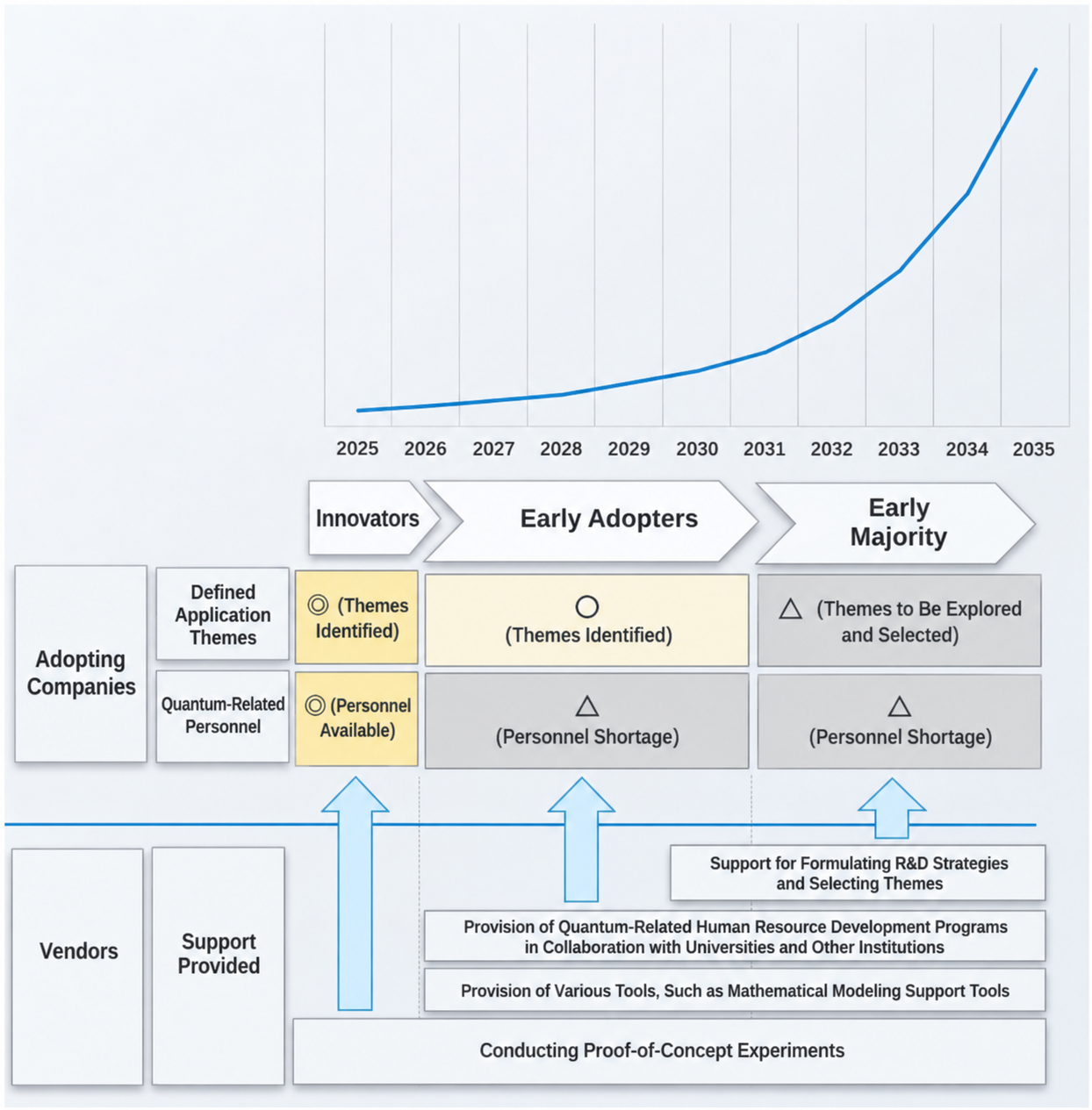
The adoption of quantum computers is expanding. Since around 2020, leading companies (innovators), including Mitsubishi Chemical and JSR, have been conducting proof-of-concept projects to explore the use of quantum computers and Ising machines, primarily in fields such as drug discovery, materials chemistry, and logistics.
These innovators have clearly defined research themes for which they wish to use quantum computers, as well as personnel and organizational structures with expertise in quantum computing. As a result, vendors work closely with these innovators, jointly conducting PoC projects through close collaboration.
For approximately seven to eight years, the use of quantum computers was largely limited to innovators. However, a second group of companies (early adopters) has finally begun entering the market in 2025–2026. Taking the results of PoC projects conducted by innovators into consideration, these early adopters are beginning to explore applications within their own business operations. In addition to the fields previously targeted, such as drug discovery, materials chemistry, and logistics, vendors report a particularly strong increase in inquiries from companies in the computer-aided engineering (CAE) field.
Like innovators, these early adopters are assumed to face challenges in initiatives involving classical computing, particularly high-performance computing (HPC). While they have clearly identified problems that they wish to address using quantum computers, many have yet to develop, or have only partially developed, the personnel and organizational capabilities with the quantum-related expertise needed to implement such applications.
For this reason, vendors are extending their support beyond conducting PoC projects to include the development of quantum-related human resources. In addition, since the use of quantum computers requires the formulation of mathematical models, the number of supporting tools is also increasing.
Examples include "PhysiLenz," a tool provided by QunaSys that supports mathematical modeling during the preprocessing stage. Quanmatic is also working to package general-purpose algorithm frameworks that can be used across industries, drawing on operational constraints and domain knowledge acquired through custom development projects.
Toshiba, meanwhile, offers "SQBM+," a solution developed as part of its quantum-inspired optimization solution. In this way, a range of solutions from various vendors is gradually taking shape to support initiatives by early adopters.
Developments Toward Standardization and Training of "Quantum Professionals"
Until recently, there had been little visible progress toward standardizing the skills and competencies required of quantum-related personnel. However, in September 2026, the Quantum Strategic industry Alliance for Revolution (Q-STAR), together with Beyont Inc., released Version 1.0 of the "Quantum Skill Standard - Professional (QSS-P)." The standard is intended to serve as a common framework for professionals responsible for quantum technology research and development, social implementation, and commercialization.
Q-STAR and its partners developed the Standard based on the Ministry of Economy, Trade and Industry's (METI) "Digital Skill Standards (DSS)" and the Innovation Platform Agency, Japan (IPA)'s "Skill Standards for IT Professionals (ITSS)." They established four QSS skill levels and defined the competencies required at each level.
More specifically, quantum professionals are classified into three occupational categories: "Quantum Hardware Engineer," "Quantum Software Engineer," and "Quantum Business Strategist." The standard then provides detailed descriptions of the roles and responsibilities associated with each category.
In our interviews, human resource development has also been identified as one of the challenges to the wider adoption of quantum computers. Some industry players are establishing and operating communities to promote human resource development. Examples include QunaSys's "QPARC," OptQC's "HIQALI," and Quanmatic's "TAQUMI." These initiatives include inviting lecturers from affiliated universities and other research institutions to provide training sessions for community members.
Fujitsu, for example, is also undertaking initiatives such as application development contests, which allow user companies to experience firsthand the potential applications of quantum computers.
Expansion of PoC Projects with a View Toward the Use of Gate-Based Quantum Computers
As described above, the range of companies adopting quantum computers is gradually expanding from innovators to early adopters. Along with this trend, the range of potential applications for quantum computers is also expanding. Broadly speaking, the applications of quantum computing can be considered in two main categories: gate-based quantum computers and Ising machines. This section focuses primarily on gate-based quantum computers.
Regarding gate-based quantum computers, the current hardware landscape is dominated by NISQ (Noisy Intermediate-Scale Quantum) systems. However, Early-FTQC (Fault-Tolerant Quantum Computing) systems are expected to begin emerging gradually around 2030. The period from approximately 2030 to 2033 is expected to be a transitional phase, during which Early-FTQC systems will gradually replace NISQ systems.
Naturally, applications are not expected to rely on gate-based quantum computers alone. Rather, adoption is increasingly centered on hybrid computing approaches that combine quantum computers with classical computers.
As hardware continues to advance in this way, the range of application fields is also expanding. In addition to established areas such as materials chemistry, drug discovery, and finance, vendors have recently been receiving an increasing number of inquiries, particularly from the CAE sector.
In July 2026, for example, TechnoStar, a CAE vendor, signed a memorandum of understanding (MOU) on collaboration with QunaSys. This demonstrates that not only companies using CAE but also CAE vendors themselves are beginning to focus on the potential applications of quantum computers.
We also monitor the CAE market. At the time of my 2024 research, vendors showed relatively little interest in the use of quantum computers. Therefore, this can be regarded as a field in which interest has increased rapidly over the past one to two years.
Meanwhile, although still at an early stage, a growing number of research papers have been published in fields such as energy and automobiles. These studies address simulations using quantum simulators and emulators, as well as algorithm development, with a view toward the eventual emergence of FTQC systems.
In the energy sector, for example, various initiatives are beginning to emerge. These include exploring the use of quantum computing in the development of more efficient solar panel manufacturing processes, simulations related to battery development for solar power generation, and the development of hydrodesulfurization (HDS) catalysts used in petroleum refining processes.
Investment in R&D Is Not Enough: Regulatory Reform Must Also Be Considered Where Necessary
The adoption of quantum computers is finally beginning to expand beyond innovators to early adopters. In the early stages of innovation, there is generally a period known as the "Valley of Death." At present, although not all applications have reached this stage, some initiatives are gradually moving beyond the R&D phase and beginning to move toward deployment in actual production environments.
In Japan, quantum computing has been included among the 17 strategic fields under the Takaichi administration. Governments around the world, led by the United States and China, are implementing various measures, including massive investments, to support quantum computing research and development as a matter of national strategic importance.
However, supporting research and development alone would be an incomplete policy response.
In addition to overcoming the "Valley of Death" that innovative initiatives inevitably face, companies will also need to overcome what is known as the "Darwinian Sea" as technologies with potentially transformative innovative impacts begin to emerge. In this process, new developments that cannot be adequately addressed within existing regulatory frameworks are likely to arise across various industries, potentially creating conflicts with conventional practices and approaches.
Against this backdrop, it is important to recognize that there may be a growing need for policies that include regulatory reforms, as appropriate, in response to technological and industry developments. Such measures will be necessary to ensure that regulations do not impede technological progress or put Japan at a disadvantage in the international arena.
Figure: Quantum Computer Adoption Curve, Trends in Adopting Companies,
and Types of Support Provided