No.4199
Language Learning Market in Japan: Key Research Findings 2026
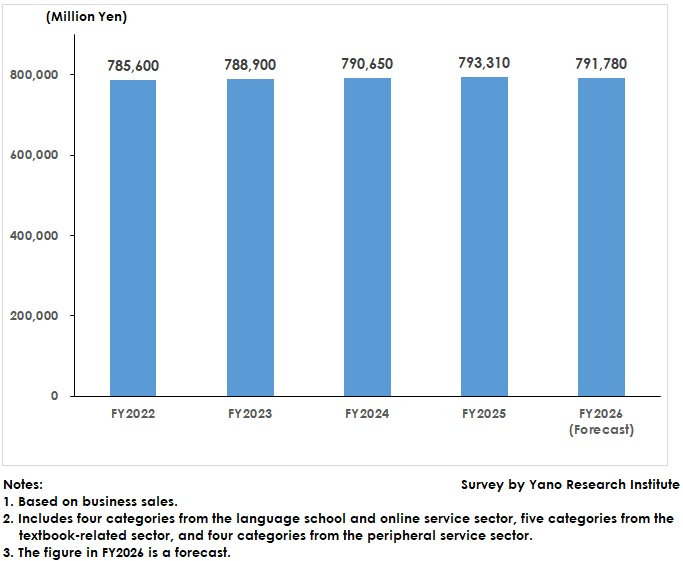
The Language Learning Market, Consisting of 13 Categories, is Expected to Reach 793.31 Billion Yen in FY2025, a 0.3% Increase from the Previous Fiscal Year
Yano Research Institute (the President, Takashi Mizukoshi) conducted a study of the domestic language learning market. The study revealed market player trends, market trends by category, and future outlook.
Market Overview
Based on business sales, the language learning market is estimated to be worth 793.31 billion yen in FY2025, which is equivalent to 100.3% of the size of the previous fiscal year. The market comprises 13 categories across three sectors.
The foreign language class sector consists of three markets: language classes for adults; English conversation classes for children and infants; and preschools. Overall, the sector has leveled off, with steady growth in the preschool and English conversation classes for children and infants, despite a slight decline in foreign language classes for adults.
Language learning apps, which include AI-powered English conversation apps, are driving the online learning sector. However, online English conversation classes are currently struggling, despite their past contributions as a sector driver.
Compared to the previous fiscal year, the peripheral service sector's markets for language exams and overseas education arrangements have grown. Meanwhile, the market for English teacher dispatch services for kindergartens and daycare centers has flattened, and the interpretation and translation services market has declined.
Noteworthy Topics
Language Learning Apps and AI-Powered English Conversation Apps Gaining Prominence
Language learning apps and AI-powered English conversation apps are rising to prominence in the language learning market, due to their advanced digital technology and convenience.
While the market for traditional real-time online English conversation classes is struggling, the language learning app market is booming. These apps are attracting a wide range of users with their convenient learning style, which is not limited by place or time.
Additionally, the number of newcomers to the AI-powered English conversation app market is growing. Amid technological advancements, including generative AI, the demand for these apps is rising as they are perceived as causing less psychological pressure. Active promotions and campaigns, including TV commercials, have increased user numbers in conjunction with growing awareness. However, app vendors may face challenges regarding profitability and differentiation from other competitive services going forward.
Future Outlook
In FY2026, the language learning market (a total of 13 categories) is expected to reach 791.78 billion yen, which is equivalent to 99.8% of the market size in the previous fiscal year.
Despite the persistence of external factors, such as a weaker yen and rising commodity prices, travel-based demand continues to underpin the market amid surging inbound tourism and globalization.
Advanced technologies, including generative AI, are expanding the scope of AI empowerment in the language learning market and rapidly eliminating the distinctions among instructional markets and services, such as traditional face-to-face instruction, textbooks, and mobile apps.
As AI-powered English conversation apps and language learning apps gain traction, their competition for customers with other services, including traditional real-time online English conversation classes, is likely to intensify. Vendors are required to go beyond providing basic learning features to offer unique value propositions and take differentiation strategies to improve profitability.
Research Outline
2.Research Object: Foreign-language school operators, developers and publishers of language study materials, and other businesses related to language education services
3.Research Methogology: Face-to-face and online interviews by specialized researchers, questionnaire survey, and literature research
About the Language Learning Market
This research defines the language learning market as comprising the following three sectors, which together include 13 categories:
The Language School and Online Service Sector: 1) foreign language classes for adults, 2) English conversation classes for children and infants, 3) preschools, 4) online language learning;
The Textbooks-Related Sector: 5) paper-based textbooks, 6) language self-learning hardware and software, 7) electronic dictionaries, 8) English conversation class textbooks for children and infants, 9) correspondence education
The Peripheral Service Sector: 10) language exams, 11)overseas education arrangements, 12) English teacher dispatch services for kindergartens and daycare centers, 13) interpretation and translation services
The Peripheral Service Sector is defined as “the related businesses” within the language learning market.
<Products and Services in the Market>
Foreign language classes for adults, English conversation classes for children and infants, preschools, online language learning, paper-based textbooks, language self-learning hardware and software, electronic dictionaries, English conversation class textbooks for children and infants, correspondence education, language exams, overseas education arrangements, English teacher dispatch services for kindergartens and daycare centers, and interpretation and translation services.
Published Report
Contact Us
The copyright and all other rights pertaining to this report belong to Yano Research Institute.
Please contact our PR team when quoting the report contents for the purpose other than media coverage.
Depending on the purpose of using our report, we may ask you to present your sentences for confirmation beforehand.