No.4047
Global Market for Materials DX (Digital Transformation in Material Science): Key Research Findings 2026
The Global Materials DX Market Expected to Exceed 3 Trillion Yen by 2030
Yano Research Institute (the President, Takashi Mizukoshi) conducted a survey of the global materials digital transformation (DX) market. The survey revealed market trends by segment, trends among the surveyed companies, and the future outlook. This paper highlights the global materials DX market.
Market Overview
Traditionally, material development, including substance and ingredient development, relied on engineers’ experience and insights, and trial-and-error experiments. However, recent advancements in supercomputers and cloud technology have greatly improved the practicality of computational science and simulations. These improvements increase the accuracy of material property forecasts, which enables the subsequent development processes to be dramatically streamlined. Materials informatics is a foundational technology involving broad fields, such as telecommunications, energy, medicine, and the environment. It is essential to solving the complicated issues that modern society faces.
Materials digital transformation (DX) is about to enter a new development phase with the emergence of process informatics (PI). While traditional materials DX focused on materials databases and composition prediction models, the latest approach focuses on creating digital twins (*which enables various simulations by creating a virtual model of a physical object based on accumulated actual data) for entire manufacturing processes. This paradigm shift in focus from materials to processes is not just a simple technological trend, but it implies a conversion of material development methods.
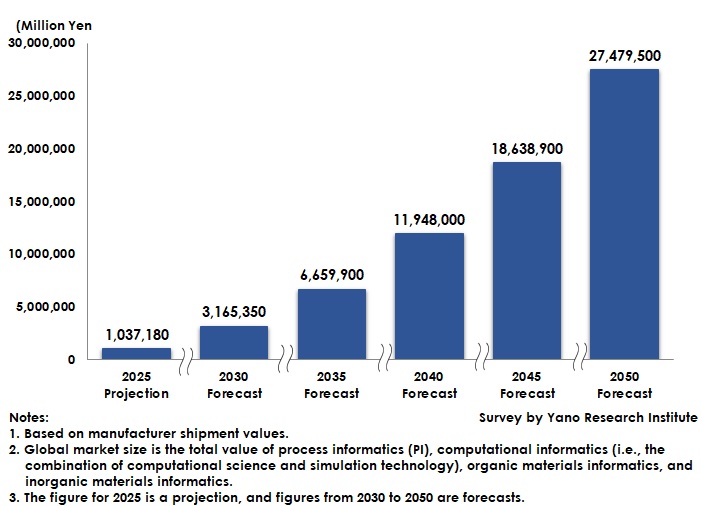
Based on manufacturer shipment values, the global materials DX market size (a total of four segments) is projected to reach 1.0371 trillion yen in 2025. Organic materials informatics accounts for 41% of the total, followed by inorganic materials informatics accounting for 37.9%, process informatics (PI) accounting for 16.6%, and computational informatics (i.e., the combination of computational science and simulation technology) accounting for 4.5%.
*Source: Ministry of Internal Affairs and Communications’ Website (https://www.soumu.go.jp/johotsusintokei/whitepaper/ja/r06/html/nd217530.html)
Noteworthy Topics
Organic Materials DX Can Be Most Represented by Unique Organic Molecular Structure and Highly Functional Flexibility
Organic materials are used in a wide range of fields, including electronics, energy, biomedicine, and the environment, due to their flexibility, lightweight nature, and design versatility.
However, the development processes of organic materials tend to be more complex than those of inorganic materials because organic materials are susceptible to structural diversity in molecules and processing conditions. Experiment-based methods require numerous trial-and-error cycles, consuming an enormous amount of time and money.
In this context, digital transformation (DX) has become imperative for the field of organic materials. In particular, the use of materials informatics (MI) is accelerating. MI is based on data-driven science and comprehensively employs experimental data, predictive data based on computational science, and machine learning algorithms. This significantly streamlines material exploration and performance predictions, compared to traditional methods.
Future Outlook
The global materials DX market size (a total of four segments) is forecast to reach 3.16535 trillion yen by 2030. Organic materials informatics accounts for 42.3% of the total, or approximately 1.3392 trillion yen; inorganic materials informatics accounts for 39%, or approximately 1.2339 trillion yen; PI accounts for 14.5%, or approximately 460.4 billion yen; and computational informatics accounts for 4.2%, or approximately 131.7 billion yen.
Materials DX is more than just a technological innovation; it transforms the concept of material development. This approach enables rapid and efficient material exploration by combining factors that would have been impossible with traditional frameworks: These factors include advances in individual technologies, the creation of material data infrastructure, standardization and automation, and collaboration among researchers, engineers, and AI agents. It also involves a mixture of interdisciplinary integration and open innovation — combining diverse technologies, knowledge, and ideas from within and outside the company to create innovative values that would be difficult to achieve alone.
Moving forward, materials DX will dramatically shorten research and development cycles while establishing itself as the foundational technology to support the next-generation society. The next step is to connect it directly to industrial applications and solutions to social issues. From this perspective, materials DX is expected to become a framework for the strategic implementation of material developments across industry, academia, and government. This includes researchers, engineers, companies, and administrators.
Research Outline
2.Research Object: R&D institutions studying device technologies in the materials DX market, producers, distributors, dealers of such materials
3.Research Methogology: Face-to-face interviews (including online interviews) by our expert researchers, and literature research
What is the Materials DX Market?
Traditionally, materials development, including substance and ingredient development, relied on engineers’ experience and insights, and trial-and-error experiments. However, recent advancements in supercomputers and cloud technology have greatly improved the practicality of computational science and simulations. These improvements increase the accuracy of material property forecasts, which enables the subsequent development processes to be dramatically streamlined. Materials informatics is a foundational technology involving broad fields, such as telecommunications, energy, medicine, and the environment. It is essential to solving the complicated issues that modern society faces.
This research defines the materials DX market as including process informatics (PI), computational informatics (i.e., the combination of computational science and simulation technology), materials design using artificial intelligence (AI)/machine learning, organic materials informatics, and inorganic materials informatics. Based on manufacturer shipment values, this research calculates the total global market size of these segments, excluding materials design using AI/machine learning.
<Products and Services in the Market>
Technologies and materials DX-based process informatics, the combination of computational science and simulation technology, materials design using AI/machine learning, organic materials informatics, and inorganic materials informatics, and related materials, development, and services in each of these fields
Published Report
Contact Us
The copyright and all other rights pertaining to this report belong to Yano Research Institute.
Please contact our PR team when quoting the report contents for the purpose other than media coverage.
Depending on the purpose of using our report, we may ask you to present your sentences for confirmation beforehand.