No.3992
Fitness Facilities in Japan: Key Research Findings 2025
There are 13,876 Fitness Facilities Nationwide as of August 2025
Yano Research Institute (the President, Takashi Mizukoshi) conducted a survey of nationwide fitness facility operators and their facilities. The survey revealed the number of fitness facilities as of August 2025, trends in fitness facilities by type of operation, and prospects for the industry.
Market Overview
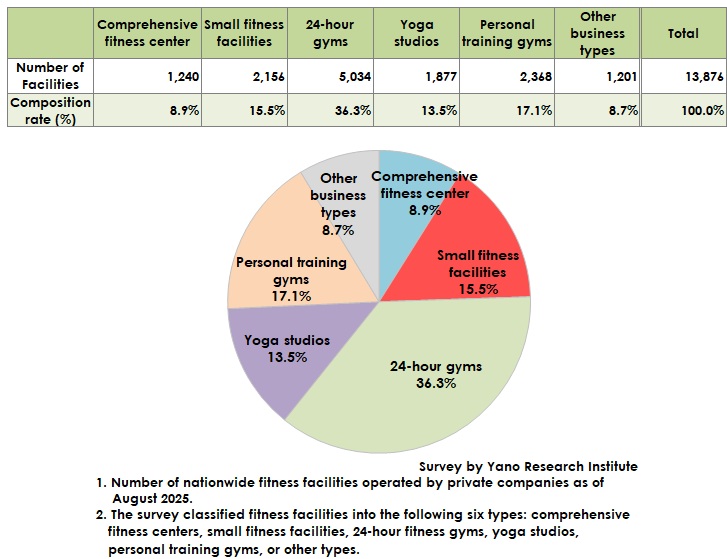
A nationwide survey of fitness facilities and the companies that operate them revealed that there were 13,876 facilities nationwide, as of August 2025.
Of those, 1,240 were comprehensive fitness centers, 2,156 were small fitness facilities, 5,034 were 24-hour gyms, 1,877 were yoga studios, 2,368 were personal training gyms, and 1,201 were other types.
Thus, 24-hour gyms outnumbered all other types, accounting for 36.3% of the total. Since multiple companies are proactively opening this type of gym, their share is growing.
Yoga studios increased in number, accounting for 13.5%. While hot yoga facilities previously drove the growth of yoga studios, reformer Pilates studios have become more popular in recent years.
Noteworthy Topics
Number of New Facilities Reached 1,266 from September 2024 to August 2025
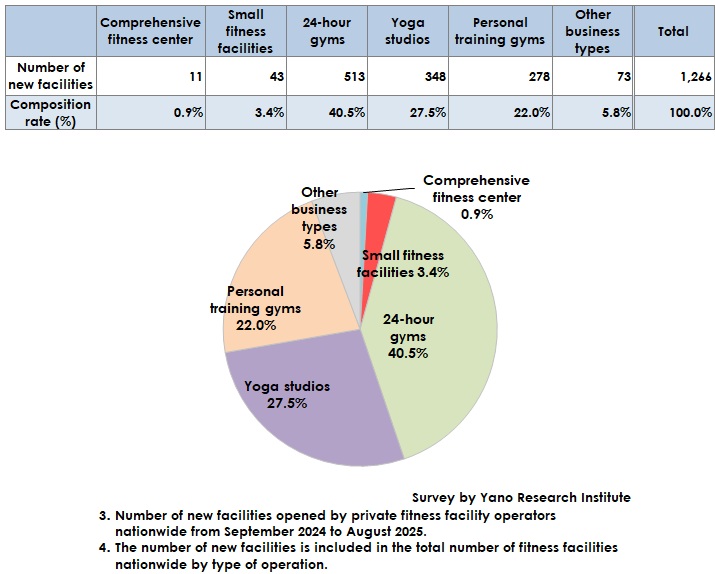
From September 2024 to August 2025, 1,266 new fitness facilities opened, making up 9.1% of the total 13,876 facilities. The new facilities comprised 11 comprehensive fitness centers, 43 small fitness facilities, 513 24-hour gyms, 348 yoga studios, 278 personal training gyms, and 73 other types.
Thus, 24-hour gyms accounted for the largest share, at 40.5%. The number of unmanned 24-hour gyms targeting beginners is rapidly increasing nationwide. Several 24-hour gym brands operate dozens of these gyms. Yoga studios accounted for the second-largest share, at 27.5%. Personal training gyms accounted for 22.0%.
The growth of yoga studios is driven by an increasing number of Reformer Pilates studios. “Reformers” are unique machines that support Pilates movements and allow users to adjust the load. This enables even beginners to exercise at an appropriate level. Studio operators can expand their offerings by providing classes with different load levels that target different user abilities. Some studios have rapidly grown by offering video lessons. By offering classes that combine Reformers with other training methods, new business types have been launched, while existing studios have increased theirs.
Future Outlook
The future fitness facility trends are analyzed as follows.
Comprehensive fitness centers face severer conditions to attract customers due to intensifying competition with other business types, such as 24-hour gyms. To improve profitability, they are leveraging their strengths, including existing facilities like swimming pools and their ability to develop unique programs that keep participants engaged, to expand their contracted services with local governments.
Traditionally, small fitness facilities had a senior female customer base, but they are expanding to target younger populations and developing facilities geared toward men. They also aim to grow by diversifying their business of product sales, primarily protein products.
Dut to their low operating costs, 24-hour gyms have expanded into local suburbs. However, this growth has led to commoditization. These gym operators are taking steps to differentiate themselves.
Despite the current growth in the number of Reformer Pilates studios, the future growth of yoga studios depends on their ability to expand into local suburbs.
The number of personal training gyms is growing, because they require minimal space. However, as with Reformer Pilates studios, their ability to expand into local suburbs will determine their future growth in the market.
Research Outline
2.Research Object: Private fitness facility operators nationwide and their fitness facilities
3.Research Methogology: Face-to-face interviews (including online interviews) by our expert researchers, survey via telephone, and literature research
The Fitness Facility Market
This survey determined the number of fitness facilities operated by private companies nationwide as of August 2025. The facilities were classified by type of operation to analyze the status, challenges and prospects of each type. Additionally, quantitative studies of fitness facilities were conducted by analyzing their locations using Geographic Information Systems (GIS) and their environments via demographic statistics.
The survey classified fitness facilities into the following business types:
- Comprehensive fitness center: The facility is equipped with a swimming pool(s), a gymnasium, and studios.
- Small fitness facility: The facility is primarily used for circuit training.
- 24-hour fitness gym: The facility is open 24 hours and offers self-service periods.
- Yoga studio: The studio specializes in yoga, hot yoga, and Pilates.
- Personal training gym: The gym offers personalized fitness programs designed to help each client safely and effectively achieve their goals.
- Other facilities: Facilities that do not fall under the categories of comprehensive fitness centers, small fitness facilities, 24-hour fitness gyms, yoga studios, or personal training gyms.
- Other facilities: Facilities that do not belong to comprehensive fitness centers, small fitness facilities, or yoga studios.
<Products and Services in the Market>
Fitnesss facility operators, fitness facilities (comprehensive fitness centers, small fitness facilities, 24-hour fitness gyms, yoga studios, personal training gyms, and others)
Published Report
Contact Us
The copyright and all other rights pertaining to this report belong to Yano Research Institute.
Please contact our PR team when quoting the report contents for the purpose other than media coverage.
Depending on the purpose of using our report, we may ask you to present your sentences for confirmation beforehand.