2026/09/09
Outlook and Strategies for the Tandem Perovskite Solar Cell Market
Outlook and Strategies for the Tandem Perovskite Solar Cell Market
2032—20 Years After the Introduction of the FIT Scheme—Will Be the Last Chance to Revive Japan’s Solar Cell Industry: Rather Than Pursuing Perfection, a “Use It Wherever It Works” Strategy Could Open Up New Possibilities for Manufacturing
By Tomoko Funaki, Executive Researcher
Industrial Technology, Yano Research Institute Ltd.
June 2026
Japan’s Seventh Strategic Energy Plan, approved by the Cabinet in February 2025, sets a target of increasing solar power’s share of the domestic power generation mix to 23–29% by FY2040. Compared with solar power’s 9.8% share of the power generation mix in FY2023 (preliminary figure), the FY2040 target is an extremely ambitious 2.3 to 3 times higher. The plan also sets a target of approximately 20 GW of installed perovskite solar cell (PSC) capacity by 2040. This would be equivalent to the annual electricity consumption of approximately 5.3 million average households. Expressed in terms of the number of households, the calculation suggests that PSCs would generate enough electricity to meet the needs of roughly 10% of Japan’s households.
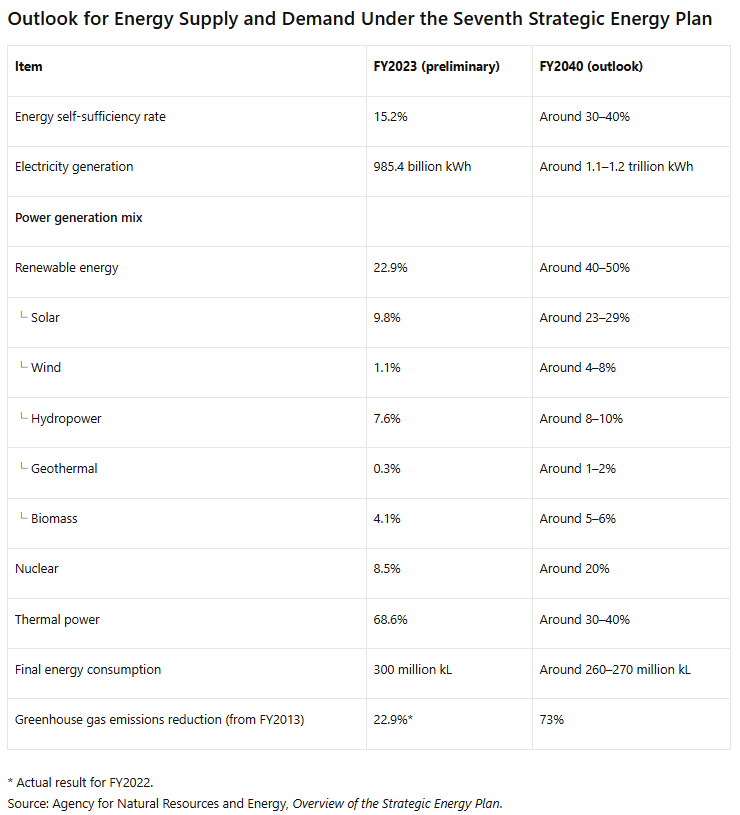
As of the end of FY2024, Japan’s cumulative installed solar power capacity stood at 76 GW, ranking third in the world after China and the United States. The density of installed solar panels per unit of flat land exceeds 500 kW/km², indicating that installations on flat land are already approaching saturation. To achieve both a 23–29% share of solar power in Japan’s power generation mix and 20 GW of installed PSC capacity by 2040, Japan must expand installations beyond ground-mounted solar power facilities to include residential rooftops, building exterior walls, factories, commercial and public facilities, carports, agricultural land, and other locations. It will also be essential to improve conversion efficiency per unit area—and thereby increase power output—through tandem structures.
Accordingly, manufacturers of single-junction PSCs are developing tandem configurations, while established crystalline silicon (c-Si) solar cell manufacturers are working to develop tandem PSCs that incorporate their own c-Si solar cells.
Tandem PSCs can be broadly classified into three types: perovskite/Si cells with a crystalline silicon (c-Si) bottom cell; all-perovskite tandem solar cells (APTSCs), which use perovskite materials for both the top and bottom cells; and perovskite/CIGS cells with a copper indium gallium selenide (CIGS) bottom cell. Perovskite has a relatively wide bandgap of approximately 1.55 eV and absorbs short-wavelength light in the visible spectrum. By contrast, c-Si and CIGS have narrower bandgaps of Approx. 1.1 eV and absorb longer-wavelength infrared light. It is therefore relatively easy to adjust the bandgaps in tandem cells that use perovskite for the top cell and c-Si or CIGS for the bottom cell. For APTSCs, however, material development is essential to achieve suitable bandgap matching between the top and bottom cells.
All three types remain at the development stage in Japan. Perovskite/Si cells, however, are closest to practical application. Their bottom cell is made from technologically mature c-Si, and they are manufactured by depositing perovskite on an existing c-Si cell. Existing module designs and mounting systems can therefore be adapted for their use.
Perovskite/Si Cells Expected to Capture Replacement Demand for c-Si Solar Cells
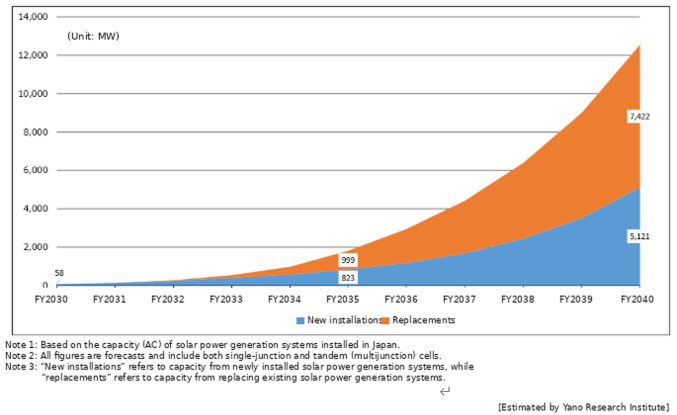
Cumulative PSC Installations, Including Single-Junction and Tandem Cells, Forecast at 12.5 GW in 2040
Demand for PSCs, measured by installed capacity, is expected to come not only from new installations but also from applications in which existing c-Si solar cells that have exceeded their service life are replaced with PSCs to improve efficiency.
When PSCs first enter the market, installations are expected to consist mainly of trials at public facilities and public housing. Full-scale adoption in residential and non-residential applications is forecast to begin in FY2030, with newly installed capacity of 58 MW—approximately 1% of all new solar power installations. Adoption is then expected to advance, particularly at non-residential sites such as factories and warehouses. Once annual PSC installations reach the gigawatt scale in FY2040, adoption is forecast to accelerate rapidly, reaching 3.4 GW in 2050.
At present, it is difficult to predict whether single-junction PSCs or multijunction tandem PSCs will be selected for new installations. Many manufacturers currently developing single-junction PSCs have also begun developing tandem PSCs in anticipation of the future need for higher efficiency. Even if these manufacturers initially enter the market with single-junction PSCs, single-junction and tandem PSCs are ultimately expected to coexist in the market, with each selected according to customer needs.
Solar cell installations on flat land in Japan are already approaching saturation. Future installations are therefore expected to focus on roofs, exterior walls, windows, and other glazed areas of residential and commercial buildings, as well as on buildings with limited load-bearing capacity. Other expected installations include small ground-mounted solar panel systems at offices, factories, schools, hospitals, government buildings, and similar facilities, and panels installed on curved or uneven surfaces. Of these, residential rooftops and small ground-mounted systems can be served by conventional c-Si solar cells. However, c-Si solar cells are less suitable for vertical installations on exterior walls or in windows and other glazed areas, buildings with limited load-bearing capacity, and curved or uneven surfaces; PSCs are therefore expected to be used in these locations. For these uses, the most likely options are single-junction PSCs or, in the case of tandem PSCs, APTSCs or flexible perovskite/CIGS cells.
Solar cells have a service life of 20–30 years; Japan’s statutory useful life for tax depreciation purposes is 17 years. Panels are often replaced once they have been in use for more than 20 years. Such replacements will occur at residential rooftops, building rooftops, solar power plants, and other sites where c-Si solar cells are already installed. Because the replacement panels will generally be used in conventional fixed, flat-panel installations, perovskite/Si cells based on c-Si are expected to be adopted more widely than newer products such as single-junction PSCs and APTSCs.
Tandem PSCs are estimated to account initially for slightly more than 20% of replacement demand in residential applications and Approx. 5% in non-residential applications. Combining these estimates, cumulative domestic PSC installations are forecast to reach 1.8 GW in FY2035 and 12.5 GW in FY2040, slightly below the target set in the Seventh Strategic Energy Plan.
By capturing replacement demand, perovskite/Si cells are expected to secure substantial demand earlier than APTSCs or perovskite/CIGS cells. The challenge, however, will be competition from overseas suppliers. Japanese manufacturers once boasted the world’s highest-performing solar cells. From the 1990s through the mid-2000s, manufacturers led by the three dominant players—Sanyo Electric Co., Ltd. (now Panasonic), Sharp Corporation, and Kyocera Corporation—held a combined 50% market share. China subsequently made the development of its solar cell industry a national policy priority while securing a 98% global share of the c-Si wafers used as cell materials. Large volumes of low-cost solar cells manufactured in China flowed into the Japanese market, squeezing the earnings of domestic solar cell manufacturers and prompting a succession of market exits. This remains a painful lesson for Japan’s industry.
Today, many manufacturers engaged in the solar cell business in Japan outsource module production to partner factories overseas. They also depend on China for cells, even for high-value-added products such as heterojunction (HJT) solar cells and HJT back-contact cells. Some companies conduct cell design and quality control themselves, but the fact remains that the cells are not manufactured in Japan.
In China, c-Si solar cell manufacturers are rapidly developing perovskite/Si cells as next-generation products that enhance their existing offerings, while working to secure adoption. Kunshan GCL, a member of the GCL Group, a major polysilicon producer, has announced plans to launch a gigawatt-scale mass-production line in Kunshan City, Jiangsu Province, China. Tongwei Co., Ltd., part of the Tongwei Group, another major polysilicon producer, is operating a megawatt-scale pilot line in Sichuan Province.
Outside China, UK-based Oxford Photovoltaics Ltd. (Oxford PV), a start-up specializing in perovskite/Si tandem solar cells, has established an annual gigawatt-scale mass-production line and has already begun supplying customers. In the United States, major c-Si solar cell manufacturer Hanwha Q CELLS USA Inc. and PSC-focused start-up Tandem PV, Inc. are preparing to bring commercial production lines into operation.
While Japanese companies remain at the development stage, overseas companies are ahead in commercialization, having progressed from pilot to commercial production. The possibility cannot be ruled out that these overseas products will enter the Japanese market before domestic mass production of tandem PSCs begins.
Japan introduced its feed-in tariff (FIT) scheme in 2012. Until then, solar cells had been used mainly on residential rooftops, but the FIT scheme expanded their use to commercial and industrial applications, including utility-scale solar power plants, causing demand to grow rapidly. Assuming a service life of 20 years, replacement demand for the large volume of solar modules installed following the introduction of the FIT scheme will emerge in 2032. This timing may well represent the last chance to revive Japan’s solar cell industry.
To meet the replacement demand that will emerge in 2032, Japan must have a clear path to domestic mass production by 2030. Several Japanese manufacturers are developing tandem PSCs with the aim of market launch in 2027–2028. Newly developed products, however, can take several years to reach stable, high-volume production. Japanese manufacturers therefore need to accelerate development.
Based on Perovskite Tandem Solar Cell Market 2026 (published March 31, 2026).