No.4214
Elderly Care-Assistive Technology Market in Japan: Key Research Findings 2026
Yano Research Institute (the President, Takashi Mizukoshi) has conducted a survey on the elderly care-assistive technology market in Japan, revealing the trends by service category, trends among market players, and the market outlook.
Market Overview
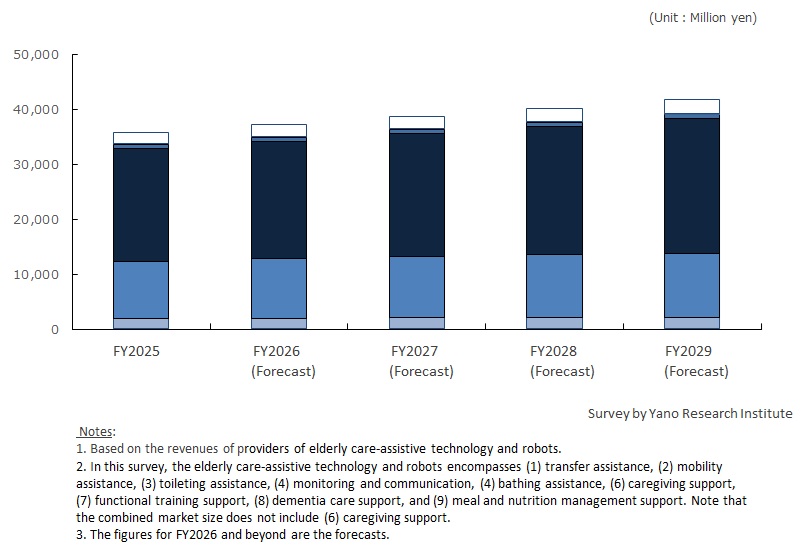
The market for eldercare-assistive technology has exceeded 36 billion yen in FY2025. As labor shortages persist in eldercare, the market is expected to expand further, driven primarily by solutions that improve nursing staff productivity.
By contrast, segments such as functional training support, dementia care support, and meal and nutrition management remain less widely recognized due to the limited range of available solutions. These segments are expected to grow as more companies enter the market and introduce new products, raise consumer awareness.
Noteworthy Topics
Monitoring and Communication Segment
The monitoring and communication segment comprises solutions for monitoring older adults in care facilities and at home, along with technologies that facilitate communication. Facility-based monitoring systems are currently the most established segment and are expected to continue expanding, supported by well-demonstrated operational efficiencies and economic benefits. By comparison, the outlook for home monitoring solutions and communication technologies is less clear, as these markets remain in the early phases of adoption and development.
Future Outlook
Ongoing workforce shortages in the elderly care sector are expected to drive increased adoption of assistive technologies. Facility-based monitoring systems and caregiving support solutions, in particular, are projected to experience sustained growth, given their proven ability to reduce staff workload and enhance care delivery efficiency. Adoption is likely to be further supported by government subsidies for assistive technology investments, reimbursement incentives tied to the implementation of these systems, and recent regulatory changes that have relaxed nighttime staffing requirements and related reimbursement criteria for elderly care facilities.
Research Outline
2.Research Object: Providers of elderly care-assistive technology and robots in Japan
3.Research Methogology: Face-to-face interviews by our expert researchers (including online) and literature research
Elderly Care-Assistive Technology and Robots
In this survey, the elderly care-assistive technology and robots include devices and systems aimed at improving the nursing care service quality, reducing the burden on nursing staff, and respecting independence of elderly persons to improves their quality of life.
The nine categories of assistive technologies are (1) transfer assistance, (2) mobility assistance, (3) toileting assistance, (4) monitoring and communication, (4) bathing assistance, (6) caregiving support, (7) functional training support, (8) dementia care support, and (9) meal and nutrition management support.
Note that the combined market size does not include (6) caregiving support.
<Products and Services in the Market>
(1) Transfer assistance (wearable and non-wearable), (2) Mobility assistance (outdoors, indoors, and wearable), (3) Toileting assistance (waste disposal, movement assistance, toileting prediction, and detection), (4) Monitoring and communication (monitoring in the facility and at home, as well as communication), (4) Bathing assistance, (6) Caregiving support, (7) Functional training support, (8) Dementia care support, (9) Meal and nutrition management support
Published Report
Contact Us
The copyright and all other rights pertaining to this report belong to Yano Research Institute.
Please contact our PR team when quoting the report contents for the purpose other than media coverage.
Depending on the purpose of using our report, we may ask you to present your sentences for confirmation beforehand.