No.4170
Retail Software Solutions Market in Japan: Key Research Findings 2026
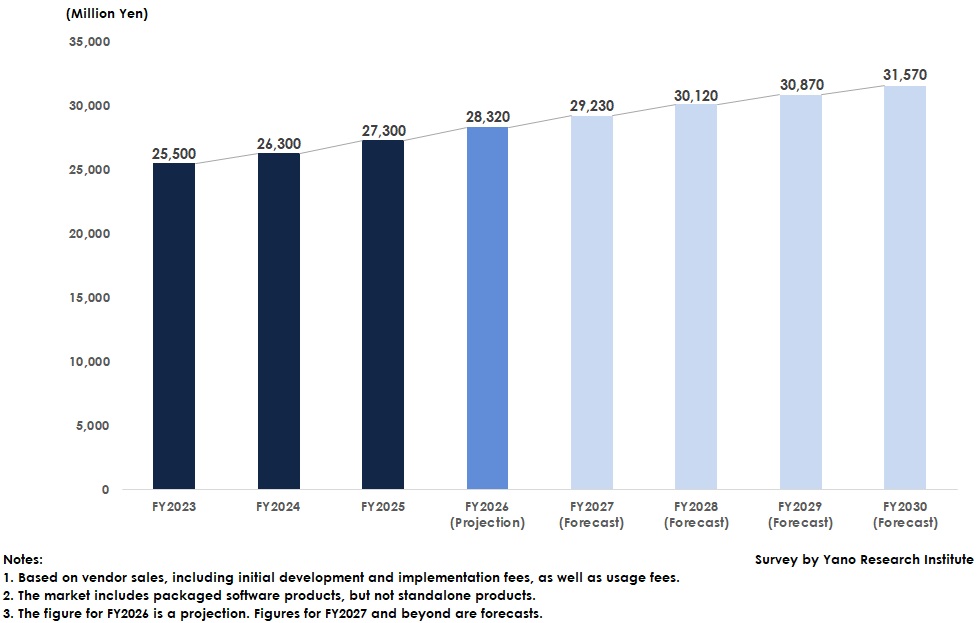
The Retail Software Solutions Market Reached 27.3 Billion Yen in FY2025, and Will Likely Reach 31.5Bilion Yen by FY2030
Yano Research Institute (the President, Takashi Mizukoshi) conducted a survey of the retail software solutions market to clarify its current status, trends among market participants, and future outlook.
Market Overview
Retail software solutions are packaged software products that support core operations in the retail and distribution industries. Based on vendor sales, which include initial development and implementation fees, as well as usage fees, the retail software solutions market in Japan reached 27.3 billion yen in FY2025.
The market emerged from the late 1980s to the early 1990s as point-of-sale (POS) systems became prevalent. These systems enabled real-time sales data collection, prompting more retailers to open multiple stores. Since then, these solutions have become an essential operational foundation for retailers of all sizes and types, including mass merchandisers, specialty stores, and department stores. However, twenty years after the market formed, retail and distribution businesses have more legacy systems than businesses in other industries. They face challenges such as system obsolescence and the black box issue (*).
In this context, growth in the market is driven by replacement demand aimed at modernizing these systems.
*A black box is a system whose internal structures and workings are opaque or black, making maintenance and repairs difficult.
Noteworthy Topics
Recent Technological Trends: Using AI to Improve Work Efficiency
Many vendors are prioritizing the use of artificial intelligence (AI) to enhance their product's functionality and accelerate their developments toward implementation of these products.
Some vendors have already implemented AI-powered demand forecasting and automatic ordering. Specifically, AI calculates optimal order volumes for each product based on past sales performance, calendar information, and climate data. This improves productivity by reducing ordering times and waste in each store. Additionally, some vendors are partnering with external companies that specialize in AI development to provide highly accurate demand forecasts for products with unpredictable demand, such as special-offer products.
Looking ahead, many vendors intend to implement AI agents to replace human work processes and decision-making. As retailers face apparent labor shortages, inheriting knowledge from skilled personnel has become increasingly difficult when making decisions at every stage of the work process. In this context, the implementation of functionalities that improve work efficiency and eliminate person-based operations relying on insights and experiences of skilled personnels is likely to accelerate.
Future Outlook
Based on vendor sales (including initial development and implementation fees, as well as usage fees), the retail software solutions market in Japan is expected to reach 31.57 billion yen by FY2030, continuing its moderate growth trend due to the stable demand for increased work efficiency stemming from labor shortages. Market growth will likely be further driven by the ongoing gradual adoption of the "fit-to-standard" concept among retailers, whereby work processes conform to system standards.
While some vendors are downsizing their retail software businesses due to recruiting and training challenges, vendors specializing in retail are expanding their sales by offering comprehensive proposals incorporating industry-specific knowledge and peripheral systems. Consequently, robust growth is anticipated in the market overall.
Research Outline
2.Research Object: Vendors of retail software solutions
3.Research Methogology: Face-to-face interviews (including online interviews) by expert researchers, and literature research
What is the Retail Software Solution Market?
This research defines retail software solutions as packaged software products that supports core operations in the retail and distribution industries, such as management of procurement, inventory and sales.
While the research generally excludes general-purpose, standalone ERP software, standalone point-of-sale (POS) software, peripheral systems such as electronic data interchange (EDI), and hardware sales, it includes integrated core operations products that incorporate all these features. Market size is based on vendor sales, including initial development and implementation fees, as well as usage fees.
<Products and Services in the Market>
Packaged software that supports core operations in the retail and distribution industries (mass merchandisers, specialty stores, department stores)
Published Report
Contact Us
The copyright and all other rights pertaining to this report belong to Yano Research Institute.
Please contact our PR team when quoting the report contents for the purpose other than media coverage.
Depending on the purpose of using our report, we may ask you to present your sentences for confirmation beforehand.