No.4131
Mail-Order Food Market in Japan: Key Research Findings 2026
The Mail-Order Food Market to Exceed 5 Trillion Yen in FY2025
Yano Research Institute (the President, Takashi Mizukoshi) conducted a survey on the domestic mail-order food market in Japan. The survey revealed market trends by business form, trends among market players, and market outlook.
Market Overview
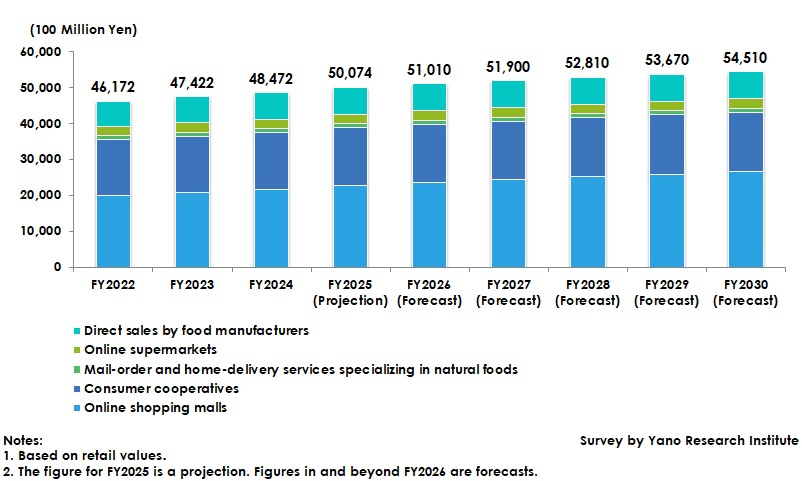
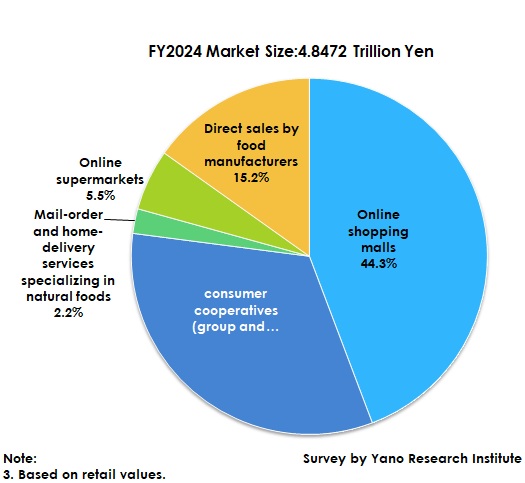
The mail-order food market is estimated to be worth 4.8472 trillion yen in FY2024, which is a 2.2% increase in retail value from the previous fiscal year. Mail-order food businesses flourished during the pandemic but subsided after the behavioral restrictions were lifted. Nevertheless, mail-order food has become a part of consumers' daily purchasing habits. The rise in commodity prices and increased awareness of financial security have made consumers more reluctant to spend. This caused consumers to choose products with a long shelf life, cost-effective items that are worth purchasing, and highly convenient foods, such as frozen foods. The shortage and rising prices of rice caused consumers to search for inventory and purchase rice online. This increased demand for rice, which boosted the entire mail-order food market.
The domestic mail-order food market is expected to exceed 5 trillion yen, reaching 5.0074 trillion yen in FY2025, marking a 3.3% year-over-year increase. Shopping malls are driving this growth due to the convenience of purchasing multiple products across categories and to point-rewarding systems matching consumers’ saving sentiment. Meanwhile, co-ops and mail-order and home-delivery services specializing in natural foods are experiencing a decline in users because consumers feel that the products are overpriced. Online supermarkets are in a transitional period and are required to review their business profitability, as growth has plateaued.
Noteworthy Topics
Prevalence of Digital Food Gifting
Digital gifting is a new purchasing option that is spreading among mail-order food services. It allows people to send food gifts via URL through social media or email, eliminating the need for a gift sender to know the recipient's address. Triggered during the pandemic, this casual-style gift giving among friends and relatives has become prevalent, enabling people to exchange and enjoy high-quality gourmet food at home at any time. As awareness of digital gifts has grown through corporate adoption in recent years, their scope and purpose have expanded. They are now used for birthdays, Mother’s Day, thank-you gifts, and souvenirs. Food items such as sweets, fruit, rice, eel dishes, and prepared foods—including deli items—are well-suited for digital gifting. Due to its convenience of immediate availability, digital gifting is well-positioned to capture last-minute demand. Consequently, digital gifting is expected to see an increase in popularity as a means of everyday communication, thereby boosting demand for mail-order food sales.
Future Outlook
Rather than simply trying to increase the number of users, the mail-order food market should focus on raising purchase unit prices and usage frequency of existing users. The market will continue to be supported by the demand for bulk purchases of heavy, long-lasting, and convenient daily foods. However, demand for expensive mail-order food items is influenced by consumers’ saving sentiments and takes time to recover. Demand can be concentrated in shopping malls due to their strengths in price comparisons and rewards programs.
As mail-ordering food becomes a regular option for purchasing food, market growth will depend on increasing daily usage frequency and fueling special-occasion demand, such as gift-giving and ordering of region-specific products.
Research Outline
2.Research Object: Mail-order businesses, food-related businesses, co-operatives, food retailers, food wholesalers, etc.
3.Research Methogology: Face-to-face interviews (including online interviews) by expert researchers, questionnaires, survey via telephone, and literature research
The Mail-Order Food Market
For the purposes of this survey, the mail-order food market includes the following: 1) online shopping malls (including ecommerce malls and catalog sales); 2) consumer cooperatives (group and individual delivery); 3) mail-order businesses and home-delivery services specializing in natural foods; 4) online supermarkets; and 5) direct sales by food manufacturers.
The survey covers the following three categories of food and beverages: fresh produce (including seafood, meat, vegetables, and fruits), rice, beverages (including mineral water but not home-delivered water) as well as alcoholic beverages, confectionery, health foods, frozen foods, and other processed foods. Daily necessities are generally excluded, though above categories 3) and 4) include some non-food items.
<Products and Services in the Market>
Mail-order food business: fresh produce, rice, beverages, alcoholic beverages, confectionery, health foods, frozen foods, and other processed foods
Published Report
Contact Us
The copyright and all other rights pertaining to this report belong to Yano Research Institute.
Please contact our PR team when quoting the report contents for the purpose other than media coverage.
Depending on the purpose of using our report, we may ask you to present your sentences for confirmation beforehand.