No.4083
Kimono Market in Japan: Key Research Findings 2026
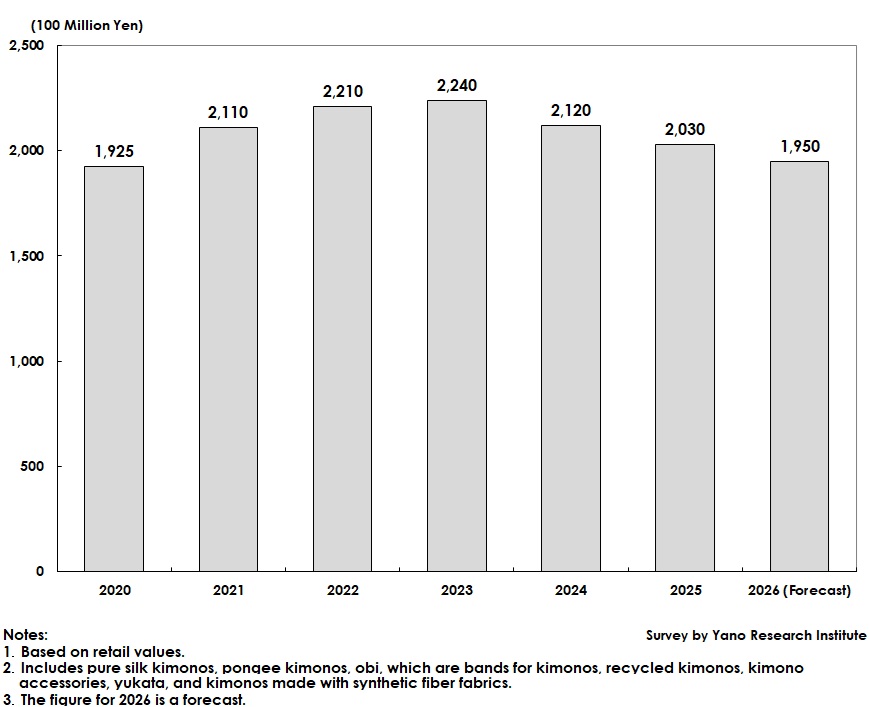
The Kimono Retail Market Reached 203 Billion Yen in 2025, Marking a 4.2% Year-Over-Year Increase
Yano Research Institute (the President, Takashi Mizukoshi) conducted a survey of the kimono market in Japan. The survey revealed market status, trends among market players, and future outlook.
Market Overview
The estimated kimono retail market size is expected to decline by 4.2% year over year, reaching 203.0 billion yen in 2025. The market plummeted in 2020 amid the pandemic and experienced an uptick through 2023. However, it has declined again since 2024.
This decline is due to consumers' reluctance to purchase kimonos because of rising kimono prices and the general increase in the cost of living.
Since the pandemic subsided, prices of materials in various fields have continuously increased. Because many kimonos are tailored overseas using imported materials, the weaker yen, as well as rising material, labor and transportation costs, have caused the selling prices to soar.
While consumers’ actual wages have not improved, buying kimonos, which are nonessential items, has been discouraged.
Noteworthy Topics
Analysis of the Kimono-Related Questionnaire
Yano Research Institute conducted a mail survey of major kimono-related companies.
Regarding kimono products and services, 51.0% of the 98 responding companies answered that demand for kimono rentals is increasing.
Meanwhile, 29.6% answered that demand for kimonos made of eco-friendly materials is decreasing.
Future Outlook
Based on retail values, the kimono retail market is expected to shrink by 3.9% year over year, reaching 195.0 billion yen in 2026. Although the market is highly unlikely to plummet as it did during the pandemic, there are no factors stimulating new growth.
In such a context, an increasing number of companies are focusing on providing more opportunities to wea kimonos as a measure to revitalize the kimono market. Now that people face lower disposable income, making them tend to be less proactive in purchasing, the opportunity to wear kimonos is expected to fuel kimono purchases.
In this context, an increasing number of companies are focusing on creating more opportunities to wear kimonos as a measure to revitalize the kimono market. As people's disposable income decreases and they become less proactive about making purchases, these opportunities are expected to encourage kimono purchases.
Research Outline
2.Research Object: Kimono-related manufacturers, wholesalers and retailers
3.Research Methogology: Face-to-face and online interviews by our expert researchers, mailed questionnaire, and literature research
What is the Kimono Market?
This research defines the kimono market as including pure silk kimonos, pongee kimonos, obi, which are bands for kimonos, recycled kimonos, kimono accessories, yukata, and kimonos made with synthetic fiber fabrics. Market size is calculated based on the retail value and does not include kimono rentals.
<Products and Services in the Market>
Pure silk kimonos, pongee kimonos, obi, recycled kimonos, kimono accessories, yukata, and kimonos made with synthetic fiber fabrics
Published Report
Contact Us
The copyright and all other rights pertaining to this report belong to Yano Research Institute.
Please contact our PR team when quoting the report contents for the purpose other than media coverage.
Depending on the purpose of using our report, we may ask you to present your sentences for confirmation beforehand.