No.4081
Next Generation Local Transportation Market in Japan: Key Research Findings 2025
Next Generation Local Transportation Market in Japan (Redesigning of Existing Transportation System & Introduction of DRT and Autonomous Shuttles) Forecast to Expand to Up to 720 Billion Yen by 2035
Yano Research Institute (the President, Takashi Mizukoshi) has completed a comprehensive survey of the next generation local transportation market, identifying current market landscape and status of societal implementation. This press release shares the projected market size up to 2035.
Market Overview
The viability of Japan’s traditional local transportation—defined by fixed-route, fixed-schedule services—is currently facing an existential threat. This decline is driven by a steady erosion of ridership, and critical driver shortages stemming from the 2024 Issue. The labor crisis has been exacerbated by the 2024 Issue, which has placed unprecedented pressure on driver availability. Today, a significant majority of local bus operators are operating at a deficit. Even with the cushion of government subsidies, these entities are reaching a breaking point where they can no longer reliably secure the personnel required to maintain basic service levels.According to the Ministry of Land, Infrastructure, Transport and Tourism (MLIT), 2,057 districts lack adequate transportation services, meaning 14 million people across the country (12.5% of the national population) do not have gas station or bus stop in close proximity. (Source: “Policy for Transportation Desert Resolution”, MLIT, 2025)In response, local governments have launched pilot projects for introduction of Demand-Responsive Transport (DRT) and autonomous shuttles to ensure the continuity of essential local transportation.The Japanese government has also announced the target of introducing DRT in 500 municipalities by 2027 as well as replacing one-sixth of the total fleets (10,000 buses) to autonomous shuttles by 2030.In this market report, we have assessed the feasibility of local transportation systems based on current status and challenges identified through interviews with local governments and local transportation service operators.
Noteworthy Topics
Addressing the Dual Hurdles: Technical Maturity and Fiscal Sustainability
Currently, municipal autonomous shuttle deployments are grappling with two critical bottlenecks: technical reliability and long-term financial sustainability.
Traditional autonomous driving systems—built on rigid, rule-based "if-then" navigation—are increasingly proving unfeasible for the unpredictability of real-world environments. These systems often suffer from "phantom braking" triggered by benign variables such as parked cars, rustling roadside foliage, or harsh sunlight glare. Such inconsistencies not only disrupt service but also erode public confidence in autonomous transit as a dependable alternative. To solve this, the industry is pivoting toward "End-to-End AI" architecture. By replacing hard-coded logic with neural networks trained on human driving behavior, we can transition toward a smoother, more intuitive driving style that mimics human nuance while enhancing safety.
From a commercial perspective, the most significant hurdle is the persistent need for an onboard safety host or a dedicated remote operator for every vehicle. This dependency negates the primary economic advantage of autonomous mobility: the reduction of labor costs. To achieve true fiscal viability, operators must evolve in two key areas: operational scaling (transitioning to a "1-on-N remote monitoring" framework, where a single operator oversees multiple fleets simultaneously, and asset utilization (diversifying vehicle usage beyond passenger transit to increase overall utilization rate).
By aggressively reducing labor overhead while maintaining robust fare revenue, local transportation operators can finally break their reliance on public subsidies and transition into self-sustaining business entities.
Future Outlook
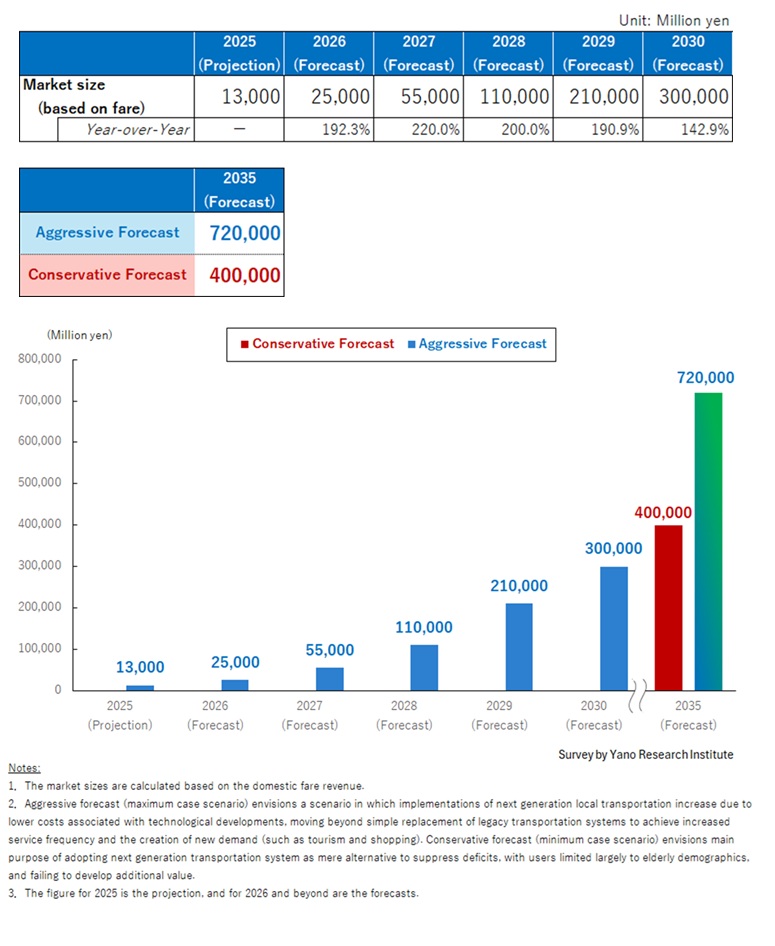
Japan’s next-generation local transportation market is poised for significant expansion, with projections reaching 300 billion yen by 2030 and scaling to 720 billion yen by 2035 (based on a SOM analytical framework). The catalyst for this growth lies in a fundamental shift: moving beyond the mere replacement of legacy bus systems toward a comprehensive restructuring of local transit infrastructure.
By 2030, approximately 50% of municipalities currently classified as transportation deserts are expected to transition to next-generation solutions. As successful use cases proliferate, the initial barriers to entry will diminish, triggering an accelerated market adoption curve.
Looking toward 2035, implementation rates are forecasted to exceed 90%. This growth will extend into "New Towns", which are suburban metropolitan areas grappling with aging populations and demographic decline. The maturation of this phase unlocks a critical economic lever: 1-on-N remote monitoring. The cost efficiencies gained here will be reinvested to maximize service frequency locally. By achieving a level of convenience that rivals private car ownership, we expect a behavioral shift among residents can be expected—moving away from the costs of vehicle maintenance toward a subscription-based mobility model.
Ultimately, the combined market (encompassing both regional and metropolitan segments) is projected to reach the 720 billion yen threshold. In this final stage, local transportation transcends its role as a subsidized welfare service. Instead, it emerges as a self-reliant social asset and an integrated platform for the local economy, seamlessly merging logistics, data analytics, and public mobility into a profitable, independent ecosystem.
Research Outline
2.Research Object: Local governments that are actively engaged in building new local transportation, local transportation service operators, etc.
3.Research Methogology: Face-to-face interviews by our expert researchers (including online interviews), telephone interviews, and secondary research
What is the Next Generation Local Transportation?
Japan’s public passenger transportation underpins residents’ daily lives, enables social and economic activity, and serves tourists. This survey focuses on secondary transport—short-distance travel, typically providing local access to and from transport hubs (i.e., first- and last-mile mobility). Long-distance, intercity primary transport, such as air and rail, is outside the scope of this report.
While the term secondary transport generally encompasses local rail, bus, taxi, car rental, and bike share, this report highlights two segments that are particularly at risk of continuing services due to declining ridership and driver shortage: local buses and taxis in regional areas.
Against the background of aging population and declining demographics, resilient local transportation is fundamental to local economies. Alongside the overview of structural challenges in local public transportation, this report delved into initiatives for redesigning local transportation through MaaS, and introduction of Demand-Responsive Transport and autonomous shuttles.
<Products and Services in the Market>
Redesigning of existing transportation system including MaaS initiatives, Introduction of Demand-Responsive Transport (DRT) and Autonomous shuttles
Published Report
Contact Us
The copyright and all other rights pertaining to this report belong to Yano Research Institute.
Please contact our PR team when quoting the report contents for the purpose other than media coverage.
Depending on the purpose of using our report, we may ask you to present your sentences for confirmation beforehand.