No.4077
E-Learning Market in Japan: Key Research Findings 2026
The E-Learning Market in Japan Expects Growth in Both the B2B and B2C Sectors in FY2025
Yano Research Institute (the President, Takashi Mizukoshi) surveyed the e-learning market in Japan. The survey revealed respective trends of B2B and B2C sectors, the trends among market players, and the future prospects.
Market Overview
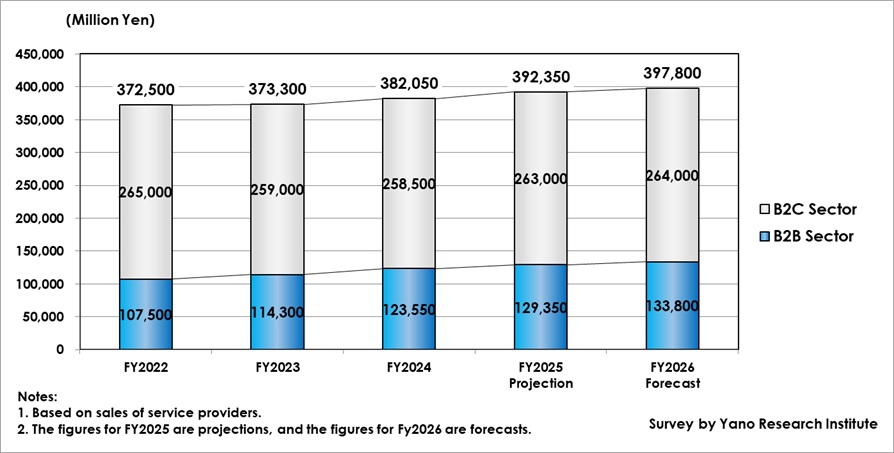
Based on sales from service providers, the estimated e-learning market in Japan is expected to reach 392.35 billion yen in FY2025, a 2.7% increase from the previous fiscal year. The B2B sector, which includes individuals within companies and organizations, is forecast to reach 129.35 billion yen, marking a 4.7% year-over-year increase. Meanwhile, the B2C sector is expected to grow by 1.7% year over year, reaching 263.0 billion yen. Thus, both the B2B and B2C sectors are expected to grow.
In FY2025, the B2B sector maintained an uptrend, as companies shifted their investments toward strategic human capital management (HCM) and digital transformation initiatives. The B2C sector experienced an uptick for the first time in three years, due to slight growth in university preparatory courses and supplementary class services, which comprise most of the sector. The sector also saw an increase in the language and the qualification services. After experiencing high demand during the pandemic, both sectors became established as standard learning infrastructures. Currently, both sectors appear to be entering a transitional period, shifting their focus from quantitative expansion to quality.
Noteworthy Topics
Rapid Prevalence of Generative AI Forces E-Learning Businesses to Reform Their Business Models
The e-learning market is facing a major turning point due to two trends, the rapid proliferation of generative artificial intelligence (AI) and a dramatic change in the labor environment. Many businesses have developed efficient methods of conveying knowledge and providing video classes, but these methods can no longer serve as a source of differentiation. Currently, anyone can create content by using AI at a low cost. Services that only provide information can easily be replaced by free video platforms and AI tools.
In this context, demand for e-learning will shift away from AI-replaceable domains, such as encouraging learners to engage in repetitive practices and acquiring basic knowledge—which will be automated—to content taught by highly reliable lecturers and instructors. There will also be demand for domains that cannot be replaced by AI, such as formulating hypotheses on unknown topics, facilitating creative interactions, and managing motivation. Technology deployment is no longer a differentiating factor. The key to the success of e-learning providers lies in how well they can operate AI and the value they can add for learners.
Future Outlook
The e-learning market in Japan is expected to reach 397.8 billion yen in FY2026, a 1.4% increase from the previous fiscal year. The B2B sector is expected to reach 133.8 billion yen, up 3.4% year over year, while the B2C sector is expected to reach 264.0 billion yen, up 0.4% year over year.
The continuous growth of the B2B sector owes to structural demand, such as companies’ human capital management (HCM) and employee reskilling practices, as well as the IT literacy education for digital transformation initiatives. Due to having fewer children, the B2C sector is expected to experience lower enrollment in university preparatory courses and supplementary class services, which comprise most of the market. Consequently, the overall market is expected to level off or experience a slight increase, even if English classes and qualifications grow.
Research Outline
2.Research Object: E-learning system developers, architects, and distributors; e-learning content developers, producers, and providers; and business training and seminar providers who use e-learning content (including operators of private preparatory schools, language schools, and business trainers); learning software developers, producers, and distributors
3.Research Methogology: Face-to-face interviews by expert researchers (including online interviews), survey via telephone & email, and literature research
The e-Learning Market
The e-learning market in this research refers to a form of learning services delivered over networks including the Internet. It does not include learning methods that use gaming devices or PC software. E-learning genres range extensively from business, academic subjects, languages, IT technologies, certifications, to various cultural and general knowledge.
<Products and Services in the Market>
Learning Management Systems (LMS), e-learning content, e-learning operation and services
Published Report
Contact Us
The copyright and all other rights pertaining to this report belong to Yano Research Institute.
Please contact our PR team when quoting the report contents for the purpose other than media coverage.
Depending on the purpose of using our report, we may ask you to present your sentences for confirmation beforehand.