No.4024
Pachinko Industry Key Indicator Forecasts in Japan: Key Research Findings 2024
Number of Pachinko Parlors Estimated at 5,600 and Number of Pachinko & Pachi-Slot Machine Installations 3.08 Million by 2030
Yano Research Institute (the President, Takashi Mizukoshi) forecasted key indicators of the pachinko industry through 2030 based on the YANO Pachinko Database. This paper highlights the forecasts regarding the number of pachinko parlors and pachinko and pachislot machine installations.
Market Overview
Though once referred to as the 30-trillion-yen industry, the size of the pachinko market has been shrinking since the mid-2010s. Revisions to the pachinko and pachislot machine regulations in 2018 required the replacement of these machine models (from #5 to #6 machines), placing a significant burden on pachinko parlor operators. This was followed by the introduction of smart pachinko and smart pachislots, as well as newly issued currency notes requiring updates to each machine. The introduction of these machines and the necessary updates required capital investments amid weakened operations caused by the pandemic. Consequently, primarily small-scale parlor operators or those without much leeway had to close or withdraw from their businesses.
However, the adoption of smart pachislot machines has led to an uptick in pachinko parlor performance and slowed the decline in the number of parlors. Nevertheless, the recovery caused by smart pachislots is evident among major parlor operators with investment funds available. Therefore, there has been further polarization between operators with sufficient funds for proactive investments and those without.
Although the number of parlors is expected to continue decreasing primarily among those with a small number of machines and those owned by small-scale operators, the rate of decrease is likely to slow. Meanwhile, the decline in the number of installed machines will likely not be as significant as the decline in parlors, since installations per parlor are increasing.
*) Smart Pachinko and Smart Pachislot:
These are machines that users can play without using tangible balls or medals. The gameplay is digitally managed, including the number of balls or medals acquired by players, benefiting both operators and players. Players do not need to take the obtained balls or medals with them when they change the machines to play. Revisions to the Nihon Yugiki Kogyo Kumiai (Nikkoso) regulations have expanded the range of possible machine specifications, enabling the development of smart gaming machines with diverse gameplay features.
Noteworthy Topics
The research used the YANO Pachinko Database to forecast key indicators showing the current status of the pachinko industry through 2030. Overviews of the number of pachinko parlors and installed gaming machines are as follows:
The Number of Pachinko Parlors:
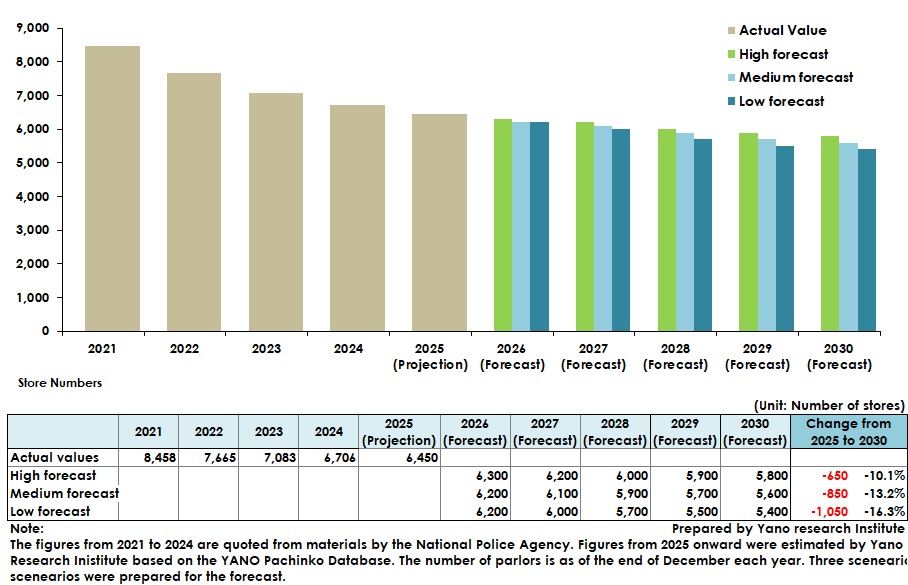
Based on operating licenses, there were 6,450 parlors in 2025, which is a decrease of 256 (3.8%) from the previous year. The decline was most significant among small parlors with 300 machines or fewer. In contrast to extra-large parlors with over 1,000 machines becoming more common, medium-sized parlors with 301 to 500 machines are declining rapidly. This is because of their disadvantage in customer attraction compared to extra-large parlors, which have many machines and a wide selection of popular models. Due to the increasing number of installations per parlor, the decline in the number parlors with fewer installations than average seems unstoppable.
However, the decline in pachinko parlors is expected to slow because large-scale capital investments, represented by the newly issued currency notes in 2024, are unlikely to occur soon. According to the mid-level scenario, the number of parlors is expected to be 5,600 by 2030.
The Total Number of Installed Pachinko and Pachislot Machines
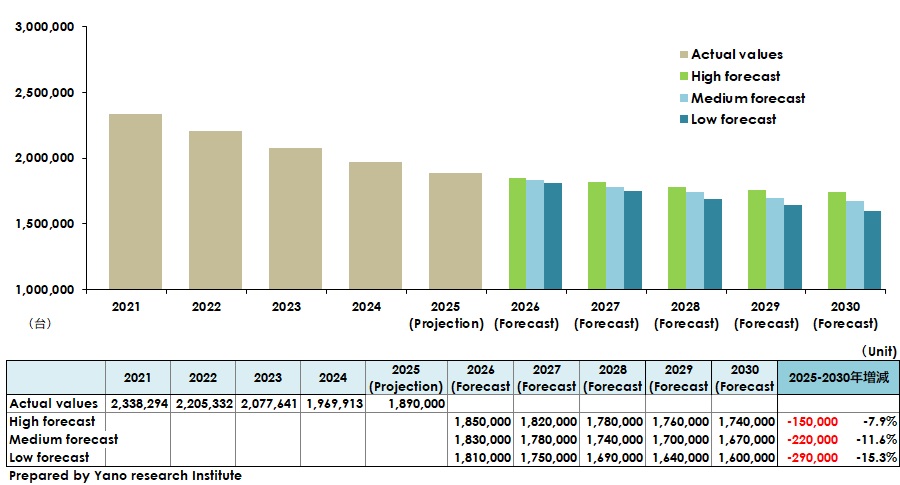
In the early 2010s, the number of installed gaming machines increased, which was inversely proportional to the decreasing number of parlors. However, since around 2014, the number of gaming machines has been decreasing. This suggests that newly opened parlors, as well as remodeled and expanded existing ones, can no longer offset losses from store closures. In recent years, closures and withdrawals have continued among small-scale parlor operators and those without sufficient investment capacity. This has led to a decrease in installations.
Nevertheless, the rate at which parlors are closing has slowed, because large-scale investments, such as adopting smart gaming machines and accepting new currency notes, are no longer urgently needed. This has slowed the decrease in installations. The number of installations is expected to follow the trend of store numbers and reach 3.08 million units by 2030 (mid-level forecast).
Research Outline
2.Research Object: Pachinko or pachislot players, pachinko parlor operators, and pachinko and pachislot gaming machine manufacturers
3.Research Methogology: Market forecast by our expert researchers
About the Survey
The survey used the YANO Pachinko Database to forecast key indicators reflecting the industry's current status. These indicators included the number of pachinko parlors and installed pachinko and pachislot machines, market size in sales (medal/ball fees) and gross profit, and the number of sold pachinko and pachislot machines and the number of participants. Three scenarios were used to prepare forecasts: high, medium, and low estimates.
*) The "Yano Pachinko Database" is a database of pachinko parlors and operators owned by the Yano Research Institute.
<Products and Services in the Market>
Market size, participant population, number of pachinko parlors, number of installed pachinko and pachislot machines, the number of sold pachinko and pachislot machines.
Published Report
Contact Us
The copyright and all other rights pertaining to this report belong to Yano Research Institute.
Please contact our PR team when quoting the report contents for the purpose other than media coverage.
Depending on the purpose of using our report, we may ask you to present your sentences for confirmation beforehand.