No.4234
Fertilizer Market in Japan: Key Research Findings 2026
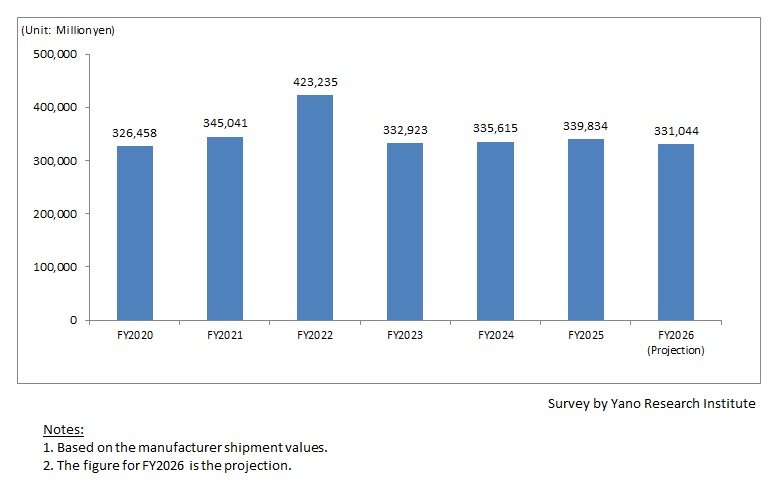
Fertilizer Market in Japan Projected to Decline 2.6% Year on Year to 331,044 Million Yen in FY2026
Yano Research Institute (the President, Takashi Mizukoshi) surveyed the fertilizer market in Japan, discovering the market size, trends of market players, and future outlook.
Market Overview
Fertilizer-related businesses are facing a challenging operating environment marked by rising procurement costs for fertilizer ingredients, as well as higher energy, transportation, and storage expenses. While manufacturers have sought to mitigate these pressures through internal cost-reduction initiatives, sustained cost increases have made price pass-through increasingly unavoidable. In addition, the cost of fertilizer bags and other ancillary materials surged following a rise in naphtha prices triggered by the Middle East crisis in spring 2026. Amid ongoing uncertainty surrounding global geopolitical developments and foreign exchange markets, fertilizer ingredient prices are expected to remain elevated in the foreseeable future.
Against the backdrop of rising rice prices since 2024, paddy rice farmers have increasingly applied fertilizers and soil conditioners to improve yields and maximize profitability. Consequently, the domestic fertilizer market grew by 1.3% year on year to JPY 339,834 million in 2025, driven by increased fertilizer and soil-conditioner usage among paddy rice farmers seeking to capitalize on higher rice prices.
Noteworthy Topics
Developments in the Use of Domestic Fertilizer Ingredients
Japan's heavy reliance on imported fertilizer ingredients, which are essential for agricultural production, poses a potential risk to the country's food security. To enhance supply resilience, diversifying procurement sources and increasing the use of domestically sourced materials, such as livestock manure and sewage sludge, has become increasingly important.
At the same time, growing international pressure to reduce environmental impact has prompted the Ministry of Agriculture, Forestry and Fisheries (MAFF) to advance the Green Food System Strategy, which promotes reduced reliance on chemical fertilizers and improved soil health through the use of compost and other organic resources. In addition, under the Policy Outline for Strengthening Food Security, adopted in December 2022, the government set targets to double the use of fertilizer ingredients derived from compost and sewage sludge by 2030 and increase the share of domestically sourced phosphorus-based fertilizer ingredients to 40% of total usage. As a result, the fertilizer industry is gradually shifting from imported raw materials toward domestically available resources, including sewage sludge-derived fertilizers.
Some municipalities, including Kobe City and Fukuoka City, have made progress in recovering phosphorus from sewage sludge. Recovered phosphorus can be readily incorporated into existing fertilizer manufacturing processes without significant modification, making it an attractive alternative to imported phosphorus. However, the high capital and operating costs associated with phosphorus recovery limit its cost competitiveness, presenting a key barrier to wider adoption
Future Outlook
Fertilizer demand is expected to weaken in 2026 due to soft rice prices. Reflecting this trend, the fertilizer market is projected to decline by 2.6% year on year to JPY 331,044 million.
Fertilizer manufacturers are operating in an increasingly challenging environment amid persistent volatility in fertilizer ingredient prices, rising logistics costs, and uncertainty surrounding exchange rates and global economic conditions. To mitigate pressure on profitability and offset slowing fertilizer demand, manufacturers are pursuing a range of measures, including streamlining operations through economies of scale and optimizing logistics networks in collaboration with Zen-Noh, prefectural agricultural cooperative federations, and other industry participants. In addition, expanding sales of higher value-added products has become an important growth strategy.
At the same time, elevated fertilizer prices have encouraged growers to reduce fertilizer application rates. As a result, demand for conventional fertilizers that provide only basic nutrient replenishment is declining, while demand is increasing for environmentally friendly, labor-saving, and high-performance products. These include organic compound fertilizers, controlled-release fertilizers, and liquid fertilizers, which offer greater efficiency and agronomic benefits.
Fertilizer ingredient prices have remained highly volatile in recent years, and future market conditions remain difficult to predict. Furthermore, increasing climate-related uncertainties are altering crop production patterns and cultivation practices, reducing the effectiveness of conventional sales approaches and product recommendations. In this rapidly evolving market environment, fertilizer suppliers must remain agile, deepen their understanding of growers' changing needs, and develop solutions that address both productivity and sustainability requirements.
Research Outline
2.Research Object: Manufacturers and developers related to fertilizers, soil breeding/improvement agents, and feeds, National Federation of Agricultural Cooperative Associations (JA Zennoh), and other fertilizer-related organizations.
3.Research Methogology: Face-to-face interviews (including online) by expert researchers, surveys via telephone, and literature research
Fertilizer Market
The fertilizer market in this research refers to the market for compound chemical fertilizers, mixed fertilizers, organic fertilizers, single nutrient fertilizers, liquid fertilizers, coated fertilizers, paste fertilizers, and other fertilizers. Market size is calculated based on the manufacturer shipment values.
<Products and Services in the Market>
1) Soil breeding and soil improvement agents (soil breeding for rice, for horticulture, for home gardening, soil improvement agents for greenery activities, micro-organic soil improvement agents) 2) Fertilizers (compound fertilizers [high analysis compound fertilizers, NK compound fertilizers, NPK compound fertilizers, organic compound fertilizers], compound chemical fertilizers, mixed fertilizers, organic fertilizers, single nutrient fertilizers, liquid fertilizers, coating fertilizers, paste fertilizers, and others), 3) Feed (formula feed, eco-feed)
Published Report
Contact Us
The copyright and all other rights pertaining to this report belong to Yano Research Institute.
Please contact our PR team when quoting the report contents for the purpose other than media coverage.
Depending on the purpose of using our report, we may ask you to present your sentences for confirmation beforehand.