No.4197
Global Automotive Lithium-ion Battery Market: Key Research Findings 2026
In 2026, the Global Automotive LiB Market is Expected to Grow at an Increase of 10% Levels
Yano Research Institute (the President, Takashi Mizukoshi) conducted a survey on the global automotive lithium-ion battery (LiB) market. The survey revealed the trends by product segment and among market players, as well as future perspectives. This article discloses the market size forecasts for global automotive LiBs.
Market Overview
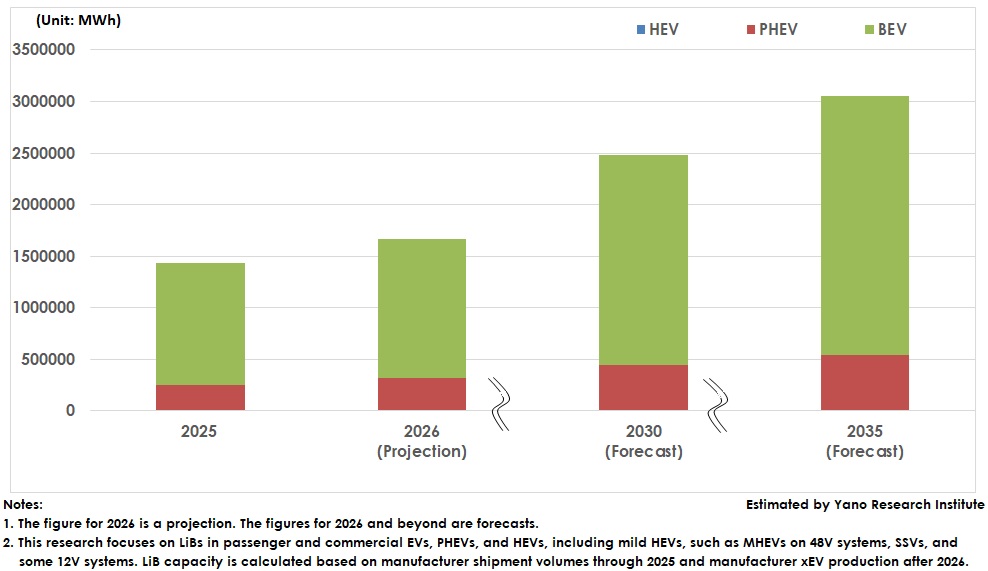
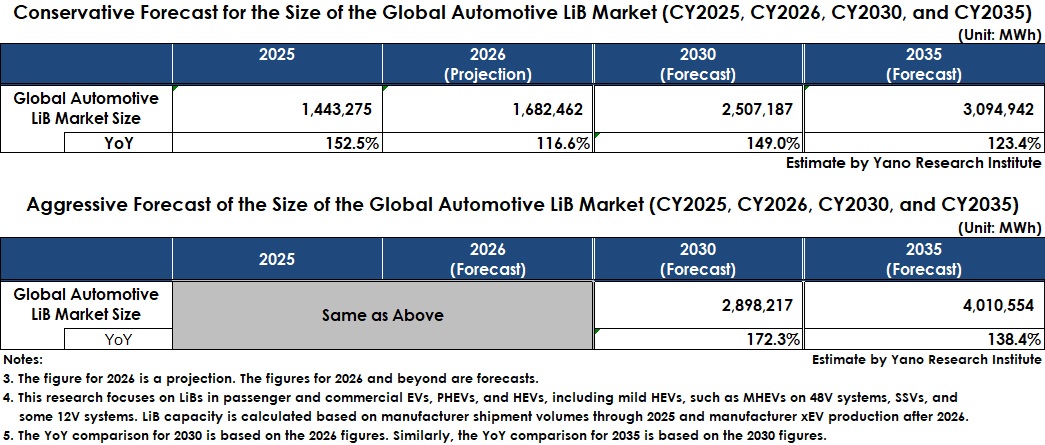
Based on the capacity, the global automotive lithium-ion battery (LiB) market is expected to reach 1,682 GWh in 2026, which is equivalent to 116.6% of the previous year's size. This growth aligns with the increase in global production of xEVs (i.e., electric vehicles [EVs], plug-in hybrid electric vehicles [PHEVs], and hybrid electric vehicles [HEVs.]) The anticipated growth in LiB capacity is as follows: 16 GWh for HEVs, 320 GWh for PHEVs, and 1,345 GWh for EVs.
Despite the anticipated slowdown in growth, the xEV market is expected to account for over 40% of global automotive production. While Europe maintained its growth from 2025 to the first half of 2026, China experienced rapid domestic demand shrinkage beginning in 2026. This decline has been offset by an increase in exports. Sluggish demand in the United States, caused by major policy shifts in 2025, is likely to persist in 2026.
Noteworthy Topics
Policy-Driven Growth in Europe, Rapid Domestic Demand Shrinkage in China, and Sluggish Demand in the U.S. Remain
In Europe, the policies of major countries, particularly those regarding subsidies, as well as enhancements in low-price BEVs by automotive OEMs, are expected to fuel momentum for market growth. However, high dependence on subsidies is a cause for concern.
In China, the reduction of tax exemptions for new energy vehicle (NEV: PHEV and EV) purchases has decreased demand for low- to medium-capacity BEVs. LiB prices increased between the second half of 2025 and the first half of 2026. These price hikes appear to be due to the newly established national safety criteria and the resumption of battery consumption taxes in 2026. Since customers of low- to medium-capacity BEVs tend to prioritize price, fierce competition is anticipated to continue.
The North American BEV market is expected to experience slow growth until 2030. Looking beyond 2030, American automotive OEMs are groping for the ideal BEV model in conjunction with their EV strategy reviews.
Japan has already established its “eco car market,” which consists primarily of HEVs. However, BEV sales surged in the first half of 2026 due to increased subsidies for purchasing them.
Amid skyrocketing gasoline prices from 2023 to 2025, the strong hybrid electric vehicles (SHEVs) market is growing. This has prompted major European and American automotive OEMs to focus on these vehicles, in addition to Japanese OEMs that have offered them from the beginning. China has begun showing interest in SHEVs since the beginning of 2026. As tax exemptions for NEV (PHEV and EV) purchases are gradually scaled back, price and performance are becoming increasingly important factors for both PHEVs and SHEVs. As the price gap between the two types of vehicles narrows, the proactive development of SHEVs is anticipated.
Future Outlook
Yano Research Institute offers two scenarios to forecast market growth: aggressive forecasts, which suggest relatively high growth, and conservative forecasts, which predict relatively low growth.
According to the aggressive forecast, the global automotive LiB market is expected to reach 2,898 GWh by 2030 and 4,010 GWh by 2035.
This forecast is based on the following. As previously mentioned, market growth is anticipated in Europe, boosted by growth in BEVs. This growth is driven by policy trends and increased low-price BEV offerings from automotive OEMs. In China, positive factors include robust demand for high-end BEVs from an affluent population and increased BEV exports to emerging nations, despite sluggish domestic demand. Meanwhile, the adoption of EVs with range extenders (REEVs), which are categorized as a type of PHEVs, is increasing among automotive OEMs, except for Chinese OEMs. The increased adoption of REEVs stems from the range extender, which is a combustion engine system that generates power to increase range and facilitate REEV commercialization, provided that OEMs can procure the system from suppliers. REEVs can expect corporate demand in Europe and demand in Southeast Asia and other regions with developing infrastructures. They are also expected to be one of the solutions for the electrification of large vehicles, such as pickup trucks and large sport utility vehicles (SUVs).
Meanwhile, conservative forecasts predict that the global automotive LiB market will reach 2,507 GWh by 2030 and 3,094 GWh by 2035.
This forecast is based on the following. Fierce competition in the Chinese low- to medium-capacity BEV market can persist, as consumers in this market are price-conscious, especially amid rising costs, including LiB price hikes. Europe is concerned about its high subsidy dependency. When subsidies end, the fate of low-price BEVs may mirror China’s. The Industrial Accelerator Act (IAA), published in March 2026, requires BEVs to use EU-made components and adapt to low-carbonization requirements to receive public procurement or subsidies. Meeting these requirements may further increase production costs for BEVs.
Regarding PHEVs and REEVs, it may be difficult to appeal their superiority against the intensifying competition with SHEVs. Minimizing the size of a vehicle with two powertrains — an engine and a battery with a certain level of capacity — is difficult. Having two powertrains also puts PHEVs and REEVs at a disadvantage in terms of price competition against vehicles with one powertrain. This conservative forecast predicts the growth for SHEVs, since these vehicles are garnering attention in Europe, North America, and China, and prompting many OEMs to make new moves.
Research Outline
2.Research Object: Automakers, automotive lithium-ion battery manufacturers in Japan, Europe, China, and South Korea
3.Research Methogology: Face-to-face and online interviews by expert researchers and literature research
About the Automotive Lithium-Ion Battery Market
Automotive lithium-ion batteries (LiBs) power the motors of electric vehicles (EVs), plug-in hybrid electric vehicles (PHEVs), and hybrid electric vehicles (HEVs).
This research focuses on LiBs in passenger and commercial EVs, PHEVs, and HEVs, including mild HEVs, such as MHEVs on 48V systems, SSVs, and some 12V systems. LiB capacity is calculated based on manufacturer shipment volumes through 2025 and manufacturer xEV production after 2026.
<Products and Services in the Market>
LiBs for EVs, LiBs for PHEVs, LiBs for HEVs, LiBs for Mild HEVs
Published Report
Contact Us
The copyright and all other rights pertaining to this report belong to Yano Research Institute.
Please contact our PR team when quoting the report contents for the purpose other than media coverage.
Depending on the purpose of using our report, we may ask you to present your sentences for confirmation beforehand.