No.4179
Global Technological Trends in AI- and Data-Driven Materials Informatics (MI): Key Research Findings 2026
The Global Market for AI- and Data-Driven Materials Informatics Expected to Reach 7.2 Trillion Yen Levels by 2030
Yano Research Institute (President, Takashi Mizukoshi) conducted a survey on technological trends in AI- and data-driven materials informatics (MI) in Japan and abroad. The survey revealed the trends by field, the activities of participating companies and research and development (R&D) institutions, and future prospects.
Market Overview
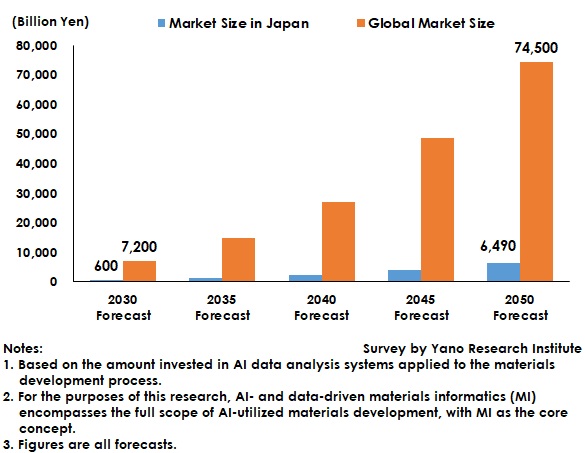
By 2030, the AI- and data-driven materials development informatics market size is expected to reach 600 billion yen in Japan, and 7.2 trillion yen worldwide. For the purposes of this research, AI- and data-driven MI encompasses the full scope of AI-utilized materials development, with materials informatics (MI) as the core concept.
The largest barrier in traditional materials development was the vast search space. For example, when discovering metal materials, potential candidates must be identified from among hundreds of element combinations. For polymers, the number of candidates is astronomical due to the greater freedom of molecular structures. Manual discovery in these vast spaces is principally inefficient. Time and cost constraints have hindered the development of new materials.
Currently, AI- and data-driven methods enable the rapid identification of promising candidate materials. These methods use machine learning models to analyze existing data and theoretical calculations. As a result, a dramatic reduction in the development cycle is anticipated. Additionally, the emergence of autonomous laboratories, which automatically suggest experimental conditions, and generative models, which learn the entire material production process, has made AI a presenter of a new design policy itself, beyond being a research assistant.
Noteworthy Topics
AI Adoption in Materials Design
In recent years, AI has become a powerful tool for accelerating the design and discovery of new materials in the field of materials science. The development of nanostructural materials, next-generation media, and complicated, multi-component composites depends on multifactorial, highly nonlinear fields intertwined with quantum effects and interfacial phenomena. In these areas, which have vast design spaces, optimal solutions cannot be identified through traditional theoretical calculations or a researcher’s rule of thumb. Data-driven AI approaches are essential.
However, AI innovations often raise serious concerns. In many cases, design solutions generated by powerful AI models, such as deep learning models, do not explicitly present the inference processes used to identify optimal compositions or structures. This obscurity poses an extreme risk in materials development settings, where strict scientific evidence is required.
Future Outlook
The market size for AI- and data-driven materials informatics is expected to reach 6.49 trillion yen in Japan and 74.5 trillion yen worldwide by 2050.
There are high expectations for the use of AI and machine learning in materials development. Infusing intelligence into materials science involves more than improving research efficiencies. The ultimate goal is to expand the concept of materials themselves to create new value for industries and societies.
The technological convergence of information and matter is evident in autonomous materials, such as self-adaptive materials that change their properties in accordance with external environments and materials that themselves function as sensors and information processors. This convergence could lead to intelligent systems that transcend the traditional electronics framework and directly solve social challenges, such as those in the medical, agricultural, and environmental management sectors. Thus, this transformation will affect not only individual technologies, but also design theories, industrial structures, and entire social systems. This evolution is expected to connect diverse areas, including information, quantum, and life sciences, into a comprehensive framework.
Research Outline
2.Research Object: Companies and industries prioritizing material development, including those in the chemical, semiconductor, battery, and pharmaceutical sectors.
3.Research Methogology: Face-to-face and online interviews conducted by our expert researchers, and literature research
What is AI- and Data-Driven Materials Informatics?
For the purposes of this research, AI- and data-driven materials informatics (MI) encompasses the full scope of AI-utilized materials development, with MI as the core concept. This includes research and development trends and investment scale in AI data analytics systems (including MI), which are applied to materials development processes in industries and companies that prioritize materials development as their core business. These industries include the chemical, semiconductor, battery, and pharmaceutical sectors.
<Products and Services in the Market>
Nanomaterial discovery using machine learning, autonomously evolving intelligent materials technology, AI applications in the field of energy materials, quantum AI and condensed matter research, and current AI adoption in materials design.
Published Report
Contact Us
The copyright and all other rights pertaining to this report belong to Yano Research Institute.
Please contact our PR team when quoting the report contents for the purpose other than media coverage.
Depending on the purpose of using our report, we may ask you to present your sentences for confirmation beforehand.