No.4173
Bakery Ingredients and Functional Materials Market in Japan: Key Research Findings 2026
The Commercial Bakery Ingredients Market in Japan Estimated to be Worth 335.8 Billion Yen in FY2025 and 353.0 Billion Yen in FY2030
Yano Research Institute (the President, Takashi Mizukoshi) conducted a survey of the Japanese bakery ingredients market for business use. The market comprises five major segments and seven submarkets. The survey revealed market size transitions and forecasts, trends among market participants, and future market outlook.
Market Overview
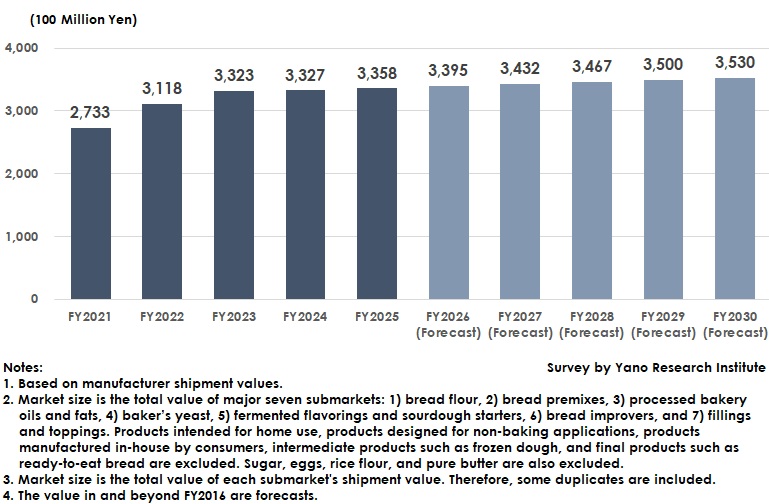
Based on manufacturer shipment values, Japan’s commercial bakery ingredients market was estimated to be worth 335.84 billion yen in FY2025, which is a 1.0% increase from the previous fiscal year. The market comprises five major segments and seven submarkets.
Market growth from FY2022 to FY2023 was driven by inflation in packaging materials, energy, and logistics, as well as rising material costs, including wheat and fats. After FY2024, however, overall market growth became moderate as the impact of price increases diminished. Basic bread ingredients, such as bread flour and processed bakery oils and fats, have plateaued due to stalled growth in bread production volumes caused by a shrinking population and rising bread prices.
In this context, shortages in labor, including skilled bakers, are increasing the demand for ingredients that facilitate bakery work processes, such as measuring, mixing, and preparing dough. There is high demand for materials that stabilize product quality. This has led to robust sales of bread premixes, fermented flavorings, sourdough starters, and bread improvers. Fillings and toppings also show favorable sales, driven by demand for products that can differentiate from others in flavor and appearance, as well as those that simplify preparation processes.
Additionally, features that ensure easy-to-use doughs, quality after freezing and refrigeration, and softness and a good aroma after baking are being valued, in conjunction with the prevalence of frozen and refrigerated production methods and broader bread distribution. Bakery ingredients are chosen not only for their own properties, but also as a means to reduce production workload, stabilize quality, and improve shelf life.
Noteworthy Topics
The Process of Choosing Ingredients Prioritizes Work Efficiency and Waste Reduction, In Addition to Price
Bakery companies tend to consider more than just price when choosing ingredients. They take a comprehensive approach that includes headcounts, work timeframes, the rate at which defective products are produced, and waste.
Ingredients that reduce the workload of measuring and dough preparation, as well as reduce product variability and defective products, can lower production costs per loaf of bread, despite their potentially higher price compared to traditionally used ingredients. Ingredients that stabilize quality and improve shelf life contribute to waste reduction and revenue growth.
Going forward, the key to ingredient adoption appears to depend on how much of the production process workload can be reduced according to facilities and production methods, rather than on the prices and features of ingredients themselves.
Future Outlook
Japan’s commercial bakery ingredients market is projected to reach 353.01 billion yen by FY2030, which represents 105.1% of the FY2025 market size. Moderate market growth is anticipated during this period, with an expected compound annual growth rate (CAGR) of 1.0%.
Against the backdrop of labor shortages and the growing adoption of frozen and refrigerated production methods in bakeries, products that streamline measuring and mixing processes, extend shelf life, and distinguish themselves from other merchandise are expected to remain in high demand, as are functional ingredients that stabilize bread quality. Basic ingredients, such as bread flour and processed bakery oils and fats, underpin the market, while ingredients that solve on-site challenges will support moderate growth.
However, high raw material and logistics costs persist. Higher bread prices may cause consumers to hesitate, which could stall market growth. Consequently, the domestic commercial bakery ingredients market will experience moderate growth rather than rapid expansion.
Research Outline
2.Research Object: Manufacturers, suppliers, distributors, and trading companies that deal in bread flour, premixes, processed oils and fats, bakery yeast, fermentation ingredients, bread improvers, fillings toppings, etc.
3.Research Methogology: Face-to-face interviews (including online interviews) conducted by our expert researchers, surveys via telephone, and literature research
What is the Commercial Bakery Ingredients Market?
This research defines the domestic business-use bakery ingredients market as consisting of five major segments and seven submarkets. Market size is calculated based on manufacturer shipment values.
The seven submarkets of the domestic business-use bakery ingredients market are as follows: 1) bread flour, 2) bread premixes, 3) processed bakery oils and fats, 4) baker’s yeast, 5) fermented flavorings and sourdough starters, 6) bread improvers, and 7) fillings and toppings.
This report excludes products intended for home use, products designed for non-baking applications, products manufactured in-house by consumers, intermediate products such as frozen dough, and final products such as ready-to-eat bread. It also excludes sugar, eggs, rice flour, and pure butter.
Some bakery ingredients are supplied as raw materials for other bakery ingredients, which are then supplied to bakers. Therefore, the total value of the five major segments and seven submarkets includes some duplicates.
Published Report
Contact Us
The copyright and all other rights pertaining to this report belong to Yano Research Institute.
Please contact our PR team when quoting the report contents for the purpose other than media coverage.
Depending on the purpose of using our report, we may ask you to present your sentences for confirmation beforehand.