No.4238
Global Automotive System-On-a-Chip (SoC) Market: Key Research Findings 2026
The Global Automotive SoC Market Expected to Reach 180.33 Million Units, or US$38 Billion by 2035
Yano Research Institute (the President, Takashi Mizukoshi) conducted a survey of the global automotive systems-on-a-chip (SoC) market. The survey provided an overview of the market by application, AI computing performance, and region. The survey also examined product development trends among major SoC manufacturers and adoption trends among automakers. This article forecasts the volume- and value-based global market size through 2035 and elaborates on market growth factors and trends by application.

Market Overview
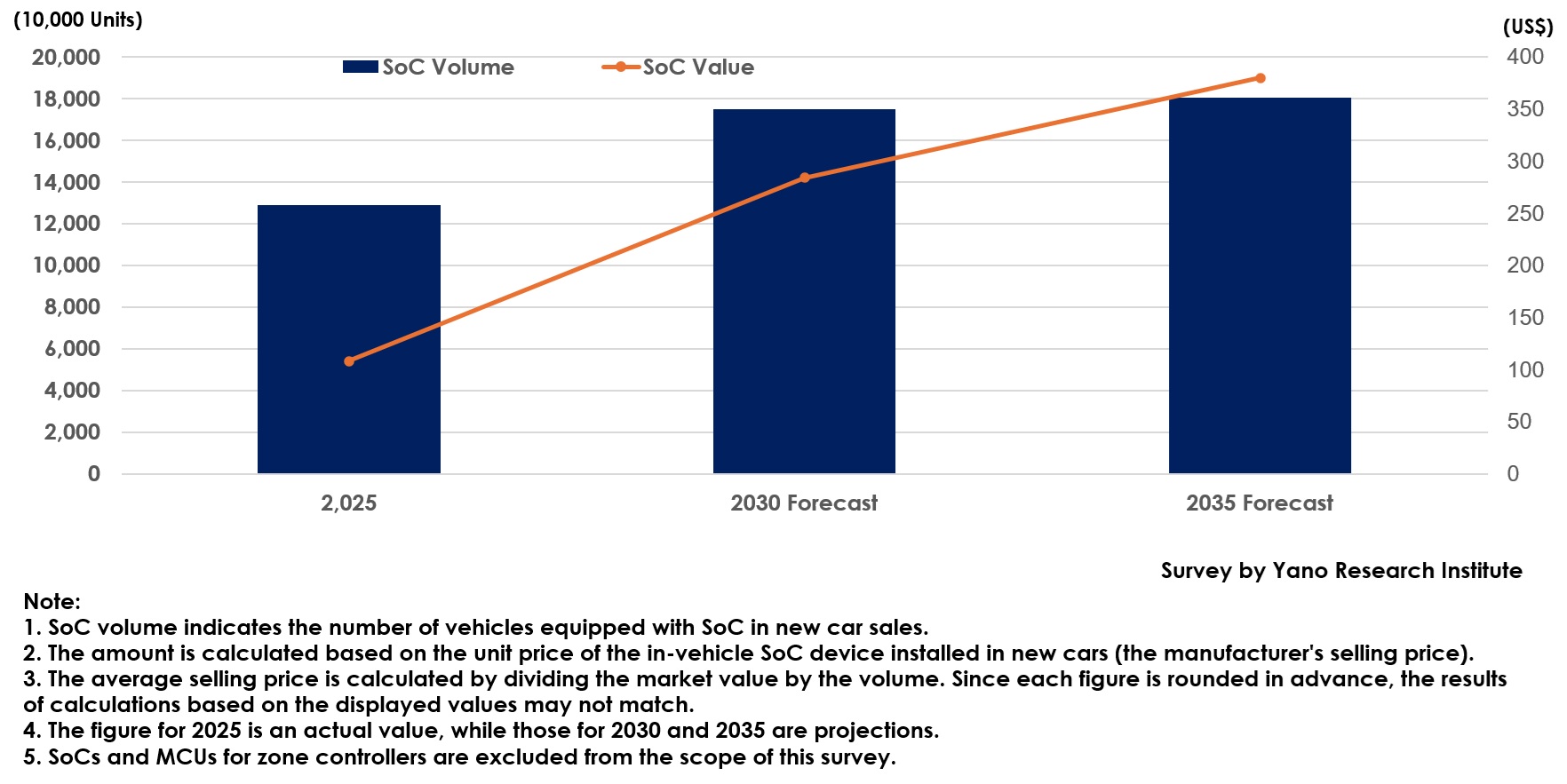
The size of the global automotive (System-on-Chip) SoC market grew to 128.99 million units by volume and US$ 10.8 billion by value in 2025. The evolution of autonomous driving (AD) and advanced driver assistance systems (ADAS), as well as the diversification of digital cockpit and in-vehicle infotainment (IVI) system features, increased the embedded volume of automotive SoCs and the demand for high-performance SoCs.
In China, the adoption of SoCs with high AI computing performance is gaining momentum as Level 2+ (Navigation on Autopilot [NOA] on highways) and Level 2++ (NOA in urban areas) become more prevalent in AD and ADAS systems. SoCs are also required to have higher processing performance in digital cockpits and IVI systems due to the growing deployment of large, high-definition displays, integrated control of multiple screens, and enhanced AI assistant features.
Additionally, automotive electrical/electronic (E/E) architectures are expected to undergo phased transition primarily among high-end vehicles from traditional domain-oriented structures, which arrange controllers according to features, to cross-domain-oriented structures, which integrate multiple features into a controller, and to centralized structures, which integrate the vehicle’s major control and information processing features into a central, high-performance computer, by 2030. These integrations are expected to continue beyond 2030. However, the pace of this transition varies by automotive segment, as some low-priced vehicles will continue to adopt traditional structures due to cost issues. In this context, the adoption of SoCs that consolidate the processing for multiple applications, such as AD, ADAS, cockpits, and IVI systems, is likely to gradually increase. Consequently, the automotive SoC market is growing in both volume and value due to increased installations and value stemming from the demand for high-performance products.
Noteworthy Topics
Advancement of AI Technology and Integration of Applications Increased Demand for High-Performance SoCs
In addition to the proliferation of L2+ (highway NOA) and L2++ (urban NOA), AD and ADAS have experienced the development of AI-powered driving assistance systems, including end-to-end (E2E) AI, vision-language models (VLMs), and world models. These systems process large amounts of information obtained from sensor systems, such as cameras and radars, in real time to recognize and assess complex traffic conditions. Therefore, automotive SoCs are required to have high AI performance.
AI features have also advanced in cockpits and IVI systems, as generative AI-powered voice assistance and services according to in-vehicle conditions are provided. These advancements in AI technology, as well as the integrated processing of multiple applications, such as AD, ADAS, cockpits, and IVI systems, are increasing the demand for high-performance SoCs.
Demand for SoCs with the level of hundreds of TOPS (trillions of operations per second), a metric for AI computational performance, is expected to grow primarily for L2++ (urban NOA), which utilizes high-level AI models, as well as for cross-domain-oriented E/E structures, which integrate the processing of multiple features, and centralized structures. In the future, the advancements and increased processing targets of AI models, as well as the consolidation of SoCs will likely increase the ratio of high-performance products. Furthermore, Chinese emerging EV manufacturers are primarily developing SoCs in-house for AD and ADAS. Their development of AI models and designs that align with AD and ADAS software improves computational performance and accelerates the development of optimized hardware and software.
Future Outlook
By 2030, the global automotive SoC market is expected to reach 174.71 million units by volume and US$28.4 billion by value. This growth is driven by the adoption of L2+ (highway NOA) and L2++ (urban NOA). This adoption, initiated in China, is expected to expand to the United States, Europe and Japan, increasing the demand for high-performance SoCs for AD and ADAS. Additionally, advanced AI features, increased AI application use in cockpits and IVI systems, as well as SoC adoption in cross-domain-oriented structures to consolidate the processing for multiple applications, are expected to fuel market growth.
The global automotive SoC market is expected to grow to 180.33 million units by volume and US$38.0 billion by value by 2035, which is approximately 3.5 times larger than the value-based market size in 2025. The compound annual growth rate (CAGR) is estimated at 3.4% by volume and 13.4% by value from 2025 to 2035.
During this time, advancements of AD, ADAS, cockpits, and IVI systems will increase the number of SoCs installed per vehicle from an average of 1.4 to 1.8 units. After 2030, SoCs are expected to transition according to the evolution of E/E architectures, from SoCs for cross-domain-oriented, which consolidate multiple features, to those for centralized structures. This transition will likely slow the growth in the number of SoCs installed.
Looking ahead, advancements in AI technologies and the consolidation of multiple features will increase the demand for high-performance SoCs and high-performance products. Consequently, the average sales price (calculated by dividing the market price amounts) is expected to increase from US$ 80 in 2025 to US$ 211 by 2035, representing higher growth in value than in volume expected by 2035.
Research Outline
2.Research Object: Automakers, tier1 suppliers, and semiconductor manufacturers
3.Research Methogology: Face-to-face and online interviews conducted by expert researchers, surveys via telephone, and literature research
What is an Automotive System-On-a-Chip (SoC)?
An automotive SoC (System-on-Chip) is a type of logic semiconductor that processes and controls information. This high-performance semiconductor is equipped with multiple features, including a central processing unit (CPU), a graphics processing unit (GPU), and a neural processing unit (NPU). All of these features are integrated into a single chip. As the "brain" of a vehicle, an automotive SoC performs various functions, such as processing information obtained from cameras and sensors, controlling driving support features, displaying information on a screen, and recognizing speech.
This research calculates the global market for automotive SoCs based on installed quantities and amounts. The research includes SoCs for autonomous driving (AD) and advanced driver assistance systems (ADAS), as well as those for digital cockpits, in-vehicle infotainment (IVI) systems, and cross-domain and centralized structures that integrate and process multiple applications.
Please note that this research excludes SoCs and microcontroller units (MCUs) for zone controllers (controllers aligned according to automotive zonal structures that control and communicate with electronic devices), MCUs for other individual controls, memory semiconductors, and power semiconductors.
<Products and Services in the Market>
SoCs for autonomous driving (AD) and advanced driver assistance systems (ADAS), SoCs for digital cockpits and in-vehicle infotainment (IVI), as well as SoCs that integrate various automotive features, such as AD, ADAS, digital cockpits, and IVIs, into one single chip.
Published Report
Contact Us
The copyright and all other rights pertaining to this report belong to Yano Research Institute.
Please contact our PR team when quoting the report contents for the purpose other than media coverage.
Depending on the purpose of using our report, we may ask you to present your sentences for confirmation beforehand.