No.4168
Housing Equipment Market in Japan: Key Research Findings 2026
The Housing Equipment Market to Reach 2.2802 Trillion Yen by FY2030
Yano Research Institute (the President, Takashi Mizukoshi) conducted a survey of the domestic housing equipment market to clarify its current status, trends among market participants, and future outlook.
Market Overview
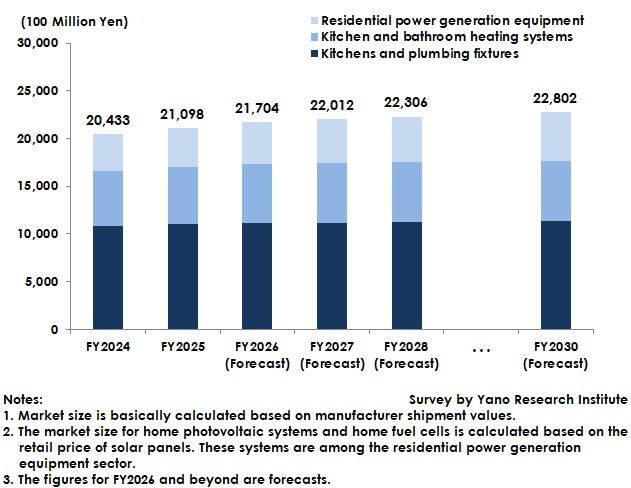
The major housing equipment market (the total of three categories, kitchens and plumbing fixtures, kitchen and bathroom heating systems, and residential power generation equipment) was estimated to reach 2.10975 trillion yen in FY2025, marking a 3.3% increase from the previous fiscal year. Specifically, the market for kitchens and plumbing fixtures reached 1.10495 trillion yen (a 2.1% year-over-year increase); the market for kitchen and bathroom heating systems reached 593.4 billion yen (a 2.2% year-over-year increase); and the market for residential power generation equipment reached 411.4 billion yen (an 8.3% year-over-year increase).
Stable demand for home renovations and price adjustments by manufacturers fueled the increase in kitchens and plumbing fixtures. The growth of kitchen and bathroom heating systems market was driven by a new regulation that took effect in April 2025, requiring all buildings to conform to the energy-saving standard. This led to a surge in new house construction prior to April, especially from February to March of that year. The surge increased sales of dishwashers equipped with dryers for the kitchens of these new houses. The hot water supply system market grew due to the improved sales share and price revisions of highly efficient hot water supply systems, which use less energy than traditional systems to supply hot water. Expanded offerings of integrated power generating and storing systems fueled the growth of residential power generation equipment. This increased the market for home photovoltaic systems and home fuel cells.
Noteworthy Topics
As the Supply and Demand Adjustment Market Began Accepting Bids from Broad Suppliers, Households Became Able to Trade Electricity Through Residential Energy Equipment
Since FY2026, households and small businesses have been able to participate in the supply and demand adjustment market by using electricity storage systems, heat pump water heaters, and electric vehicles. Established in 2021, this market trades "adjustment capacities," which bridge the gap between electricity supply and demand. Tiny power sources from these entities' power supply systems are integrated into these capacities by using "aggregation" technology.
Specifically, household power storage systems can contribute directly to the overall electricity network's supply and demand adjustment, because these systems discharge power during periods of tight supply and charge power during periods of excess supply. Households that have installed these systems for self-consumption and emergency preparedness now derive additional value from their systems’ role in providing adjustment capacity during normal times.
There have been some moves to encourage the installation of these systems, such as policies to support adoption expenses and aggregation services that bind these systems together to operate in the supply and demand adjustment market. While these aggregation services for households and small businesses are still limited, their development is noteworthy.
Future Outlook
The total market for major housing equipment, comprising three categories, is expected to reach 2.802 trillion yen by FY2030, which is an 8.1% increase from FY2025.
Despite the anticipated decline in demand for new home construction due to a shrinking population and number of households, the kitchen and plumbing fixture sector is expected to grow slightly. This growth is driven by stable demand for home renovations and manufacturers' continuous price adjustments due to rising material and labor costs. The kitchen and bathroom heating systems sector is also expected to grow, as highly efficient hot water supply systems are likely to increase shipments due to stricter environmental regulations. Further market growth is anticipated for residential power generation equipment, because municipalities are mandating the installation of renewable energy facilities and because the adoption of the government-promoted "GX ZEH series,” which are high-performance home standards, is expected to increase.
Research Outline
2.Research Object: Housing equipment manufacturers and industrial organizations
3.Research Methogology: Face-to-face interviews (including online interviews) by expert researchers, surveys via telephone and email, and literature research
The Housing Equipment Market
This research categorizes the housing equipment market, which is the market for home-use equipment installed in residences, into three types: 1) kitchens and plumbing fixtures; 2) kitchen and bathroom heating systems; and 3) residential power generation equipment. Details of each category are as follows:
(1) Kitchens and plumbing fixtures: Systematic kitchens, systematic baths, electronic toilet seats, household sanitary equipment, and washstands (not including taps)
(2) Kitchen and bathroom heating systems: Dishwashers equipped with dryers, hot water supply systems, stoves (including gas and induction heating [IH] systems), and bathroom heater and dryer systems
(3) Residential power generation equipment: Household energy storage systems, home photovoltaic systems, and home fuel cells
The market size of each type of housing equipment is basically calculated based on manufacturer shipment values. However, the market size for home photovoltaic systems and home fuel cells is calculated based on the retail price of solar panels.
<Products and Services in the Market>
Housing equipment (kitchens and plumbing fixtures, Kitchen and bathroom heating systems, and residential power generation equipment)
Published Report
Contact Us
The copyright and all other rights pertaining to this report belong to Yano Research Institute.
Please contact our PR team when quoting the report contents for the purpose other than media coverage.
Depending on the purpose of using our report, we may ask you to present your sentences for confirmation beforehand.