No.4136
The Individual Consumption Food Market in Japan: Key Research Findings 2026
The Individual Consumption Food Market Reached 744.3 Billion Yen in FY2025, and Is Expected to Exceed 1 Trillion Yen by FY2030
Yano Research Institute (the President, Takashi Mizukoshi) conducted a survey of the market for originally-defined, individual-consumption foods. The survey revealed market trends by category, product trends, peripheral market trends, and market participant activities, as well as the market's future outlook.
Market Overview
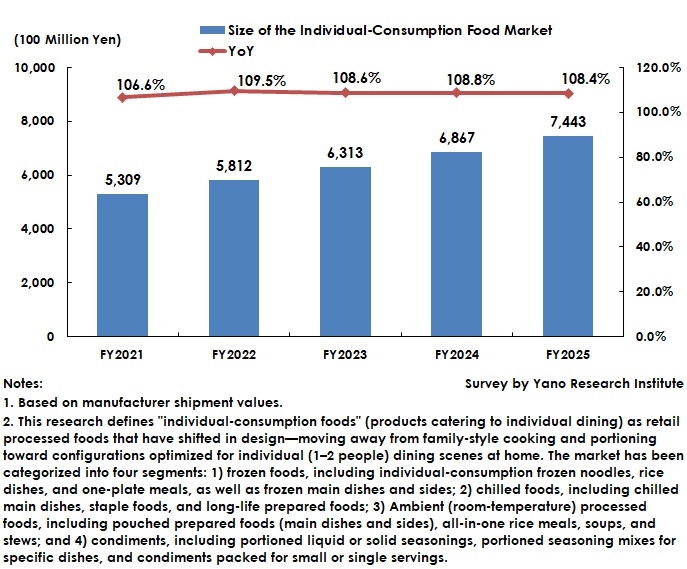
The individual-consumption food market in Japan continues to grow robustly. Based on manufacturer shipment values, the market, which comprises a total of four segments, was valued at 530.9 billion yen in FY2021 and reached 744.3 billion yen in FY2025, marking an 8.4% increase from the previous fiscal year.
This growth was driven by an increase in single-person households (*1) and senior populations (*1), which represent changes in household structures. Additionally, the growing number of dual-income households has created a need to reduce the time spent on chores and has altered the timing and amount of time that family members spend at home. These changes have led each family member to dine individually at home and eat different meals at different times.
To eliminate the labor of dividing traditional family-sized food products into individual portions, as well as the food waste associated with large quantities, there is an increasing demand for convenient, all-in-one products that can be served directly, or easily cooked in a microwave. This demand is driving the market.
*1) Source: Census results and demographic statistics from the Statistics Bureau of the Ministry of Internal Affairs and Communications.
*2) Source: The Labor Force Survey from the Statistics Bureau of the Ministry of Internal Affairs and Communications.
Noteworthy Topics
Growing Trends of All-in-One Meal Products in the Individual-Consumption Food Market
Demand is rapidly rising for reducing traditional chores to the bare minimum, including cooking, plating, serving, and cleaning. The backdrop against this trend is changes in household structures, the prevalence of working from home due to the government workstyle reform policies, and diverse living hours. In this context, food manufacturers have accelerated the development of products designed to replace entire meals. These products have become a key development.
This trend is most evident in the frozen food market, where varieties of one-plate frozen meals have increased in recent years. The popularity of these meals lies in the availability to prepare main dishes and staples simultaneously in a microwave, their design to eliminate the need for tableware, and their affordability and cost efficiency compared to dining out or buying prepared meals, especially as consumers face rising commodity prices. Market entries by major food manufacturers have increased the variety of products, including Japanese, Western, and Chinese cuisines, as well as many rice bowl dishes.
Future Outlook
Based on manufacturer shipment values, the individual-consumption food market, consisting of four segments, will likely continue its robust growth and reach 1.0514 trillion yen by FY2030.
Changes in household structures, differences in schedules among family members in dual-income households, and lifestyles that prioritize time efficiency, especially with regard to household chores, will continue to transform the nature of home meals.
Consequently, the home meal style will shift from family-based to individual-based. Individual-consumption foods that satisfy consumers by tailoring to individual needs and that can replace a whole set of meals are expected to become the foundation of livelihoods and will likely to grow further.
Research Outline
2.Research Object: Major food manufacturers developing individual consumption foods, including frozen, chilled, and ambient processed foods, as well as condiments.
3.Research Methogology: Face-to-face interviews with our expert researchers, questionnaires, and literature research
What is the Individual-Consumption Food Market?
This research defines "individual-consumption foods" (products catering to individual dining) not merely as single-serving products, but as retail processed foods that have shifted in design—moving away from family-style cooking and portioning toward configurations optimized for individual (1–2 people) dining scenes at home. The market has been categorized into four segments: 1) frozen foods, including individual-consumption frozen noodles, rice dishes, and one-plate meals, as well as frozen main dishes and sides; 2) chilled foods, including chilled main dishes, staple foods, and long-life prepared foods; 3) Ambient (room-temperature) processed foods, including pouched prepared foods (main dishes and sides), all-in-one rice meals, soups, and stews; and 4) condiments, including portioned liquid or solid seasonings, portioned seasoning mixes for specific dishes, and condiments packed for small or single servings. Market size is based on manufacturer shipment values.
The following items are excluded from the survey:
- Segments where single-serving portions have been the market standard from the outset and have little connection to the trend toward “solo dining.” Examples include retort-packed curry and pasta sauce, powdered and freeze-dried soups, instant noodles, cup noodles, and canned foods.
- Products designed to be eaten immediately or between meals. Examples include dietary supplements, jelly drinks, pastries, snacks, and desserts.
- Products packed with ingredients that are supposed to be cooked or processed. Examples include cut or frozen vegetables, dried noodles, and dried foods.
- General-purpose, small-packaged daily items, which are difficult to distinguish from products that are selectively purchased by single-member households. Examples include natto provided in three packs, or small-portioned tofu, chawanmushi (a steamed egg dish), and fish cakes.
- Products whose main purpose is to be given to others, such as small-portion frozen deli items used in bento lunch boxes.
<Products and Services in the Market>
Frozen foods, including individual-consumption frozen noodles, rice dishes, and one-plate meals, as well as frozen main dishes and sides; chilled foods, including chilled main dishes, staple foods, and long-life prepared foods; ambient (room-temperature) processed foods, including pouched prepared foods (main dishes and sides), all-in-one rice meals, soups, and stews; and condiments, including portioned liquid or solid seasonings, portioned seasoning mixes for specific dishes, and condiments packed for small or single servings.
Published Report
Contact Us
The copyright and all other rights pertaining to this report belong to Yano Research Institute.
Please contact our PR team when quoting the report contents for the purpose other than media coverage.
Depending on the purpose of using our report, we may ask you to present your sentences for confirmation beforehand.