No.4094
Smart Agriculture Market in Japan: Key Research Findings 2025
The Smart Agriculture Market in Japan is Expected to Reach 45.5 Billion Yen by FY2025
Yano Research Institute (the President, Takashi Mizukoshi) conducted a survey of the smart agriculture in Japan. The survey revealed the market size, trends among market players, and future outlook.
Market Overview
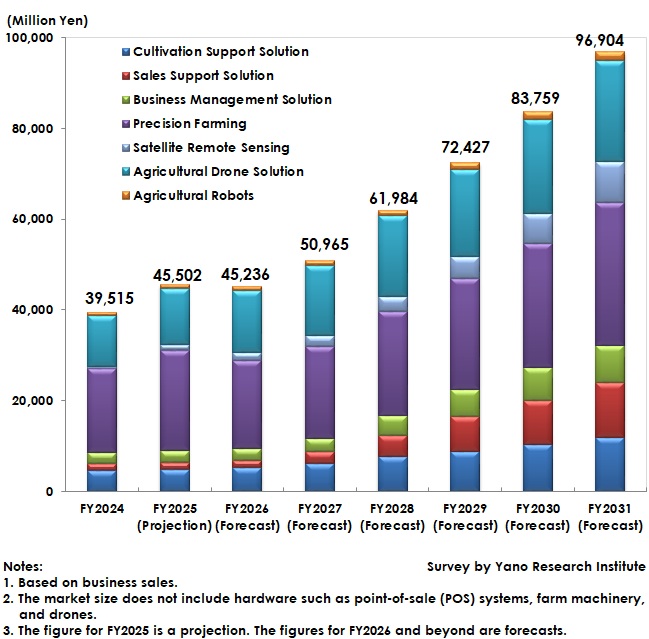
Based on business sales, the domestic smart agriculture market is expected to reach 45.52 billion yen in FY2025, a 15.2% increase from the previous fiscal year.
Rising rice prices have prompted investors to anticipate increased farmer income and plan capital investments, driving this growth. Growth is also fueled by the nationwide projects for supporting the deployment of smart agriculture systems and the growing establishment of infrastructure supporting automated systems, such as real-time kinematic (RTK) stations. These developments have prompted large-scale producers to implement systems such as GPS guidance systems, automated steering, and agricultural robotics.
Noteworthy Topics
Expanded Use of Satellite Remote Sensing
In recent years, satellite remote sensing solutions have become prevalent in Japan. The increased demand for these solutions is caused by: 1) Higher risks due to climate change and abnormal weather, which increase the demand for the early detection of crop stress and damaged areas through satellite remote sensing; 2) Soaring chemical fertilizer prices, which increase the demand for satellite remote sensing to identify the optimal amount of fertilizer to spray and reduce uneven spraying; and 3) Limitations in patrolling arable lands due to labor shortages and larger areas to manage.
In this context, solution providers have successively launched solutions that leverage satellite remote sensing technology.
Meanwhile, these solutions face challenges related to satellite images. Poor communication infrastructure, especially in mountainous and rural areas, results in less accurate images. Improvements to the Quasi-Zenith Satellite Systems and faster communication networks will make remote sensing solutions using satellite images more widespread nationwide in the future.
These solutions are expected to be widely adopted by not only producers, but also municipalities, financial institutions, and agricultural material suppliers.
Future Outlook
The smart agriculture market is expected to reach 96.94 billion yen by FY2031.
When considered only from the production site perspective, smart agriculture is a small market. However, it has the potential to generate an enormous market by using data obtained from smart agricultural technologies. This data can be analyzed and processed using AI to develop new services that benefit the food and agriculture industries. Realizing this huge potential requires collaboration among producers, material manufacturers and suppliers, relevant organizations (including JA and municipalities), market players, and food-related businesses.
In the future, the alignment of diverse participants in the smart agriculture market may be able to solve the food problems in Japan and overseas. If so, Japanese smart agriculture can contribute to the rapidly growing global food market.
Research Outline
2.Research Object: Smart agriculture businesses, agricultural corporations (paddy rice cultivation and agriculture/horticulture for vegetables, fruits, and flowers), and the relevant organizations, associations, and government agencies
3.Research Methogology: Face-to-face interviews by our expert researchers (including online interviews), surveys via telephone and email, and literature search
About Smart Agriculture
In this research, smart agriculture refers to the integration of traditional agricultural techniques and telecommunications technologies to increase production efficiency and add value to agricultural products. The goal is to achieve high productivity, reduced costs, food safety, and a safe working environment using telecommunications technology in production, harvesting, and sales.
The target market areas are as follows: 1) cultivation support solutions, 2) sales support solutions, 3) business management solutions, 4) precision farming, 5) satellite remote sensing, 6) agricultural drone solutions, and 7) agricultural robots.
Please note that this research only includes the Japanese market, and the market size is calculated based on business sales. Market size does not include hardware, such as agricultural point-of-sale systems, farm machinery, or drones.
<Products and Services in the Market>
1) Cultivation Support Solution: This includes cloud-based farming, compound environmental control equipment, and smart water management systems for arable land. 2) Sales Support Solution: This includes ICT systems to facilitate the business workflow for client companies (e.g., food service companies and JA), as well as sales support services utilizing weather data. 3) Business Management Solution: This includes accounting software for agriculture, accounting support services for agricultural corporations, and business management services using weather data. 4) Precision Farming: This includes GPS guidance systems, robotic farming machines (e.g., smart rice planting systems and robotic tractors), as well as systems that use satellite information.5) Satellite Remote Sensing: This involves using sensors on artificial satellites to visualize arable land, detect uneven growth, determine the optimal harvest period, and identify pests and crop damage. 6) Agricultural Drone Solution: This includes drone-based agrochemical spraying services and sensing for arable land. However, drone hardware is excluded. 7) Agricultural Robots: This category includes facility robots (e.g., grafting robots), manipulator robots (e.g., harvesting robots), and assisting robots (e.g., powered suits and exoskeletons)
Published Report
Contact Us
The copyright and all other rights pertaining to this report belong to Yano Research Institute.
Please contact our PR team when quoting the report contents for the purpose other than media coverage.
Depending on the purpose of using our report, we may ask you to present your sentences for confirmation beforehand.