No.4093
Digital Transformation in Municipalities (Municipal DX) in Japan: Key Research Findings 2026
Municipalities Showed High Intentions for Municipal Backoffice DX and Front Yard Reform as Their Post-Standardization Initiatives
Yano Research Institute (the President, Takashi Mizukoshi) conducted a survey on municipal digital transformation (DX), focusing on the post-standardization of core business systems and future trends. This article highlights the results of the analysis.
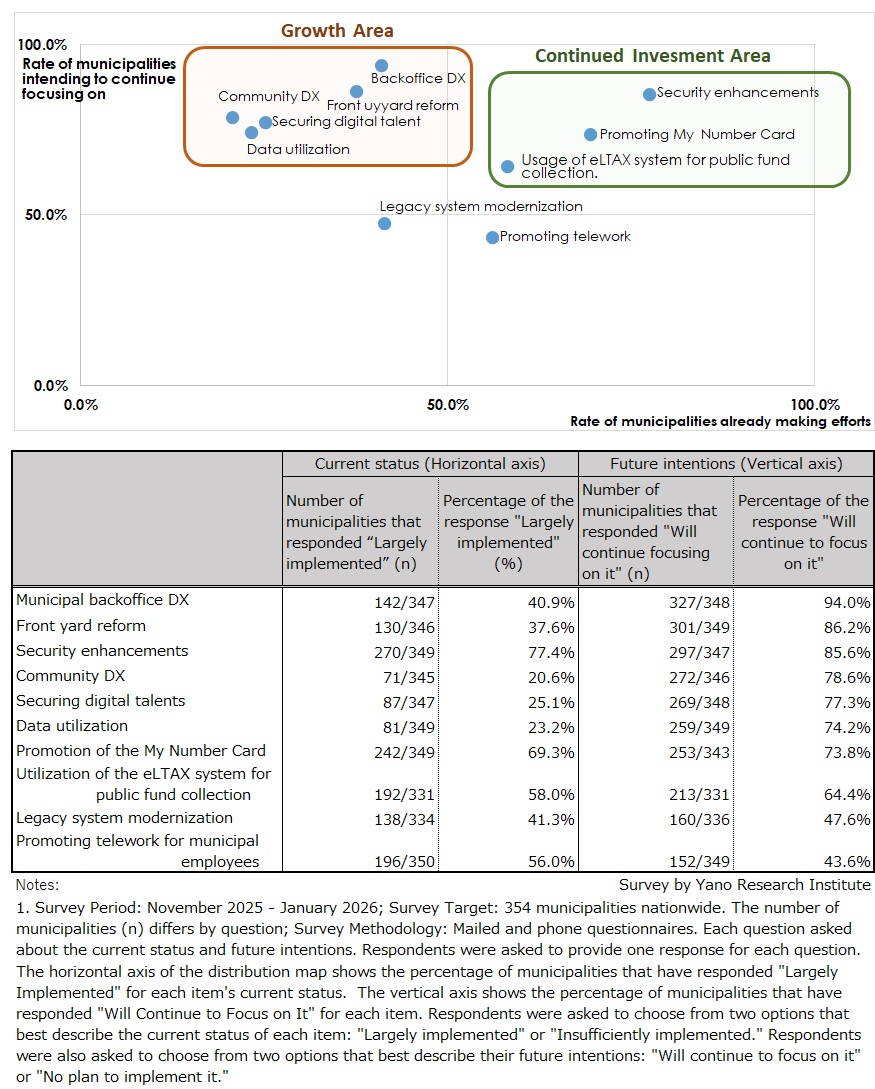
Summary of Research Findings
To reduce municipal costs, the government has set a policy to integrate and standardize core business systems for twenty work items, including resident records, taxation, and social welfare. The policy also aims to integrate these operations into the Government Cloud system procured by the Digital Agency by the end of 2025. This has prompted municipalities nationwide to standardize their core business systems.
From November 2025 to March 2026, Yano Research Institute administered questionnaires to 354 municipalities to evaluate their progress in digital transformation efforts. The study examined municipalities' current progress in standardizing their core business systems for the twenty work items, including resident records, taxation, and social welfare. The study analyzed the status of these systems and compared it with that of the subsequent focus areas after standardization. This article highlights part of the analyzed results.
The distribution map above illustrates the progress of municipalities’ digital transformation efforts. There are two main areas: The ongoing area and the future focus area. The horizontal axis shows municipalities’ current implementation status, and the vertical axis shows their future focus. Municipalities are continuously investing in efforts to increase security and promote the My Number Card. They plan to continue these efforts in the future. The future-focused area shows promise for growth as municipalities plan to increase their investments in this area. This area includes municipal back-office DX, front-yard reform*, and community DX.
The current progress rates of 40.9% for back-office DX and 37.6% for front-yard (*1) reform, as well as the future intention rates of 94.0% and 86.2%, respectively, suggest that nearly 90% of municipalities intend to invest in both initiatives, and that some have already done so. After standardizing their core business systems, these initiatives will become the focal points of municipal investment. Community DX, securing digital talent, and data utilization are initiatives in this area, with increasing expected demand. Meanwhile, 77.4% of municipalities are currently working on security enhancements, and 85.6% intend to address them in the future. These figures suggest robust current and future demand for security enhancements.
*1) The term "front yard" refers to all points of contact through which public offices provide services to residents, including reception and consultation services, as well as public space usage.
Noteworthy Topics
The Progress of Front Yard Reform Indicates Municipalities' Intension to Create a One-Stop Reception and No-Write Point of Contact
Front yard reform, which is in the growth area, will require municipalities to drastically reevaluate how the points of contact with residents should be. Municipalities intend to increase residents' convenience and municipal staff's work efficiency by leveraging digital technology. The goal is to provide public services that eliminate the need for residents to write, wait, feel lost, or visit in person. This can be achieved by offering an automated navigation system for specific processes and an online alternative point of contact. Therefore, front yard reform is at the top of the municipal DX project's priority list. While 86.2% intend to pursue this initiative in the future, only 37.6% are currently addressing it.
Among the items that make up the front-yard reform, “convenience store issuance of certificates” (84.7%), “digitization of administrative procedures” (73.6%), and “cashless payments” (68.1%), have relatively high rates of municipalities that have “already implemented it.” Therefore, these items have become prevalent overall. Meanwhile, the items with low implementation rates were “remote support desk” (13.1%), and “mobile service counter” (14.3%). 58.7% and 67.6% of municipalities, respectively, answered “No plan for implementation.” (*2)
Relatively high percentages of municipalities answered that they are planning or considering implementation for the following items: "one-stop reception" (36.3%), "no-write point of contact" (34.6%), "procedure guidance system" (30.0%), "AI chatbot" (28.4%), and "remote support desk" (28.2%). These initiatives aim to provide residents with convenient public services and eliminate the need for them to visit public offices. They are positioned as the next phase after initiatives that are already prevalent.
*2) Survey period: November 2025 to the end of January 2026; Survey targets: 354 municipalities nationwide. The number of municipal respondents differed by question; Survey methodology: mailed and phone questionnaires. Respondents were asked to choose one answer from three options for each question, “Already implemented it,” “Planning or under consideration for implementation,” and “No plan for implementation.”
Research Outline
2.Research Object: 354 municipalities nationwide
3.Research Methogology: Mailed and phone questionnaires and literature research
What is the Questionnaire on Municipal DX?
From November 2025 to March 2026, a questionnaire was administered to 354 municipalities nationwide to evaluate their progress in digital transformation efforts. The study examined the current progress of standardizing core business systems for twenty work items, including resident records, taxation, and social welfare. The study analyzed the status of these systems and compared them with those of the next focus areas after standardization. This article highlights part of the analyzed results.
Municipal DX is an initiative that promotes digital transformation in local governments. This encourages local public organizations to use data and information and communication technology (ICT) tools, thereby improving the work efficiency and convenience of public services, and solving regional issues. The research conducted by Yano includes municipal back office DX, front-yard reform*, security enhancements, community DX, My Number Cards, and the eLTAX system for public fund collection.
*The term "front yard" refers to all points of contact through which public offices provide services to residents, including reception and consultation services, as well as public space usage.
<Products and Services in the Market>
Core business systems, Municipal DX, front-yard reform, municipal back-office DX, and community DX
Published Report
Contact Us
The copyright and all other rights pertaining to this report belong to Yano Research Institute.
Please contact our PR team when quoting the report contents for the purpose other than media coverage.
Depending on the purpose of using our report, we may ask you to present your sentences for confirmation beforehand.