No.4069
Global Microwave Devices Market: Key Research Findings 2026
Global Market for Microwave Devices Expected to Reach Over 3 Million Yen by 2030
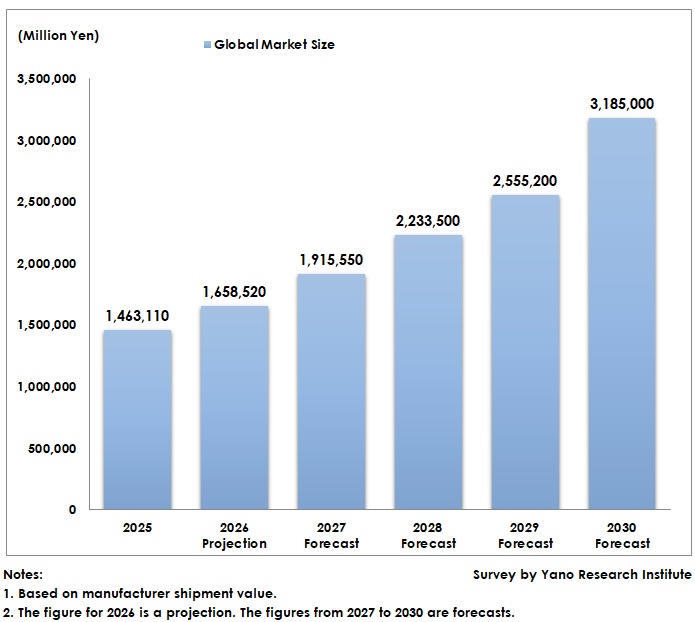
Yano Research Institute (the President, Takashi Mizukoshi) conducted a survey of the global market for microwave devices. The survey revealed the trends by category, trends among target companies, and the future market outlook. This paper highlights the transition and forecast of global microwave devices market.
Market Overview
Based on manufacturer shipment values, the global microwave device market reached 1.4631 trillion yen in 2025. Telecommunication devices accounted for 28.7% of this total, sensing devices accounted for 21.4%, millimeter wave devices accounted for 18.8%, energy application devices accounted for 17.9%, and device materials accounted for 13.2%.
Microwave devices have been optimized according to regional communication infrastructure strategies. For instance, North America and Europe are accelerating the deployment of millimeter wave technology, while Asia continues to focus on sub-6 GHz deployments. National projects, such as Japan’s Beyond 5G Promotion Strategy and Europe’s Hexa-X Project facilitate the development of foundational technologies that strengthen international competitiveness. Going forward, the competition to gain ascendancy in standardization will likely intensify.
Microwave technology has become a prominent foundational technology that contributes to extensive areas, including social infrastructure, advanced medicine, and next-generation mobility. Key features include high efficiency, low cost, environmental adaptability, system integration, and international standardization. Achieving these goals requires comprehensive efforts, from improving device performance to optimizing entire systems, including materials and processes.
There have been significant changes in the applications of microwave technologies. While they have rapidly become prevalent in consumer devices such as smartphones and automotive radars, they were previously limited to the military and other specialized applications. Specifically, millimeter wave applications in areas such as telecommunications and automotive radar are garnering attention.
Microwave devices have emerged through the accumulation of elemental technologies and in response to social demands. Their evolution is essential for realizing the next-generation smart society.
Noteworthy Topics
Microwave Devices Are Mission-Critical in Modern Wireless Communication Systems
Microwaves are electromagnetic waves with frequencies ranging from 3 to 30 gigahertz (GHz) and wavelengths ranging from 10 to 1 centimeter (cm). This frequency range is widely used for telecommunications infrastructure, including mobile phones, Wi-Fi networks, satellite communication systems, and radar systems.
Many microwave devices have been developed for communication applications, offering various features, including power amplification required for transmission and reception, selective passage through traffic signals, frequency control, and beamforming.
These devices are represented by power amplifiers for transmitters, low-noise amplifiers (LNAs) for receivers, filters and duplexers for frequency selectivity, and phase shifters and switches to enable beam steering control. Antenna-in-package (AiP) technology, which integrates microwave antennas and electronic circuits, has become more important for packing these devices more densely.
Recently, 5G’s sub-6 GHz—frequency bands of 6 GHz or lower for mobile communications—have become necessary, as have high-performance microwave-band devices for satellite communications. Microwave-band devices have evolved alongside telecommunications technology, because their performance directly impacts the performance, electricity consumption, and costs of entire communication systems.
Future Outlook
The global market size for microwave devices are forecast to reach 3.185 trillion yen by 2030. Within this total, the market size for telecommunications devices is expected to grow to 693.0 billion yen, sensing devices to 474.4 billion yen, energy application devices to 365.4 billion yen, device materials to 269.2 billion yen, and millimeter wave devices to 1.383 trillion yen.
Microwave technology has potential to do more than a simple technological innovation. It has the power to transform the very approach of materials development. By combining advances in individual technologies with the data infrastructure development and standardization, the collaboration among researchers, engineers, and AI agents, and the integration of interdisciplinary approaches with open innovation, it enables rapid and efficient material screening, something that could not be achieved within the traditional frameworks.
The next step is to connect the results of material digital transformation (DX) directly with industrial applications and solutions to social issues. With an emphasis on sustainability, environmental responsiveness, and generating new markets, the developed materials will have social value in addition to improving performance.
In other words, material DX is poised to dramatically accelerate the research and development cycle through the integration of data, AI, simulation, and automation, while simultaneously establishing itself as the foundational technology that will support the next-generation smart society. From this perspective, material DX is expected to serve as a compass for researchers, engineers, companies, and policymakers in the strategic implementation of materials development.
Research Outline
2.Research Object: R&D institutions studying microwave devices, and producers and distributors of these devices.
3.Research Methogology: Face-to-face interviews (including online interviews) by our expert researchers, and literature research
What is the Microwave Devices Market?
Microwave devices are used in various sectors, including telecommunications, sensing, and energy. Recently, their applications have expanded to include 5G/6G high-speed communications, millimeter wave radars in electric and self-driving vehicles, quantum sensing, and healthcare. There is intense international competition over technological development in the frequency bandwidth ranging from tens of gigahertz to sub-terahertz. This requires comprehensive technological innovations in materials, devices, packaging, and circuits. Additionally, microwave technologies have rapidly become prevalent in consumer devices, such as smartphones and automotive radars, as opposed to their traditional use in the military and other specialized applications. Consequently, various challenges have emerged, including the need for lower costs, mass production, integration with complementary metal-oxide-semiconductor (CMOS) integrated circuits, and the selection of sustainable materials.
This research categorizes microwave devices into the following five types: telecommunications, sensing, energy applications, device materials, and millimeter wave applications. The research systematically organizes status and perspectives on digital innovations for materials development. Market size is calculated based on shipment value.
<Products and Services in the Market>
Materials, development, and services related to various technologies involving microwave devices, such as communication devices, sensing devices, energy applications, device materials, and millimeter wave applications
Published Report
Contact Us
The copyright and all other rights pertaining to this report belong to Yano Research Institute.
Please contact our PR team when quoting the report contents for the purpose other than media coverage.
Depending on the purpose of using our report, we may ask you to present your sentences for confirmation beforehand.